
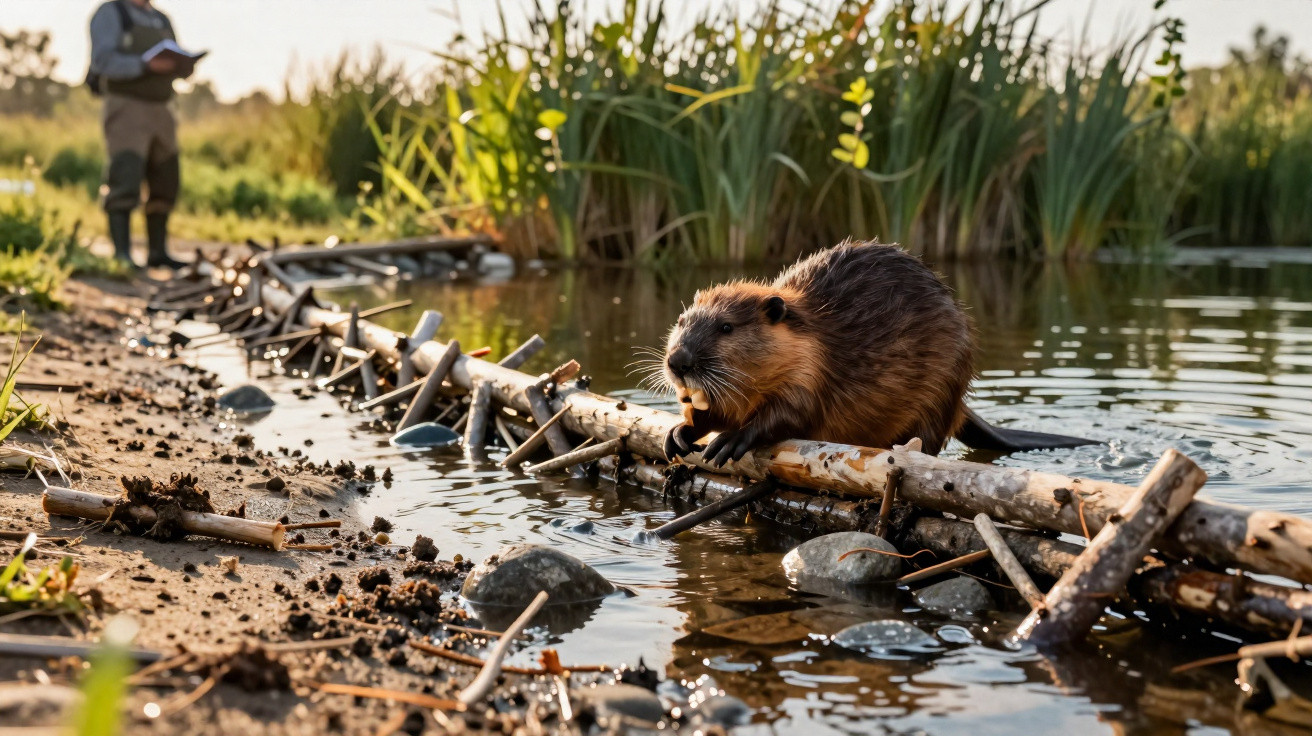
The beaver is one of the most influential natural engineers in freshwater ecosystems. Using logs, branches, mud, stones and vegetation, it builds dams that can slow rivers, create ponds, raise the water table and form wetlands that reshape the surrounding landscape.
Why do beaver dams have such a big impact on the ecosystem?
By cutting water speed, dams spread the flow across the floodplain. This increases how much water is stored in the soil, helps streams keep running for longer during dry spells, and creates habitat for fish, amphibians, waterbirds, insects and riverside plants.
Research on beavers shows their dams shift river hydrology, trap sediment, dampen flood peaks and can act as green infrastructure within restoration strategies. Their influence is not confined to the dam itself; it can reorganise whole stretches of a valley.
How does the beaver choose logs, mud and stones?
A beaver works with whatever materials are close to the bank. Logs and branches provide the main framework, stones add weight where pressure is greatest, and mud seals gaps where water would otherwise rush through too quickly.
- Logs: form the dam’s backbone and lock the structure against the current.
- Thin branches: fill the gaps between larger pieces and help distribute flow.
- Mud: acts as a sealant, cutting leakage and increasing retention.
- Stones: steady the base in sections with faster, stronger flow.
- Vegetation: helps compact the wall and gradually anchors sediment.
How does the structure control the flow of water?
A beaver dam does not shut off a river completely like a concrete wall. Instead, it behaves as a porous barrier: some water seeps through slowly, some is held back, and some spreads out over the banks when levels rise.
This layout reduces the stream’s energy. Water slows, sediment settles, the pond behind the dam deepens, and the surrounding ground becomes wetter. Rather than a narrow, fast channel, the area becomes a system of pools, marshy patches, slackwater areas and more active, living margins.
What have researchers discovered about this natural engineering?
Recent studies suggest beaver dams can store surface and groundwater, ease the effects of drought, reduce rapid run-off and steady flows during low-water periods. There is also evidence these systems help hold back sediment, nutrients and contaminants before they travel further downstream.
- Dams strengthen the connection between river and floodplain.
- Water remains in the landscape longer instead of draining away quickly.
- Sediment trapped behind the dam helps create new wet soils.
- Habitat diversity rises with ponds, side channels and aquatic vegetation.
- By cushioning flow, dams can reduce flood peaks in some contexts.
A natural structure inspiring sustainable water management
Beaver engineering has inspired restoration approaches known as beaver dam analogues-simple, human-made structures that replicate part of the effect of these natural works. The goal is to slow water down, reconnect rivers to floodplains and bring wetlands back without relying solely on large, rigid construction.
The value of this architecture lies in its mix of local materials, continual upkeep and adaptation to changing flow. Logs, mud and stones create a living dam that can shift with the river, hold water when it is scarce, and cut the speed of water when it arrives with force.






Comments
No comments yet. Be the first to comment!
Leave a Comment