
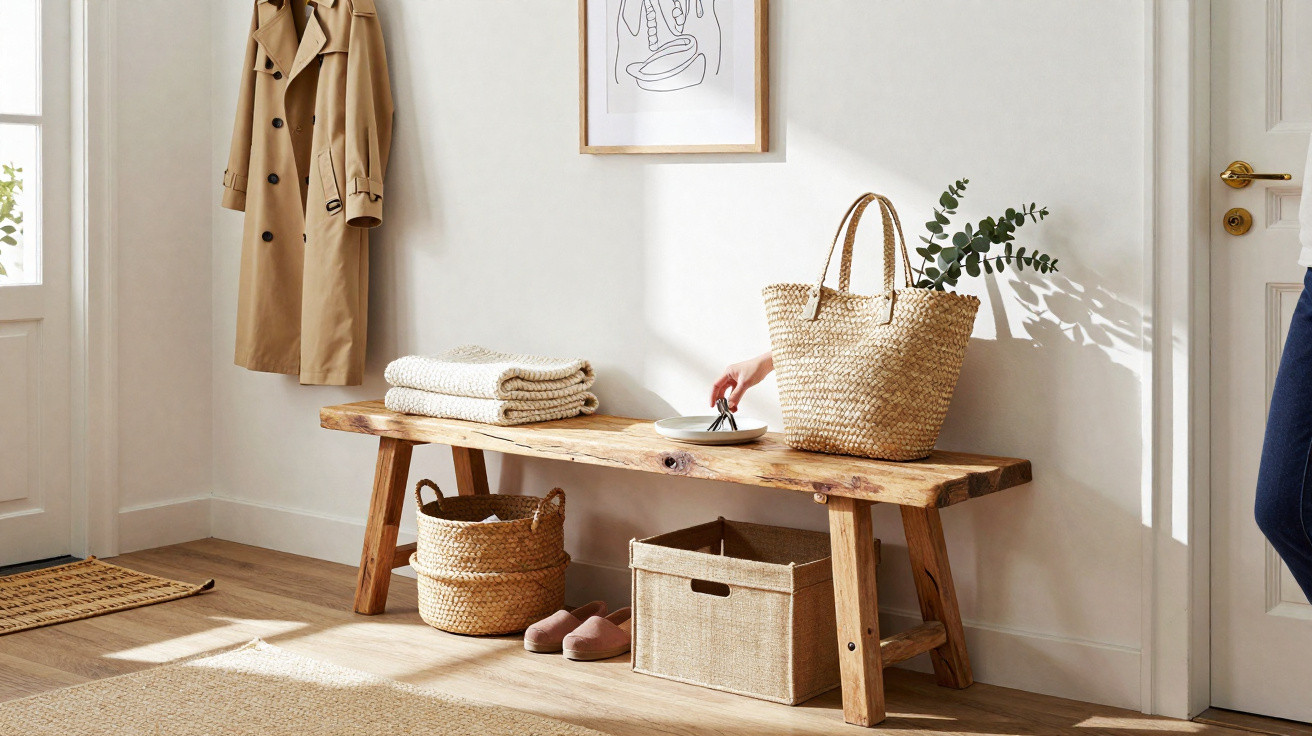
Most people pour time and money into the living room, kitchen or bedroom, while the hallway gets left to fend for itself. Yet it’s this first stretch of space that shapes the feeling you get the moment you unlock the front door. In many cases, one simple but well-chosen piece of furniture can do more than a full-on renovation. That’s exactly where a current favourite among interior fans comes in: a pared-back bench–table hybrid made from recycled wood by H&M Home.
Why a wooden bench in the hallway changes more than a fresh coat of paint
After a long day, one glance at a messy entrance can be enough to knock your mood down a peg. Coats slip off their hooks, shoes end up scattered, and a pile of post appears from nowhere. It’s easy to assume the answer is expensive built-ins or made-to-measure storage. In reality, a single, clearly purposeful piece is often all it takes.
This is where the recycled-wood bench earns its place. It brings three things that are priceless in a hallway: structure, warmth and a touch of style-without shouting for attention.
"Wood grounds a room instantly-especially recycled wood with visible marks; it feels less like decoration and more like a real home."
Metal shelving or plastic hallway furniture can quickly feel cold-almost like an office corner or a utility area. Solid wood, particularly when you can see knots and subtle shifts in tone, reads as warm and lived-in. That’s exactly the look many people want when they’re drawn to “slow living” and calmer, more intentional interiors.
Recycled wood: rough-edged charm instead of perfect uniformity
The H&M Home bench leans into timber with a past. Small inconsistencies, minor knocks and varied grain patterns aren’t flaws here-they’re part of the brief. The overall effect is closer to a flea-market find than a soulless mass-produced item.
That kind of character works especially well in pared-back, light homes with white or sand-coloured walls. The wood adds a warm counterpoint without overpowering a narrow hall. It becomes a quiet anchor-something your eye naturally lands on as you walk in.
- A visual calm point: the hallway looks more organised, even if coats are still hanging nearby.
- A deliberate contrast: natural material softens sterile or ultra-minimal schemes.
- A more homely start: the entrance feels like part of the living space, not just a passage.
More than somewhere to sit: how interior pros use the bench
Interior designers and home-styling consultants don’t choose benches like this only for sitting. The real strength is how many roles one piece can take on at once: seat, landing spot and a display surface for small styling moments.
Day to day, it handles the ordinary jobs neatly: a quick perch to put shoes on, a place to drop shopping bags, somewhere to set a backpack down without chucking everything on the floor. The solid wooden slats are sturdy enough to cope with heavier bags without complaint.
It gets even more interesting if you treat the bench like a low console table. You can create little vignettes that instantly add personality to the hallway:
- A stack of oversized coffee-table books or interiors titles that spark conversation as soon as guests arrive.
- A ceramic or smoked-glass table lamp that throws a soft, warm glow in the evening.
- A simple, generously sized ceramic or glass vase filled with branches, grasses or the first spring cuttings.
With that, a purely functional zone turns into a small, decorative welcome area. If you like changing things up, swapping books, branches or objects every few weeks refreshes the “opening scene” of the home-without buying new furniture.
Making clever use of storage under the seat
Another advantage is the space underneath. In slim hallways, a closed cupboard can feel bulky and heavy. The open area under the bench offers storage without visually crowding the room.
Woven baskets made from jute or other natural fibres are a popular choice-you simply slide them underneath. They’re ideal for hiding away:
- guest slippers
- hats, scarves and gloves
- dog lead and toys
- umbrellas or reusable shopping bags
The surface still looks tidy even if the baskets are doing the hard work inside. And the hallway feels more sorted, without adding extra time to the morning rush.
Design at a sensible price: why so many people choose H&M Home
Alongside looks and practicality, cost is often the deciding factor. Because hallways and entrance areas are small, many households hesitate to spend heavily on bespoke carpentry or designer pieces. A model from a high-street fashion-and-home retailer like H&M Home fits neatly into that gap.
The style has a hint of holiday-home finds or rustic vintage furniture, but the price sits in a range that’s realistic for tighter budgets. That alone can make it easier to treat the hallway as a space worth styling, rather than a forgotten in-between.
"Instead of fast furniture with a short lifespan, the bench relies on a robust material that gains more character every year."
For anyone trying to make more sustainable choices, recycled wood is an easy win. It reuses existing resources rather than consuming newly cut timber. The bench will show wear over time, but in a way that suits the rustic finish-small marks look at home rather than out of place.
One piece of furniture, plenty of places it can live
A key benefit is that the bench doesn’t have to stay in the entrance. If your layout changes-or you move-this piece can shift into another room without fuss.
Typical alternative spots include:
| Place | Use |
|---|---|
| Bedroom | At the foot of the bed as a landing spot for throws, clothes or a tray with coffee. |
| Dining room | Extra bench seating when guests are over, or a side surface for bowls and bottles. |
| Living room | A low TV bench, plant shelf or plinth for art objects. |
| Covered balcony / loggia | A seat with cushions or a surface for plant pots. |
That flexibility makes the purchase feel worthwhile long term. Even if your taste evolves, the bench stays useful because it’s visually understated and works with plenty of styles-from Scandinavian minimalism to wabi-sabi or modern rustic.
How to upgrade your entrance with just a few quick tweaks
If you want to lift your hallway without overthinking it, start with the wooden bench as the base and build a simple mini-scheme around it. Three straightforward building blocks are often enough:
- Create the base: position the bench, leaving a small gap from the wall so it doesn’t look shoved in.
- Add warmth on top: a cushion, slim seat pad or small sheepskin brings comfort.
- Keep order underneath: baskets, crates or boxes under the seat corral the everyday bits and pieces.
If you feel like taking it further, hang a mirror, a row of hooks or a narrow picture above. It quickly becomes a cohesive little zone that makes coming home feel good every time.
Practical notes on care, pairing materials and overall style
Recycled wood is hard-wearing, but it does appreciate basic care. A lightly damp cloth is usually enough for wiping it down. It’s best to avoid harsh cleaners, as they can attack the surface. Small scratches tend to disappear into the naturally varied grain; bigger dings can often be lightly sanded and re-oiled, depending on the finish.
The bench also comes into its own when you mix materials: a cool concrete floor with warm wood, woven baskets and a glass vase creates a balanced look. If you prefer more colour, experiment with cushions, runners or wall paint and let the bench act as a calm, natural counterweight.
It also fits neatly with more conscious buying habits: choosing one sturdy, adaptable piece that stays with you for years, rather than picking up new short-lived decorative items each season. Over time, that’s how a home starts to feel not overly staged, but lived-in-shaped by use, memories, and a bench that’s far more than somewhere to sit.


Comments
No comments yet. Be the first to comment!
Leave a Comment