
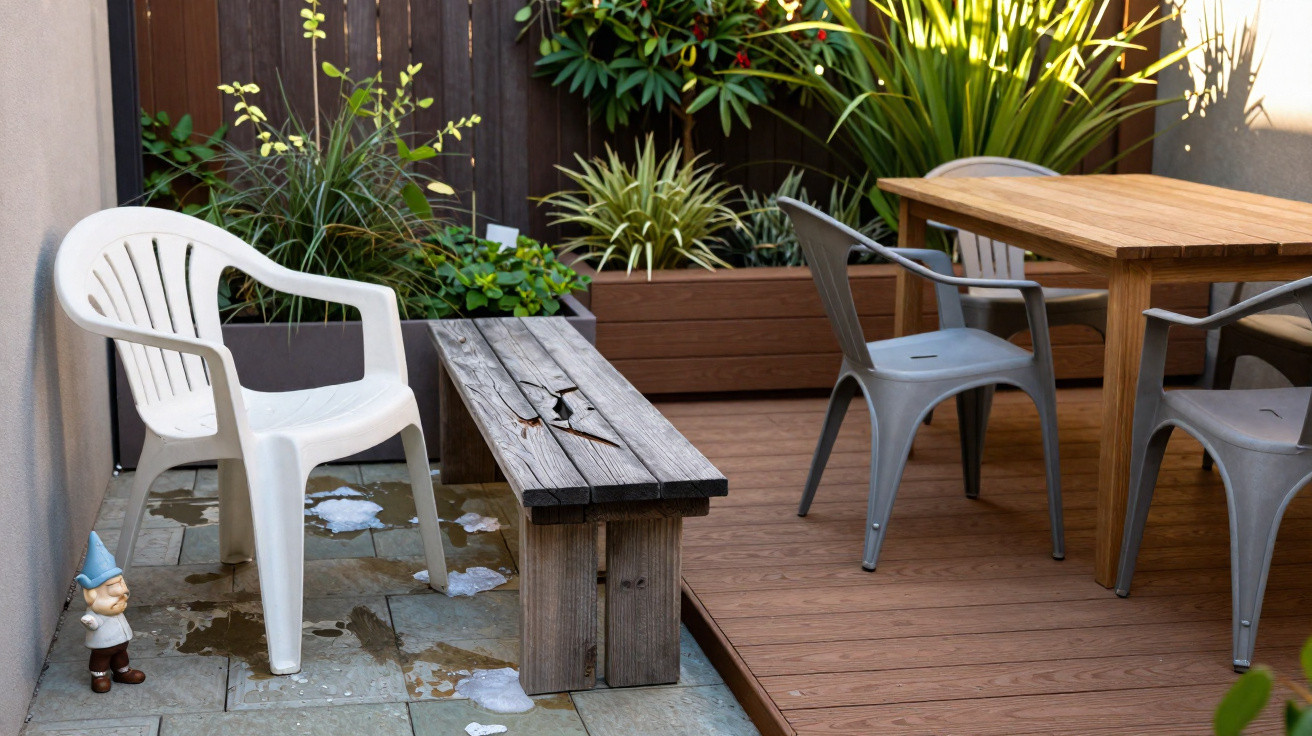
You imagine sipping coffee on the terrace in March, only to be greeted by a split bench, chairs that rock from side to side, and marks you certainly didn’t ask for. The reason is straightforward: plenty of outdoor materials simply aren’t built for real weather, and they end up being far more expensive than they look.
When one winter is all it takes to destroy your garden furniture
Across the UK, northern Europe and large parts of North America, outdoor furniture doesn’t just deal with the odd shower. It endures long stretches of rain, frost, icy mornings, brief thaws, and then frost all over again. That repeated pattern is unforgiving.
Moisture works its way into tiny pores, seams and hairline gaps. When the temperature falls, the trapped water freezes and expands. With every freeze–thaw, pressure builds inside those microscopic cracks, gradually forcing apart coatings, fixings, joints and even solid sections.
"It’s not the cold you feel on your skin that does the worst damage, but the invisible freeze–thaw beating your furniture takes all winter."
Before long, paint and varnish lift and flake off in large strips. Timber swells, then dries out, which steals its shape and weakens it. Screws start backing out, joints spread, and what felt sturdy in the shop can quickly become shaky and unsafe to sit on.
When moisture reaches deep into a material’s core, it seldom “dries out” back to normal. Timber may begin rotting from the inside. Boards made from particles can start to break down and crumble. Plastics that have already been weakened by UV light become brittle and snap. That “bargain” you brought home last spring can turn into awkward, bulky rubbish before it even reaches a second summer.
Cheap softwood and standard plastic: the outdoor money pit
Why untreated wood is a sponge in disguise
Low-cost garden sets are often made from pale softwoods such as spruce, fir or untreated pine. They can look clean and natural at first, but outdoors they behave like a sponge abandoned on the patio.
Unless the timber has been deeply treated in an industrial process, it repeatedly absorbs rainwater. While it stays damp, fungi and wood-boring insects get exactly the conditions they need. After one wet winter, that “light Scandi look” can become darkened, soft under pressure, and structurally unreliable.
"Untreated softwood might last indoors, but outdoors it’s like leaving cardboard in the rain and hoping for the best."
Oils, stains and thin varnishes applied at home can offer some protection, but most of what they do is only skin-deep. As soon as cracks appear or maintenance gets missed for a season, water finds a route in and the slow failure starts.
Standard plastics and bargain resin: cracked by cold and sun
The other common pitfall is cheap plastic: stackable white chairs, bright resin armchairs and budget loungers that flood supermarket aisles every spring. They’re sold as “no maintenance” and temptingly inexpensive, but they rarely age kindly.
The trouble begins in summer, when sunlight attacks the plastic first. UV exposure breaks down the structure and leaves it chalky and fragile. Then winter arrives and cold weather stiffens the already-weakened material. A small knock - or someone sitting down a bit too abruptly - can be all it takes to split a seat or snap an armrest.
- UV light makes low-quality plastic chalky and fragile.
- Cold temperatures increase rigidity and reduce flexibility.
- Combined, they turn a flexible chair into something that shatters like glass.
These items are often too large for standard household waste and difficult to recycle because they combine multiple plastics with metal inserts. As a result, they become inconvenient clutter in sheds and garages, or they end up at the tip after only a couple of seasons.
Aluminium and composites: the materials professionals actually choose
Aluminium: light, rust-free and unfazed by winter
Landscape designers and outdoor hospitality spaces tend to choose materials with ruthless practicality: what lasts is what gets used. Aluminium is consistently near the top of that list. Unlike steel it won’t rust, and unlike iron it doesn’t rely on constant repainting just to survive.
Most modern aluminium garden furniture comes powder-coated - the colour is baked on at high temperature. That tougher finish stands up to rain, frost and UV exposure far better than typical brush-on paint.
"Good aluminium furniture can stay outside all year, need a quick wash in spring, and still look respectable a decade later."
Another advantage is its low weight, which makes it simple to shift around when you want to chase the sun or move pieces out of the way of a storm. On balconies and roof terraces, that lighter weight can be as important as durability.
Composite materials: wood look, without wood’s headaches
If you don’t like the clean, metallic look, composites can deliver a more timber-like appearance without the same drawbacks. These engineered materials blend wood fibres with high-performance plastics, creating slats and boards that resemble wood while behaving more like a weatherproof outer layer.
High-quality composite typically:
- does not rot or attract wood-eating insects
- resists cracking and splintering under frost
- fades slowly and evenly instead of streaking or patching
- can be washed down rather than sanded and recoated
That makes composite a reliable choice for decking, benches and table tops that remain exposed throughout the year. On a terrace in Glasgow or Minneapolis, where winter seems to drag on, predictable performance matters much more than a “natural” label attached to a price tag.
Pressure-treated timber: keeping the warmth of real wood
Some people simply prefer genuine timber outdoors - the feel, the grain and even the scent. Wanting real wood doesn’t mean accepting furniture that falls apart. Pressure-treated timber, often pine, is in a different league from untreated softwood.
In pressure treatment, protective agents are forced deep into the timber under pressure. That reduces water uptake and makes the wood far less inviting to fungi and insects. Used properly, this timber can remain structurally sound outdoors for a decade or longer.
"Weathered grey on the surface doesn’t always mean rotten wood; with pressure-treated timber it’s often just a cosmetic patina."
That’s why pressure-treated boards are so common in play areas, decking and public benches. They still benefit from thoughtful design and some upkeep - especially to avoid persistent standing water - but they cope far better with a typical British winter, or a northern US winter, than basic pine garden sets.
From disposable to durable: changing how you buy for the garden
Picking the cheapest set in the spring sale feels like a win at the till. That satisfaction tends to vanish when you’re lugging snapped chairs to the recycling centre two years later. Replacing complete garden sets every few seasons brings a real financial hit and an obvious environmental cost.
Choosing longer-lasting materials changes how your outdoor area works year to year. Aluminium frames, decent composites and higher-grade pressure-treated timber mean less waste and fewer annual “maintenance jobs” that never quite happen.
| Material | Typical lifespan outdoors | Maintenance level | Winter risk |
|---|---|---|---|
| Untreated softwood | 1–3 years | High (regular staining, repairs) | Rot, warping, splitting |
| Low-grade plastic | 2–5 years | Low, until it fails | Brittle cracks, UV damage |
| Aluminium (powder-coated) | 10+ years | Low (wash when needed) | Colour fading if very low quality |
| Wood–plastic composite | 10–20 years | Low (cleaning only) | Some fading, dirt build-up |
| Pressure-treated timber | 10–15 years | Moderate (occasional protection) | Localised rot if poorly installed |
Over a ten-year period, repeatedly buying cheap plastic or untreated timber can cost more than investing once in a well-chosen aluminium or composite set. You also avoid the yearly irritation of discovering stains, warping or unexplained cracks after a single hard frost.
Key terms and real-life scenarios
A handful of technical phrases come up repeatedly when people discuss outdoor materials:
- Freeze–thaw cycle: the repeated freezing and thawing of water inside materials, which enlarges cracks and weakens structure.
- Powder coating: a dry paint applied electrostatically to metal, then baked on, forming a harder and more durable finish than liquid paint.
- Pressure treatment: an industrial process that forces preservatives deep into timber cells, making them more resistant to moisture and biological attack.
Picture two neighbours on a typical British street. One buys a fashionable untreated timber set from a supermarket every time the sun shows up. The other pays more up front for a simple aluminium table and composite chairs. Five years later, the first has spent money several times over, filled skips with broken pieces, and still rushes to cover everything at the first hint of rain. The second runs a hose over the set in spring, wipes it down, and gets on with growing tomatoes.
Compromises are still possible. Plenty of homes combine materials: an aluminium table with pressure-treated timber planters, or a composite deck paired with a few carefully selected wooden accent pieces kept in a sheltered spot. The important thing is knowing which materials shrug off winter - and which ones age badly and keep costing you long after the receipt has faded in your pocket.

Comments
No comments yet. Be the first to comment!
Leave a Comment