
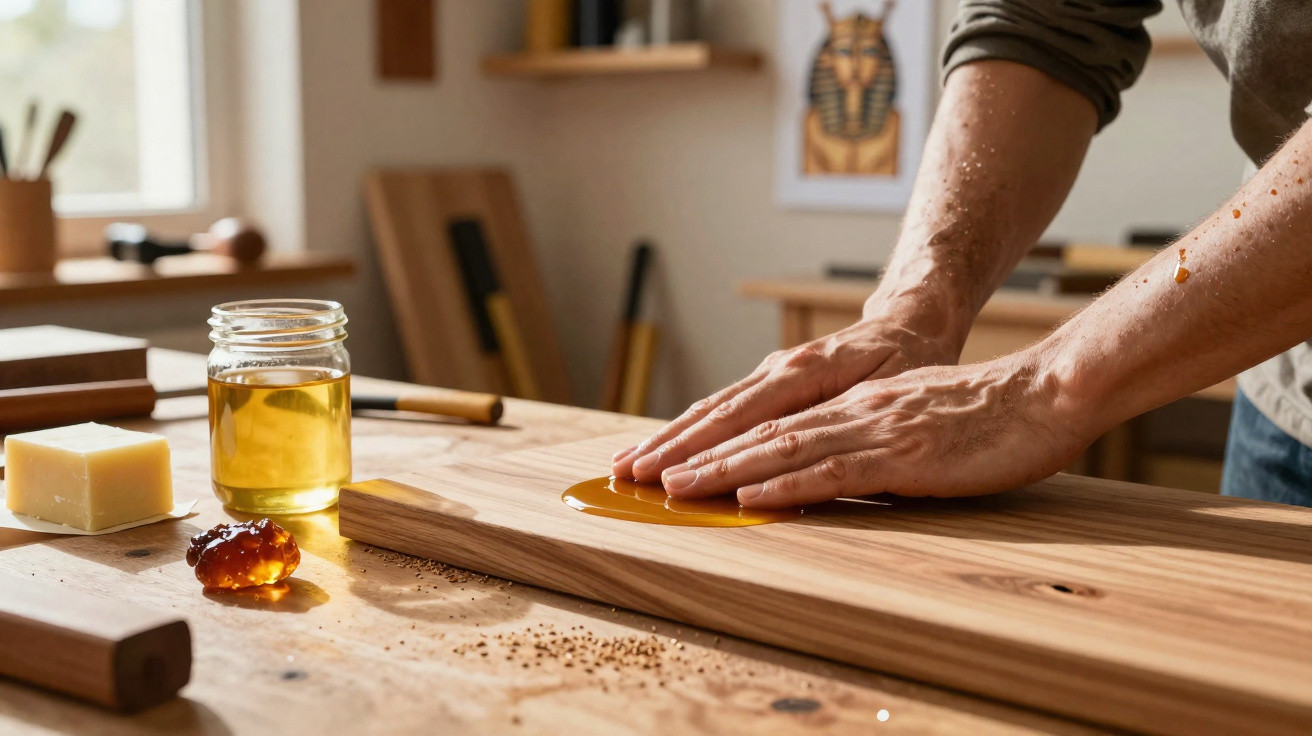
Craftspeople are quietly borrowing a 3,000-year-old finish that can breathe, carries a rain-after-the-grove scent, and helps boards and benches stay in service. The real surprise isn’t the pull of pharaohs-it’s that this old recipe still outperforms plenty of synthetics in day-to-day use.
I once watched a young maker leaning over a battered saucepan in a cramped workshop, the kind where curled shavings sit on the floor like straw nests. In the pot, beeswax and resin were melting into linseed oil, shifting from milky to amber as a small flame warmed the base. It smelled like a museum and a bakery. He loaded a cloth, spread the syrupy mix over ash, and the timber drank it in, the grain deepening like river stones after rain. After a short pause, he burnished with a horsehair brush until it glowed-never glossy, just alert. The space seemed to age by centuries. The whole formula is three ingredients, plus time.
Why an Egyptian wood finish is back on the bench
Along the Nile, woodworkers in Ancient Egypt treated timber like a precious resource. With trees scarce, furniture, coffins and boats needed protection from heat, sand, and the wear of ritual handling. Their solution was a mix of plant oil, beeswax and tree resins-something that penetrated, tightened the pores, and left a smooth, breathable skin. Modern makers are chasing the same equilibrium: protection without plastic, sheen without a hard shell.
You can spot the logic in museum objects that feel unexpectedly contemporary. Tutankhamun’s chairs carried coatings of oils and resins that still show a gentle sheen. Funerary boats have revealed traces of bitumen and conifer resin along the seams. In a Brooklyn co-op, I saw a cabinetmaker work a comparable blend into a maple café tabletop that needed to look “natural, not fragile.” He wasn’t recreating a tomb; he was adopting a principle: let wood remain wood, only more capable of handling daily life.
The science looks straightforward, but the results are layered. Linseed oil oxidises and polymerises, building a flexible network within the fibres. Beeswax sits in the surface pores and moderates moisture movement. Tree resins-pistacia in the ancient world, and pine rosin or damar for many people today-contribute hardness and tack, then set into a fine crystalline shield. Combined, they shrug off splashes, reduce fingerprints, and let small scuffs fade with a quick rebuff. It stays permeable enough to avoid trapping moisture, yet robust enough for a mug of coffee. The timber looks properly finished without appearing sealed away from the world.
How to mix and apply the oil–wax–resin, the Egyptian way
Begin with a straightforward ratio: 2 parts raw, cold-pressed linseed oil, 1 part beeswax pellets, and 1 part pine rosin or damar resin. Heat it gently in a double boiler until everything dissolves, stirring with a wooden stick. Once off the heat, you can add a few drops of cedarwood or myrrh oil if you’d like a faint hint of the Nile. While the blend is warm (but not hot), wipe on a thin coat to bare wood, leave it 20–30 minutes, then buff firmly with a lint-free cloth. Allow at least a day of curing between coats.
Keep it thin and take your time. Heavy layers stay tacky and attract dust. Hold the temperature low and consistent-overheated wax loses its grip. Work with good ventilation, and spread oily rags out flat to dry on metal, never screwed up into a ball. Rags can self-ignite. A light pass with 320-grit between coats removes nibs and helps the next layer key in. If you’re sensitive to rosin, food-contact boards can be finished effectively with raw linseed oil and beeswax on their own. And honestly, this isn’t an everyday job-set aside a slow afternoon, then enjoy how long it pays you back.
This isn’t fussy work; it’s attentive work. The blend is simple, but the cadence matters-wipe, wait, buff, breathe. A veteran restorer once told me it’s less like painting and more like polishing a thought.
“What the Egyptians understood is that wood behaves like a living material. You don’t trap it. You coach it.”
- Warm the wood slightly with a heat gun on low to encourage deeper absorption.
- Check the colour on an offcut: oil will amber pale species such as ash and pine.
- For a tougher final layer, increase resin by 10–15% in the last batch only.
- Maintain it with a quick buff and a fingertip of paste every few months.
The slower finish that changes how we see things
Most of us know the moment: a favourite table starts to look worn, with rings and scratches recording a story we’re not ready to close. An Egyptian finish won’t wipe away that history-it repairs it. After the first coat, the grain tightens into view, like a photograph snapping into focus. After the second, you get that quiet depth that’s hard to counterfeit.
There’s also a kind of timekeeping built into the process. Oil cures when it’s ready, wax buffs best when the cloth stops dragging, and resin hardens while you sleep. Work in thin coats, the old hands insist, and let oxygen do the heavy lifting. The waiting becomes part of the pleasure, and the reward is a surface that welcomes touch instead of resisting it.
It also adapts to more situations than you might expect: chopping boards, handrails, turned bowls, guitar necks, school desks that need to look tidy without looking corporate. It isn’t as bombproof as bar-top epoxy. It’s different: repairable, renewable, and quietly luxurious. When it finally needs attention, you come back with a cloth and a saucepan over a gentle flame-not a respirator and sanders screaming at midnight.
The practice reaches back to boat builders sealing planks against the Nile and forward to anyone who wants a home that feels less like a showroom and more like a place with pulse. Pass the idea to a neighbour, hand a jar to a friend setting up a first flat, or show a teenager how to buff a cutting board until the light skates across it-a small ritual that slows a room down in all the right ways.
| Key point | Detail | Why it matters to you |
|---|---|---|
| Egyptian blend basics | 2 parts linseed oil, 1 part beeswax, 1 part pine rosin/damar | Clear, repeatable recipe you can mix at home |
| Application rhythm | Wipe thin, wait 20–30 min, buff hard, cure 24–72 h | Professional results without special tools |
| Safety and upkeep | Low heat, flat-dry rags, quick seasonal refresh | Long-lasting finish with minimal risk and fuss |
FAQ:
- Is the oil–wax–resin finish food-safe? Use raw, food-grade linseed oil and pure beeswax for boards and utensils; skip added solvents. Pine rosin is widely used in food wraps but can trigger allergies in some people.
- How long does this finish last? On indoor furniture, expect 1–3 years before a simple refresh. High-wear items like cutting boards benefit from a quick rub every few months.
- Can I use it outdoors? Yes, with expectations. It sheds water and sun fairly well but needs more frequent maintenance. Consider adding extra resin for hardness and recoat seasonally.
- Will it darken the wood? Linseed oil ambers pale woods and deepens colour on darker species. Test on an offcut to preview the tone you’ll get after curing.
- Where do I find the ingredients? Raw linseed oil and beeswax are common at art or hardware stores. Pine rosin (colophony) and damar crystals are sold by art suppliers and luthier shops.





Comments
No comments yet. Be the first to comment!
Leave a Comment