
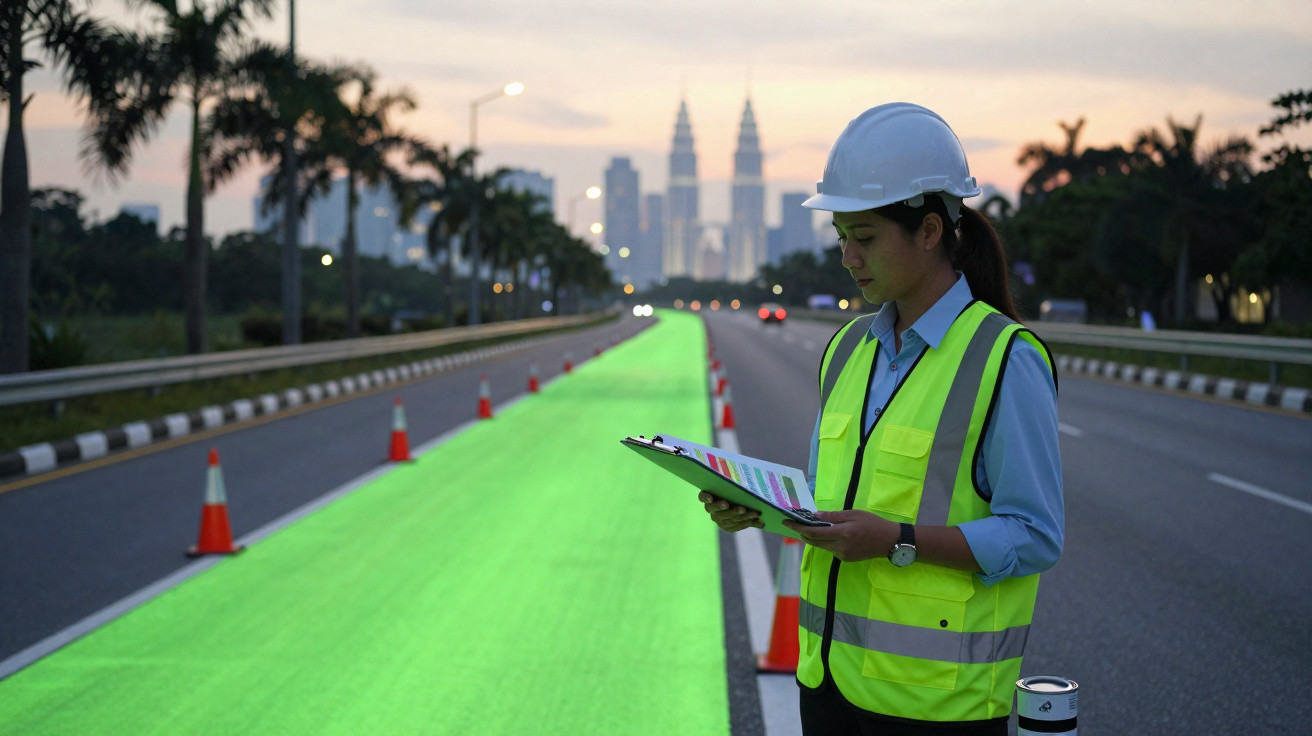
What looked like a small glimpse of the future turned, within a matter of months, into a cautionary tale about pricey innovation on public roads. In a Kuala Lumpur suburb, Malaysia trialled road markings that absorb light in the daytime and glow on their own at night. Drivers were impressed and politicians were already talking about expansion-until one crucial cost detail punctured the vision.
A future-themed test stretch: when the road itself glows
The pilot section sat near Semenyih in Selangor, on an otherwise unremarkable rural road in the Hulu Langat district. In late October 2023, roughly 245 metres of carriageway were treated with a special photoluminescent paint. Rather than installing conventional street lighting, the plan was for the lane markings to provide visibility by themselves.
By day, the stretch looked entirely ordinary: white lines much like those on any other road. After sunset, however, the scene changed. Having stored daylight, the markings began to emit a soft but clearly visible glow. For motorists who had previously driven through near-total darkness on that section, the improvement was significant.
The road became a source of light-without adding a single lamp and without any ongoing electricity use.
The Public Works Department stressed that this was not about spectacle, but about road safety. The purpose of the trial was to assess whether glowing markings could be a practical aid on unlit rural roads.
How the road’s glow paint works
The coating relies on photoluminescence. Put simply, particles within the paint absorb light energy and then release it gradually later on. That is why the marking continues to “glow” in the dark even when there is no longer any external light source.
- Daytime: absorbs sunlight or other strong ambient light
- Dusk: the glowing effect begins to appear gradually
- Night: self-illuminated lines remain visible for several hours
- Rain: the ministry said the glow remains easy to see
At the time, Works Minister Alexander Nanta Linggi said the markings could remain visible for up to ten hours, including in wet weather. That made the concept sound like a strong fit for areas with no street lighting or where electricity supply can be unreliable.
Why the project attracted attention so quickly
The Semenyih section was short, but it addressed a real need: clearer guidance on dark, lightly developed rural routes. According to motoring site “Paul Tan’s Automotive News”, a total of 490 metres of marking lines were installed across the 245-metre section. The intention was for the luminous paint to replace conventional road reflectors (“cats’ eyes”) at least in part.
Comparable ideas had already been explored in Europe. In the Netherlands, engineers trialled so-called “Glowing Lines” under the “Smart Highway” programme. There too, road markings charged in daylight and then shone after dark. During a three-month test, the lines on a trial route reportedly glowed for up to eight hours each night-without a single lamp post.
Malaysia presented its own trial less as a design showcase and more as a straightforward road-safety intervention. The emphasis was on rural stretches where the state cannot-or chooses not to-install expensive lighting infrastructure everywhere.
Expansion planned-until the numbers were on the table
Initial feedback was strongly positive. Drivers reported on social media that they felt safer on the section because the lane edges and curve alignment were finally easy to read. Selangor’s state government took that response as momentum.
As early as February 2024, the state announced plans to extend the glowing markings to 15 further sites across all nine districts. The proposal covered around 15 kilometres of marked road, including locations in Sepang, Kuala Langat and Petaling. The estimated cost: about 900,000 Malaysian ringgit.
Other states signalled interest too. Johor identified 31 roads for pilot schemes, including a 300-metre segment in Batu Pahat. What began as a small experiment suddenly looked like it could become a nationwide approach to tackling pitch-dark rural roads.
The cost shock, in black and white
Behind the scenes, cost assessments were already highlighting an uncomfortable reality: the photoluminescent paint carried an exceptionally high price tag.
| Type of marking | Cost per square metre |
|---|---|
| Conventional road paint | RM 40 |
| Glowing marking (photoluminescent) | RM 749 |
That meant the glowing lines were almost 20 times more expensive than standard marking paint-before outstanding questions about service life, tyre wear and maintenance cycles had even been fully resolved.
The parliamentary line that changed everything
In November 2024, the tone shifted abruptly. Deputy Works Minister Ahmad Maslan told Parliament that the costs were simply too high, and that the glowing lanes would very likely not be continued.
The technology impressed many drivers, but ultimately failed on the tests of cost, durability and safety standards.
Maslan added that internal trials had not satisfied the ministry’s technical specialists. He did not provide details on the specific shortcomings, but the implication was clear: the issue was not only money, but also whether the markings could meet operational requirements over time.
In that moment, the futuristic concept became a familiar infrastructure storyline: an innovation captures attention and raises expectations, but then runs aground on budgets, standards and the realities of upkeep.
What the failed trial still achieved
Halting the wider rollout does not, of course, solve the underlying problem. Road authorities still have to ensure that lane markings remain visible at night and in poor weather-particularly outside urban areas. In Japan, for example, the National Institute for Land and Infrastructure Management has spent years working in detail on measurement methods and quality standards for motorway markings.
The Semenyih episode underlines the size of the balancing act. On one hand, politicians and the public want visible innovation. On the other, any solution has to be affordable long term and technically robust. The glowing lines scored highly on first impression, but apparently did not clear the threshold for widespread adoption.
Which alternatives look more realistic
Rather than using expensive luminous paint, several other options are on the table-some of which are already well established:
- Higher-performance reflective markings: thick-film paints and glass beads increase retroreflection under headlight beams.
- Improved “cats’ eyes”: newer road studs with reflective elements or active LED components can guide drivers through bends and junctions.
- Targeted partial lighting: instead of continuous rows of lamp columns, some countries use lighting only at known danger points.
- Intelligent traffic signs: highly reflective surfaces or solar-powered LEDs can make critical warnings stand out at night.
Many of these systems are cheaper to buy or maintain, and they fit more easily into existing standards and maintenance routines-which makes them simpler to justify politically.
What photoluminescence on roads can realistically deliver
The underlying technology remains interesting. Photoluminescent coatings could still make sense for niche uses, for example:
- on short sections with a high collision rate
- in areas without a stable electricity supply
- as a temporary measure during roadworks, diversions or natural disasters
For large-scale networks, the figures do not currently stack up. Too many open questions remain around wear, rain, dirt, tropical conditions and the cost of re-coating. Each repaint would push the already high per-square-metre costs higher still.
At the same time, Malaysia’s experience shows how complex the seemingly simple goal of “clearly visible road markings” really is. It is not just paint on asphalt, but a whole system involving materials, maintenance, standards, budgets and how drivers perceive what they see. An innovation that addresses only one of those dimensions rarely gets very far.
For other countries, the brief story of the glowing road in Semenyih can serve as a useful reference: running trials is worthwhile, but it must be matched early on with a hard test of lifetime cost and technical requirements. Otherwise, the “road of the future” can end up as nothing more than a brief glow in the dark.


Comments
No comments yet. Be the first to comment!
Leave a Comment