
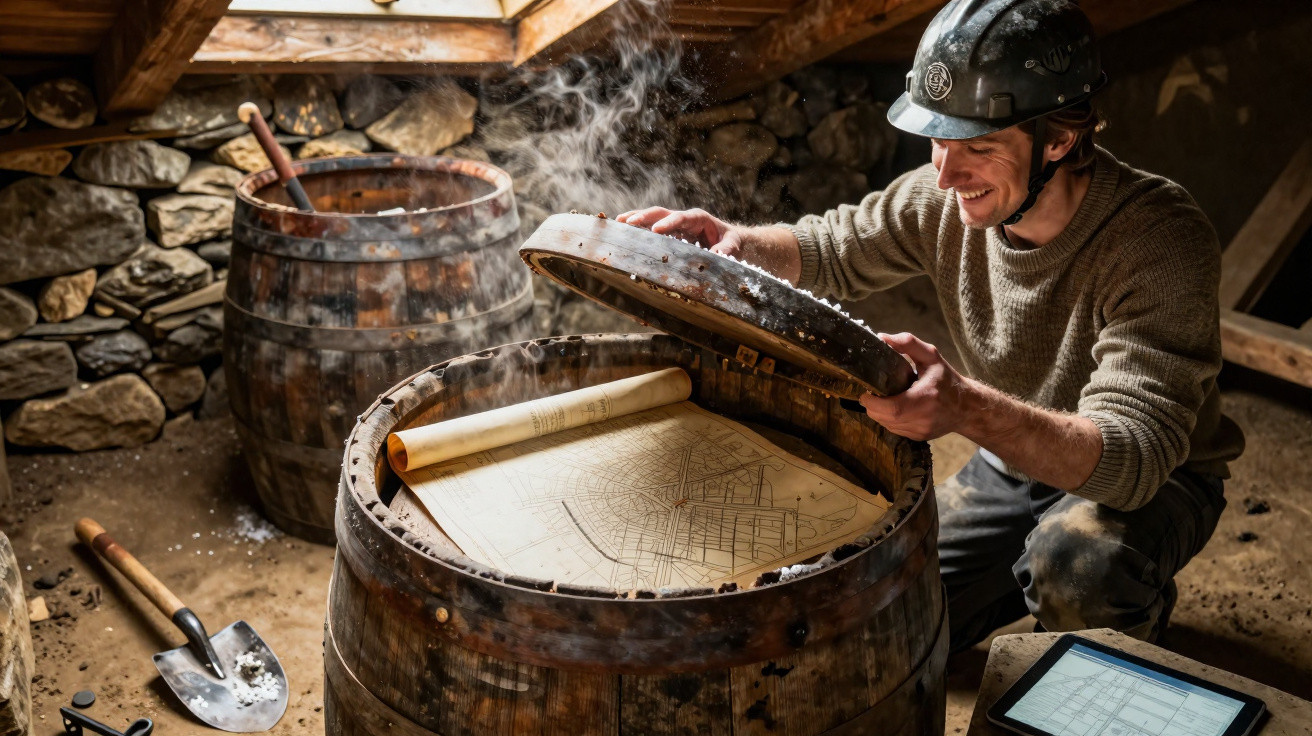
On a building site in south-eastern Norway, something surfaced that looked unremarkable at first: three old barrels, half swallowed by the ground. Yet what researchers were able to read from them is reshaping how we understand the history of Skien - and it highlights just how deliberately 17th-century builders handled their materials.
A discovery that takes us back to early modern building
Skien is among Norway’s oldest towns. Today, with just under 60,000 residents, it feels fairly quiet; in earlier centuries, it was a significant trading centre. When archaeologists carried out rescue excavations around Torggata - a street in the historic core - they encountered three large oak barrels.
Crucially, the barrels were still positioned exactly where they had been used around 400 years ago, in situ. For researchers, that is invaluable: the placement, surrounding deposits and what remains inside can all point to the original purpose. Packed between the staves were pale, crumbly residues - traces of lime. Nearby lay a roughly made wooden pestle, essentially a tamping tool.
“The three oak barrels were not used to store beer or herring, but formed part of a sophisticated building-materials logistics system in the 17th century.”
Tests of layers on the inside and outside indicated the barrels contained slaked lime - lime that had reacted with water and was suitable for producing mortar. After laboratory work, the Norwegian Institute for Cultural Heritage Research (NIKU) confirmed this was no accidental deposit, but a deliberately created store of material.
What was actually inside the old barrels
In the 17th century, lime was a core construction material. Mixed with sand and water, it produced lime mortar, used both as a binder in masonry and as plaster. In Skien, craftspeople appear to have drawn lime straight from oak barrels that had been set into the ground.
How the material worked in everyday practice
- Slaking lime: Quicklime is combined with water; it reacts chemically and becomes slaked lime.
- Storage: The slaked lime matures in a damp setting, often for weeks or months.
- Mixing mortar: On site, the lime putty is stirred together with sand and water.
- Use: The finished mortar bonds stone and brick, or forms plaster layers.
This is where the Skien find becomes especially informative. The barrels served as protected reservoirs. The wooden pestle found beside them suggests workers stirred the lime on the spot and worked it into an even, workable mass before use. Deposits on the barrel walls indicate repeated cycles of use: lime was put in, taken out, then topped up again. In other words, the barrels functioned like reusable, historical “building-material tanks”.
Underground lime storage: a smart response to a harsh climate
Their position below ground level was not accidental. Researchers believe the barrels were intentionally sunk so the contents could be kept under better control. The surrounding soil contained a lime-rich matrix, consistent with the idea that the material was handled there regularly.
“Storing it in the ground stabilised the temperature, prevented frost damage and kept the lime reactive.”
In Norway, where winters are cold, temperature management matters. If lime freezes, its structure can change and later mortar quality may suffer. An underground store works like a natural cellar: cool without being too cold, damp without becoming waterlogged. The oak barrels provided strength, while the earth around them supplied the necessary climatic buffer.
From this, researchers infer that Skien’s builders were not simply improvising: they were following a clear plan for moving and managing materials. Lime was valuable and labour-intensive to produce. Careful storage reduced waste and helped maintain the quality of walls and houses.
A town reimagined after fires
During the 17th century, Skien was repeatedly hit by major fires. Across many Nordic towns, wooden buildings burned with grim regularity. After such disasters, residents faced a practical question: how do we rebuild - and rebuild better?
The newly uncovered barrels fit precisely into this period of reorganisation. Specialists suspect the underground lime store formed part of a broader strategy to make the town more stable and resilient. More masonry, more plaster, more firebreak walls - all of this required substantial quantities of reliable lime mortar.
For historians, the find is compelling because maps, deeds and written records can reveal a great deal about property and taxation, but often say little about everyday construction logistics. The barrels provide an unusually direct piece of the puzzle: a place where the very mortar was prepared that bound the rebuilt town together.
What the discovery reveals about urban planning
Analyses point to several dimensions of building practice at the time:
| Aspect | Indication from the discovery |
|---|---|
| Material organisation | Targeted storage at a central point rather than scattered across individual yards. |
| Workflows | Mixing and preparing mortar on site, not separately for every small building plot. |
| Fire protection | Likely increased use of masonry after the fires. |
| Technical knowledge | Deliberate use of the ground’s thermal stability for quality control. |
How researchers coax a history from the barrels
Turning a few pieces of timber and some lime crumbs into a construction history requires modern techniques. NIKU specialists used several methods in combination.
- Dendrochronology: Studying growth rings in the oak can narrow down when the trees were felled.
- Microscopy: Thin layers of lime residue are examined under a microscope to assess composition and relative age.
- Geochemical analyses: Minerals and trace elements are identified to help clarify the limestone’s origin.
- Stratigraphy: The barrels’ position within soil layers indicates which building phase they belong to.
Together, these results anchor the find firmly in the 17th century and link it to known fire damage and rebuilding phases in Skien. The barrels also provide a chronological reference point for other discoveries in the same layer.
Why oak barrels survive so well
Oak was long regarded as a premium timber. In damp conditions it swells slightly, helping to seal joints; it is hard and relatively resistant to decay. For barrels that had to endure lime-laden moisture, it was an ideal choice. That the three containers remain so well preserved after centuries is also due to the consistently wet, oxygen-poor conditions underground, which slow down decay-causing microorganisms.
Finds like this are not everyday occurrences in Scandinavia, but they fit a broader pattern: in harbour areas and old town centres, archaeologists repeatedly uncover wooden structures - from latrines and wells to ship remains. Together, they speak to a period when timber was the most important raw material, and components were often given a second or third use before being abandoned.
What the find offers today’s building and conservation practice
For conservators working on historic buildings, the barrels are more than a curiosity. They provide clues about how lime mortar in the region was originally composed and the conditions under which it matured. Anyone repairing an old wall in Skien today can use that knowledge to recreate mortars that more closely match the originals.
At the same time, the discovery shows how early people began to organise material cycles. Centralised storage, optimised storage conditions, reusable containers - all of it sounds strikingly modern. “Sustainability” was not a 17th-century slogan, but careful, economical use of scarce resources certainly mattered.
For visitors to Skien, the find may one day feature in guided walks or exhibitions. Seemingly ordinary objects such as three old barrels make history tangible: it is easy to picture workers 400 years ago hauling heavy wooden buckets of lime mortar to a freshly raised wall, while a town rises from the ashes of earlier fires.



Comments
No comments yet. Be the first to comment!
Leave a Comment