
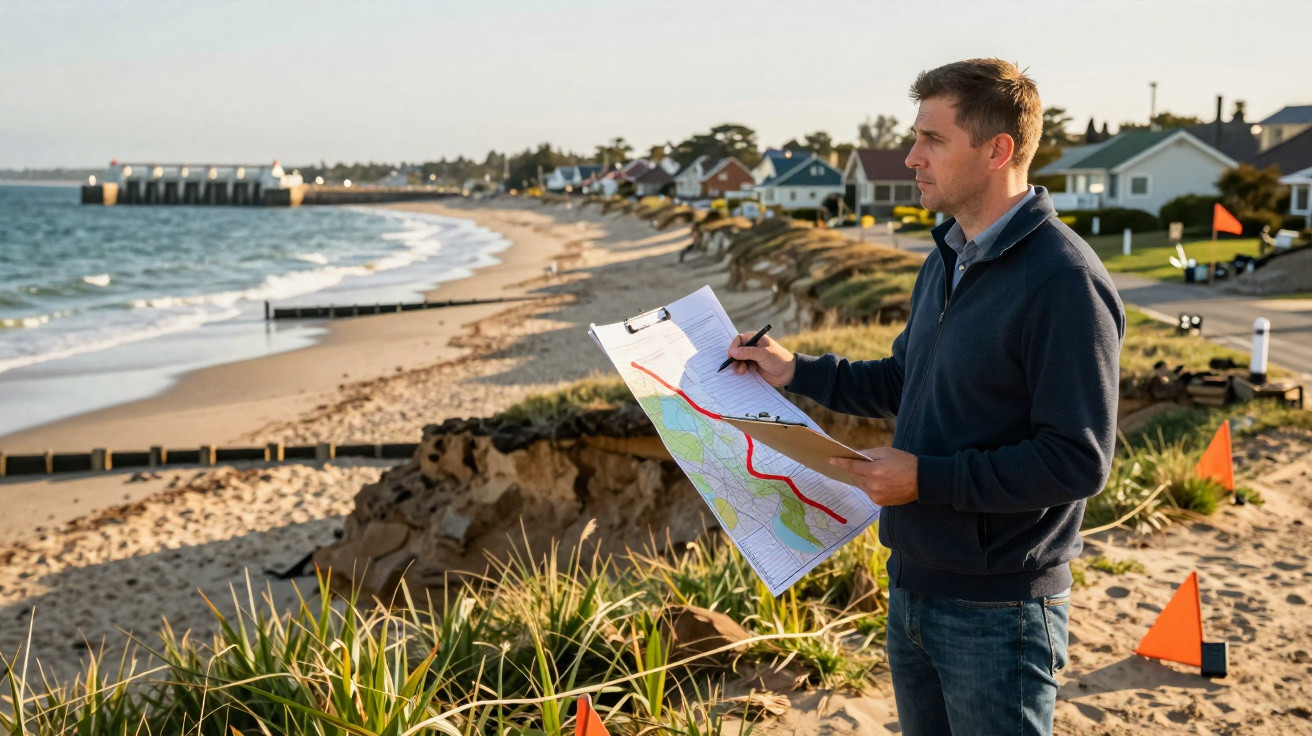
“We are already spending millions protecting the coastline, and in future it will be far more expensive.” That warning from geophysicist Filipe Duarte Santos, President of the National Council for the Environment and Sustainable Development (CNADS), captures the thrust of the latest “Reflection on Sustainable Management of the Coastal Zone”, presented publicly this Thursday at a conference hosted by the Gulbenkian Foundation.
Published 25 years after the Council’s first report on the subject, the new assessment points to worsening risks and rising costs for Portugal’s seafront unless there are structural changes in how the country deals with one of its most damaging challenges: coastal erosion.
Henrique Queiroga, the opinion’s coordinator and a biologist and researcher at the University of Aveiro, says pressures on the coastal strip are converging: climate change, a sediment deficit and urban development. “We are seeing a worsening of several environmental trends along the coast: more storms, sea-level rise and a lack of sediments,” he says. The projections are stark: under storm conditions combined with exceptionally high spring tides, “the flooded areas could extend beyond 500 metres along the coastline” by the middle of the century.
The loss of land is already measurable. Between 1958 and 2023, the country has lost the equivalent of more than 1,300 football pitches (a loss of 13.8 km2 of territory). Looking ahead, 50 square kilometres of coastal territory could be lost.
Despite decades of accumulating legislation, plans and studies, CNADS concludes that delivery has consistently fallen short. “The accumulation of legal instruments has not resulted in effective measures,” the opinion states. For Queiroga, the reasons range from institutional constraints and weak coordination to legal obstacles that make adaptation harder.
“Conflict between private interest and the public good”
A particularly visible example of this structural problem is the regime of “acquired rights”, which still enables building in risk areas. “There are building rights granted 20, 30 or 40 years ago that no longer make sense today,” says Queiroga.
Filipe Duarte Santos describes an “obvious conflict between private interest and the public good”, noting that local authorities often cannot halt such developments because they lack legal capacity. “Councils need stronger legal teams to defend the public interest,” he stresses.
In practice, the system spreads risk across taxpayers. “When there are buildings in risk areas, it is all of us who end up paying for the damage,” Queiroga warns. Filipe Duarte Santos pushes the point further, arguing that "the State should not take on these costs and that the model should evolve towards greater accountability for private actors, with a stronger role for insurance - similar to what happens in the United States, where it is unthinkable that the State would pay compensation for buildings erected in risk areas”.
Coastal erosion is also being intensified by sediment being trapped behind dams. Based on CNADS data, around 80% of the material that used to reach the sea is now retained by these structures, reducing beaches’ natural ability to replenish. “In the case of the Douro, the river now discharges less than a quarter of the sediments it carried before the dams,” Queiroga explains. The effects are clearly visible on the central coastline’s beaches between Espinho and Figueira da Foz.
Apply the accountability principle to dam owners
Although the problem is well established scientifically, it remains insufficiently quantified in Portugal. Filipe Duarte Santos argues for the "need for detailed studies on the sediments accumulated in dams”, and criticises the lack of transparency. The CNADS President points out, for instance, that "a study carried out by EDP on the effects of the dams on the Tâmega was never made public, making it difficult to assess the real impact of these infrastructures”.
Given this context, the environmental advisory body says it may be necessary to apply the “polluter pays” principle to dams, requiring their owners to contribute to artificial beach nourishment. However, without solid data on the retained sediments, the debate remains at an impasse.
At the same time, the country’s main response so far - adding sand artificially - brings heavy and growing costs. “Replenishing beaches costs around 10 euros per cubic metre of sand,” says Queiroga. Funding arrangements are also under strain.
Coastal protection has largely been supported by European funds - including those contributing to the 174 million euros announced by the Minister of Environment for coastal works through to 2028. Yet the EU source of this money is nearing its end. “We need to think about how we are going to finance this in future, because costs will keep rising,” Filipe Duarte Santos warns.
International comparisons underline Portugal’s weaknesses. While countries such as the Netherlands have set long-term strategies with guaranteed annual funding for coastal protection, Portugal tends to operate in reactive mode. “Here, we do piecemeal measures: a storm hits, something gets fixed here and there, and then it is forgotten,” the CNADS President criticises.
This lack of planning is also reflected in projects that remain unfinished. The promised bypass at Figueira da Foz - considered essential to restore the natural southward transport of sediments - was included in the 2026 State Budget, yet remains unimplemented more than a decade after it was first proposed. “We are still at square one,” says Filipe Duarte Santos.
Need for revision
Behind all of this is sustained pressure on the coastline. “Portugal is a country that leans towards the sea - for decades the population has been moving to the coast,” Queiroga notes, highlighting how tourism and urban expansion are intensifying coastal erosion. This pattern of land occupation increases exposure to risk in a context of sea-level rise which, although gradual, is already producing visible effects.
In response, CNADS calls for a deep overhaul of public policy, including changes to the acquired-rights regime, stronger integration of risk into municipal plans, and better coordination between bodies. It also stresses that any credible solution will demand difficult choices, such as the possible relocation of communities - processes with high financial and social costs. “All the mistakes made in the past and in the present will be paid for in the future,” Queiroga sums up.
Filipe Duarte Santos does not hide his frustration with the political response to the Council’s work. “I am a bit disappointed,” he admits, pointing to how hard it is to turn recommendations into action. Even so, he insists the need to change course is urgent: as storms intensify, sea-level rise accelerates and sediments remain scarce, the price of inaction will climb - and will, inevitably, be borne by everyone.






Comments
No comments yet. Be the first to comment!
Leave a Comment