
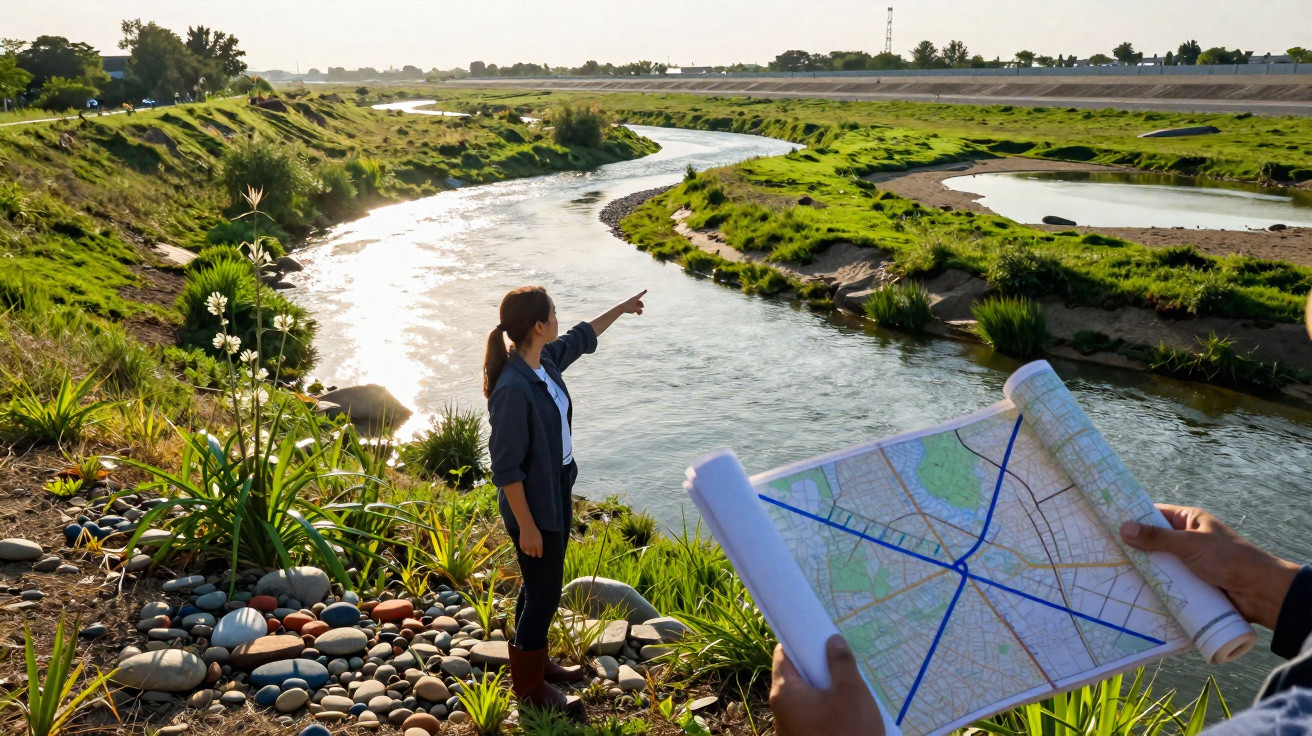
River bends were removed in many engineering schemes to speed up water flow, free up urban land, or cut local flooding. Today, the restoration of meanders shows that these natural detours help regulate discharge, erosion, sediment movement and floods along the watercourse.
Why were rivers turned into straight channels?
For many years, straightening rivers looked like common sense. By cutting out meanders and making the channel more direct, water could pass more quickly through farmland, alongside roads and through towns that wanted to avoid frequent overflows.
The trouble is that the higher speed simply shifted part of the risk elsewhere in the catchment. Water reached downstream areas sooner, carrying sediment, putting more pressure on banks and raising flood peaks.
What do river bends do to the water?
River bends slow the current and create places where water can spread out, soak in and drop sediment. This natural layout acts like a kind of hydraulic brake, particularly during periods of heavy rainfall.
- They reduce the force of the current across low-lying stretches.
- They allow more water to infiltrate the soil near the banks.
- They limit sudden sediment transfer to downstream areas.
- They create habitats for fish, birds, insects and riverside vegetation.
How do meanders help to prevent floods?
Meanders lengthen the route the water must travel. Rather than rushing straight downhill with full force, the river moves through repeated curves, losing speed and spreading the energy of the flow more evenly.
When the floodplain is protected, some of the excess water can occupy side areas without hitting streets, homes or crops as aggressively. The river stops being treated only as a drainage channel and starts functioning again as a living system.
What problems appear when the natural channel is removed?
Taking out bends can seem efficient at first, but it disrupts the balance between discharge, banks and sediment. The watercourse then tries to adapt to the new alignment, often by cutting deeper into the bed or eroding the sides.
- More severe erosion on unprotected banks.
- Siltation in stretches where the current loses strength.
- Loss of wetlands connected to the river.
- Greater risk of fast-onset flooding downstream.
- Less shelter and food for aquatic species.
Why has restoring rivers become an environmental solution?
Bringing back bends, vegetated banks and floodplains helps a river regain part of its natural dynamics. Instead of forcing water through a rigid channel, river restoration makes room for infiltration, temporary storage and a more balanced movement of sediment.
River bends show that a straight line is not always the best answer for managing water. In many watercourses, a winding path protects banks, reduces the force of floods and maintains the link between the channel, the soil, vegetation and aquatic life.






Comments
No comments yet. Be the first to comment!
Leave a Comment