
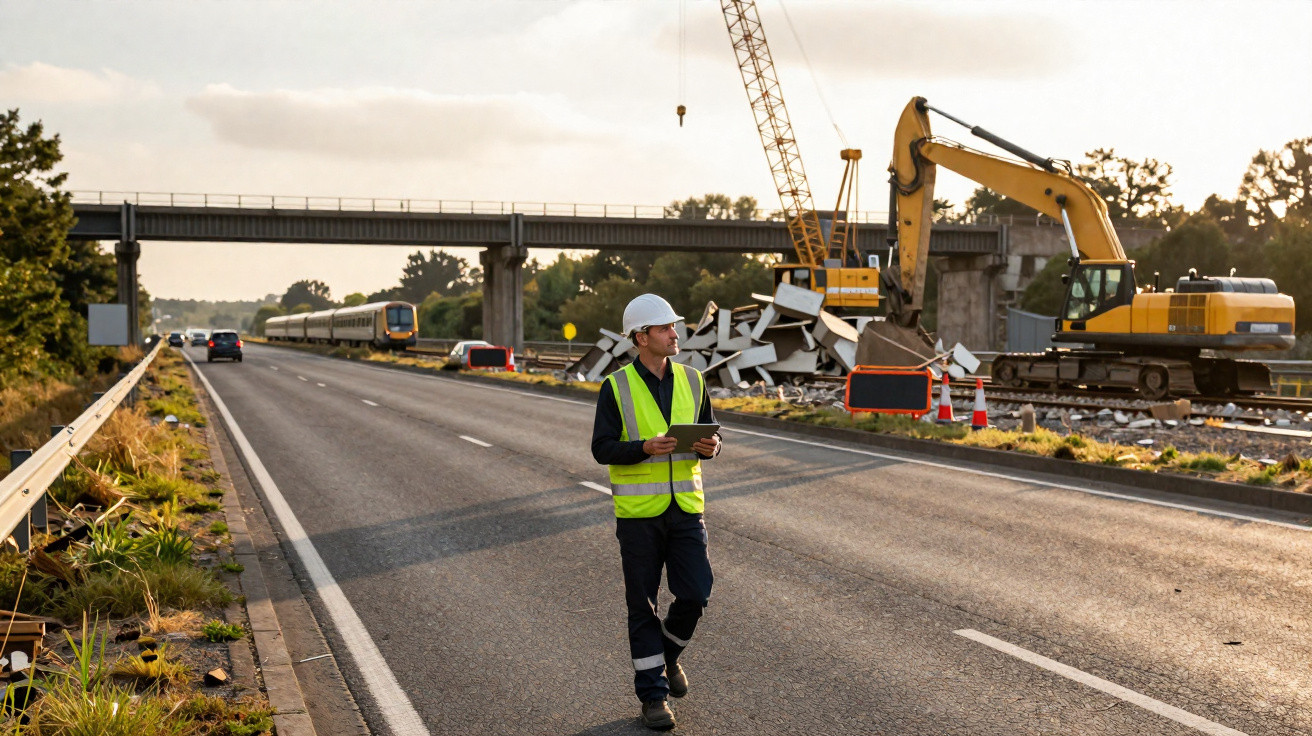
Across the Cumbrian fells, the thud of breakers and the rumble of excavators has died away after crews completed a high‑risk demolition above the M6. The railway bridge that had towered over the motorway for decades has now been removed, opening the route for a new crossing and marking the next stage of a long‑prepared West Coast Main Line upgrade.
Motorway reopens after ‘mammoth’ weekend operation
The M6 section between junction 39 at Shap and junction 40 near Penrith reopened on Monday morning, following a complete weekend shutdown so engineers could safely demolish the former Clifton railway bridge.
The concrete bridge, measuring about 130m (427ft), crossed both carriageways and carried West Coast Main Line trains. Taking it down demanded meticulous planning, a large rotating workforce and rigorous safety controls, with both road traffic and rail movements stopped in carefully managed phases.
The old Clifton Bridge is gone, the M6 is moving again, and a new 4,200‑tonne crossing is waiting in the wings.
Christian Irwin, Network Rail’s North West and Central director, called the demolition a “mammoth task”, carried out as part of a wider £60m package to modernise assets on one of the UK’s busiest rail corridors.
How engineers took down Clifton Bridge in one weekend
From Friday night through to Monday morning, teams worked continuously to dismantle the bridge, clear the waste and ready the area for the replacement. Contractors combined saw cutting, hydraulic breakers and specialist demolition excavators to take apart the deck and piers while keeping the motorway surface protected below.
Step-by-step demolition under time pressure
- Friday evening: the M6 was fully shut between junctions 39 and 40, with diversion routes put into operation.
- First hours: protective layers were installed on the carriageway to guard against falling concrete and steel.
- Saturday: the deck was removed in a controlled sequence, section by section, to prevent any uncontrolled failure.
- Sunday: debris was cleared, the motorway surface checked, and drainage and safety barriers inspected.
- Early Monday: final tidying and safety sign‑off were completed, enabling reopening ahead of the morning rush.
Skanska UK, leading contractor for the rail programme, confirmed the job was completed safely and to schedule. Rail programme director Rosario Barcena commended teams working “24/7 across the weekend” to meet the narrow window and minimise additional disruption for motorists.
Crews worked through freezing night shifts, heavy plant operating metres above the motorway, to ensure drivers could return by Monday.
Although both carriageways are open, temporary speed limits and advance warning signs will stay in place this week as traffic passes the worksite.
New 4,200‑tonne bridge waiting for its moment
With the old bridge gone, the focus moves to fitting the replacement: a 4,200‑tonne steel-and-concrete bridge that has already been assembled on land next to the railway. Rather than constructing it above moving traffic, engineers have built the new span on a “launch pad” so it can be slid or driven into position.
This approach-often described as a bridge “slide” or “jacking” operation-cuts the length of motorway closures and allows much of the work to happen away from live traffic and operational railway lines.
Key details of the Clifton Bridge replacement
| Feature | Detail |
|---|---|
| Weight | Approx. 4,200 tonnes |
| Material | Steel and reinforced concrete composite |
| Planned motorway closure | 57 hours |
| Closure times | 20:00 GMT 9 January to 05:00 12 January |
| Route affected | M6 between junctions 39 (Shap) and 40 (Penrith) |
During the next 57‑hour closure, starting at 20:00 GMT on 9 January, specialist machinery will shift the bridge into its final position over the motorway and rail alignment. It will then be secured to newly constructed foundations, before teams move on to the detailed follow‑on work: ballast, track installation, signalling cables and drainage.
Impact on drivers and rail passengers
Both the demolition weekend and the forthcoming bridge installation form part of a larger block of West Coast Main Line work that has affected services through Cumbria. Some trains have been diverted, certain stretches have used rail replacement buses, and some journeys have taken longer than usual.
On the road network, signed diversion routes have carried traffic during the closures. The longest delays are most likely for journeys between Carlisle, Penrith and Kendal, as well as for long‑distance trips linking Scotland, the North West and the Midlands.
Anyone planning journeys next weekend faces a clear choice: use signed diversions, allow more time or shift travel to outside the closure window.
Businesses in Penrith and nearby villages said weekends were quieter as passing trade fell, although some accommodation providers benefited from bookings by contractors working on the project. Regional highways managers have also advised hauliers to review routing plans, warning that late changes could trigger congestion on rural A‑roads around Shap and Tebay.
Advice for the next closure
- Check the motorway’s status before you travel, particularly for overnight and early‑morning trips.
- Build in extra time for journeys between Lancashire, Cumbria and southern Scotland.
- Where services are operating, consider rail options outside blockade periods.
- Follow official diversion signs, rather than relying solely on sat‑nav shortcuts along narrow local roads.
Why a £60m rebuild matters for the West Coast Main Line
Replacing Clifton Bridge is not just a local construction exercise. It sits within a £60m investment programme on the West Coast Main Line-the main rail route connecting London, the Midlands, North West England and Scotland.
Ageing bridges can hold back train speeds, restrict axle loads or demand frequent maintenance possessions that disrupt timetables. A replacement structure generally brings stronger support, improved waterproofing and better clearances for both the railway and the road beneath.
For freight, the result can be longer, heavier services. For passengers, it can mean better reliability and additional scope for future timetable changes, particularly on busy stretches serving Carlisle, Penrith and Oxenholme.
Modern bridges cut unplanned maintenance, reduce speed restrictions and free up timetable space for both freight and passenger services.
Network Rail is also working to tougher resilience expectations as the climate shifts. Bridges now need to cope with more intense rainfall, stronger winds and wider temperature variation than many 20th‑century structures were designed for. The new Clifton crossing includes upgraded drainage and stronger bearings to match those demands.
What a motorway–rail bridge rebuild usually involves
While every location has its own constraints, the Clifton project broadly mirrors how major rail routes are renewed where they cross motorways elsewhere in the UK. The usual sequence includes:
- Detailed surveys of the existing bridge and its foundations.
- Designing a replacement that meets current standards for safety, loading and clearance.
- Building new abutments and supports beside the operational railway.
- Assembling the bridge deck away from the motorway.
- Using short, intensive closures to remove the old bridge and position the new one.
- Completing finishing work such as track, signalling, waterproofing and parapets.
By concentrating disruption into a small number of widely advertised blockades, this method avoids months of lane restrictions or repeated overnight possessions. It also requires tight coordination between Network Rail, National Highways, local authorities and emergency services.
Risk, safety and what could have gone wrong
A full weekend motorway closure is rarely popular. Project teams must balance that inconvenience against the dangers of working above live traffic, or the alternative of delaying renewal until an asset approaches the end of its safe service life.
On a scheme like Clifton Bridge, planners have to control several key risks:
- Part of the structure collapsing unpredictably during demolition.
- Debris harming the motorway surface or any buried services.
- Hidden defects in the old bridge, including unseen corrosion.
- Poor weather reducing visibility or making heavy lifting unsafe.
- Slippage that pushes reopening beyond the advertised time.
To reduce these threats, crews use structural modelling, trial cuts and rehearsals. They also factor in contingency time so that equipment faults or deteriorating weather do not automatically lead to extended closures. Skanska’s report of a safe, on‑time finish indicates those safeguards performed as intended over the weekend.
Looking ahead: what drivers and passengers can expect next
After the bridge is installed and track is reinstated, the next focus will be testing. Engineers will use tamping machines to settle and align the new ballast, verify geometry, and carry out signalling tests before trains return to full line speed. Depending on how complex the changes are, that stage can take days or weeks.
For motorists, the critical dates remain the 57‑hour closure and any linked overnight restrictions that come afterwards. Short‑term reduced speed limits may continue around the site to protect workers and to safeguard new surfacing and joints near the abutments.
Comparable projects elsewhere suggest the biggest gains often arrive without fanfare: a renewed bridge, a little extra flexibility for timetable planners, and fewer journeys delayed by “infrastructure issues in the Cumbria area”. Freight companies may also benefit from more dependable overnight train paths, helping goods move more consistently between ports, distribution centres and Scotland’s central belt.
For communities along the M6 corridor, the intense disruption now is intended to buy quieter months later-supported by a new bridge built to modern standards, fewer urgent repairs, and a route better prepared for heavier use on both road and rail in the years ahead.





Comments
No comments yet. Be the first to comment!
Leave a Comment