
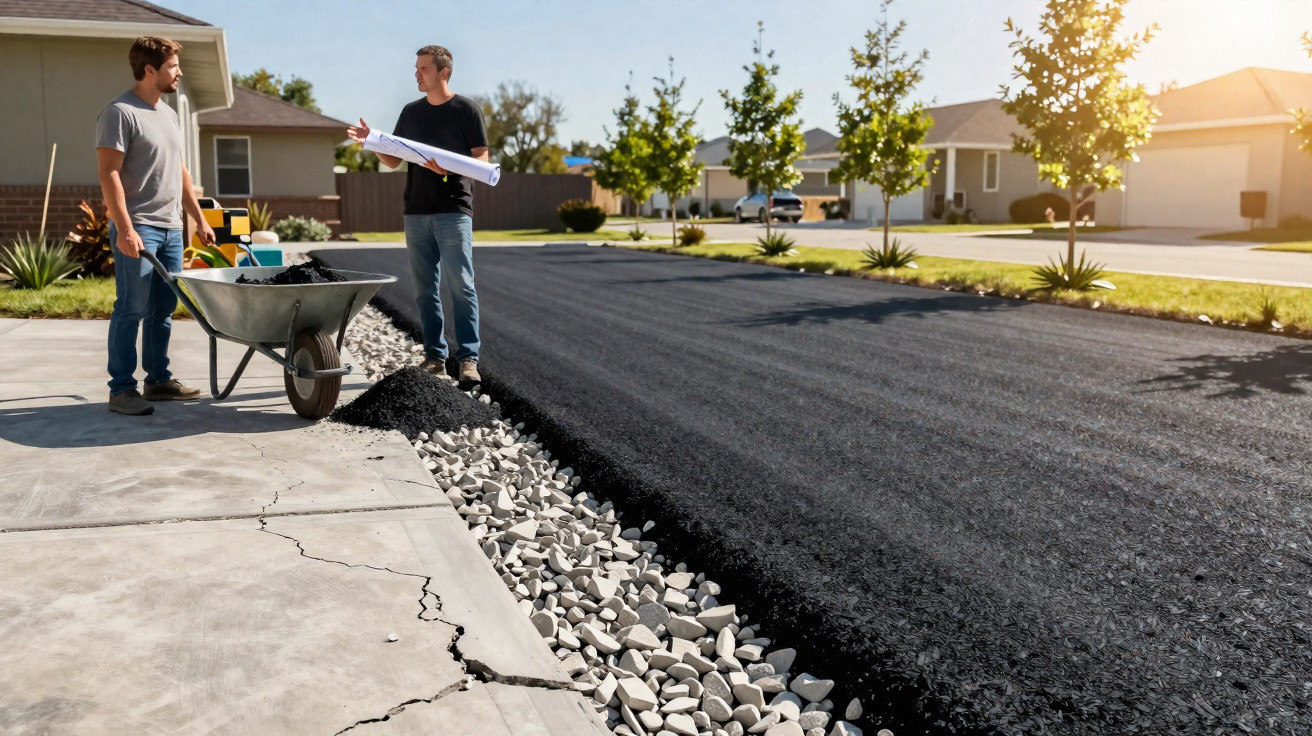
Many driveways end up looking more like a car park than part of a garden - grey, cracked and baking hot.
A cheaper, greener option is now starting to push concrete aside.
Anyone planning to refurbish a driveway often defaults to the familiar choice: a fresh grey concrete slab. It is expensive, impermeable and sold as a near-permanent fix. But rising prices, gullies overflowing during intense downpours and tighter environmental rules are making that approach look increasingly outdated. Two recycled surfacing options are quietly moving to the front: they reuse existing materials, allow rainwater to soak away and can cut costs substantially.
Why traditional concrete slabs suddenly feel outdated
For decades, concrete was seen as the safe bet: hard-wearing, supposedly low-maintenance and “built to last”. Today, two other factors matter far more - climate impact and overall cost. Cement, concrete’s key ingredient, comes with very high CO₂ emissions. Specialist sources estimate cement production accounts for just under 10% of global emissions, all for a material that is often chosen mainly because it appears practical.
There is also a second issue: sealed surfaces. Large, continuous concrete slabs stop water from soaking into the ground. During heavy rain, water runs across the surface, flooding driveways and streets and, in the worst cases, seeping into basements. Local authorities are under significant pressure from targets such as “net-zero land sealing” to reduce impermeable areas or design them more intelligently.
Concrete slabs are expensive, impermeable and carbon-intensive - and they fit less and less with today’s requirements for private plots and local councils.
Concrete is becoming trickier financially too. In some countries, a properly installed concrete driveway costs around 85 to 160 euros per square metre, including formwork, reinforcement and a labour-intensive sub-base. Then there is the risk of cracking. If the slab fails, repairs are often costly and visibly patchy - or the entire surface has to be replaced.
Recycling asphalt: a tough driveway made from old roads
One of the most compelling alternatives is recycling asphalt, known in the trade as RAP (Reclaimed Asphalt Pavement). The concept is straightforward: old road surfacing is milled off, crushed and reprocessed with binder. The result is a load-bearing, dark surface that looks very similar to a conventional asphalt driveway.
The environmental benefit is clear: rather than sending old asphalt to landfill, it goes back into the material cycle. That reduces the raw materials, energy and water that would otherwise be used to manufacture new asphalt mix. Reuse also lessens the need for new extraction from gravel pits and quarries, because less fresh aggregate has to be mined.
Durability and day-to-day practicality
Asphalt surfaces - recycling asphalt included - typically last between 15 and 30 years, depending on how they are built and how heavily they are used. They cope with temperature swings more flexibly than rigid concrete slabs. As a result, major stress cracks tend to be less common, and smaller cracks can often be repaired without tearing up the whole area.
That is appealing for domestic driveways: the surface handles car weight well, is easy to keep clean and is relatively resistant to frost. Anyone who frequently manoeuvres, or regularly parks motorhomes, trailers or delivery vehicles, benefits from the strength.
What a recycling asphalt driveway costs
On price, recycling asphalt is clearly ahead of full concrete. In many areas, professionally laid asphalt driveways (including groundworks) typically fall somewhere between 26 and 72 euros per square metre. Standard surfacing usually sits in the middle of that range, with specialist options costing more.
- Standard asphalt (hot-laid): mid-range pricing, durable and proven
- Porous asphalt: a more open-textured surface that absorbs rainwater more effectively, often starting at about 50 euros per square metre
- Plant-based binder: replaces part of the petroleum-based binder, usually up to around 20% more expensive, but with a better CO₂ balance
Compared with a high-quality concrete slab, savings of roughly a third to half are entirely possible, with similar real-world usability.
Crushed concrete: an affordable, water-permeable option for long driveways
The second alternative sounds unglamorous, yet it offers huge potential: crushed concrete. Old slabs or concrete components are fully broken up, stripped of steel reinforcement, cleaned and crushed into different grades. The finished material often contains remnants of sand, natural stone and mortar - a blend that compacts into a stable layer.
Unlike a single, continuous slab, crushed concrete forms a bed of fractured pieces with voids between them. Rainwater can drain through those gaps instead of flowing across the surface towards the road. For households in places that repeatedly see cloudbursts or overstretched drains, this can meaningfully reduce runoff.
Crushed concrete combines recycling, permeability and low cost - ideal for long driveways or areas where prestige is not the priority.
Price advantage compared with gravel and natural stone
Because it is produced from demolition concrete, the price is often well below that of new gravel or quarried stone chippings. Depending on location and supply, crushed concrete can be up to 50% cheaper. That makes it particularly attractive for long access drives, yards or parking areas where every square metre adds up.
A layered build-up is common: coarser material at the bottom, topped with a finer layer that compacts more easily. This creates a relatively even surface that remains practical to drive on.
Upkeep, everyday use and one drawback: dust
Maintenance is closer to a gravel driveway than an asphalt surface. Sweep or blow away leaves and twigs, top up any ruts with fresh material, then compact it using a vibrating plate compactor or a hand tamper - that is usually enough.
One downside remains: dust. With frequent use and higher speeds, tyres can kick up fine particles. That dust ends up on wheel arches, in garages and sometimes even in entrance halls. If that would be a nuisance, it helps to ensure the top layer is very thoroughly compacted, re-compact more often, or plan a small paved section right outside the front door.
When tackling weeds, many people reach for home remedies such as mixes of vinegar, coarse salt and washing-up liquid. Professionals warn particularly about the salt: it can sterilise soil and damage plants long-term. Using such mixtures only on fully sealed areas like asphalt or stabilised hardcore reduces the risk to nearby beds and lawns.
Which surface suits which plot?
There is no outright winner between recycling asphalt and crushed concrete. The best choice depends heavily on how the driveway is used, how it should look and what you want to spend. A few practical questions can guide the decision:
- How heavily is the driveway used? Multiple cars, regular deliveries or motorhomes usually point towards asphalt.
- How important is a tidy finish? Smooth, dark surfaces tend to look calmer and more “complete” than loose aggregate.
- How long is the driveway? On very large areas, low cost per square metre matters most - and crushed concrete tends to shine.
- How serious is surface water? If puddling and flooding are recurring issues, consider more drain-friendly options.
- What is your tolerance for noise? Gravel-like surfaces are typically louder under tyres than asphalt.
Keep legal requirements and technical details in mind
Many councils now offer points systems or incentives for unsealed or partially permeable surfaces. In some new-build areas, ideas such as rainwater management, a soakaway swale or a rainwater harvesting tank already matter more than the driveway’s appearance alone. If you are redeveloping anyway, it makes sense to incorporate such requirements from the start and avoid expensive retrofits later.
From a technical standpoint, the sub-base is critical. Whether you choose asphalt or crushed concrete, without a load-bearing, frost-resistant foundation, any driveway can turn into a constant repair job. Frost heave, settlement and potholes can be greatly reduced through proper excavation, well-compacted layers of hardcore and, where needed, a separating geotextile membrane. Cutting corners here tends to backfire quickly.
Practical examples: smart combinations for more comfort
In reality, mixed solutions are common, balancing cost, looks and comfort. For example:
- Asphalt wheel tracks with a planted centre strip: tyres run on a firm surface, while grass or ground cover in the middle adds greenery and helps water soak away.
- Crushed concrete for the long access drive, block paving by the entrance: premium materials are reserved for the areas that are most visible and most walked on.
- Porous asphalt with an adjacent rain garden: some water drains through immediately, while excess flows into a planted swale that buffers heavy rain.
Planning in this way allows very targeted spending and often creates a noticeably better microclimate in front of the house: less heat build-up in summer, fewer icy sheets in winter, and more greenery instead of a grey slab.
Key terms explained briefly
Permeable surface: A surface layer that lets rainwater soak into the ground or releases it gradually, rather than sending it all away as surface runoff.
Recycling asphalt (RAP): Reprocessed road surfacing made from milled old asphalt. After crushing and mixing with binders, it becomes new surfacing for roads, yards and driveways.
Crushed concrete: Broken-up reclaimed concrete from demolition, used as an alternative to hardcore in road and path building, for driveways, or as a base layer.
If you want to get rid of the grey concrete wasteland in front of your home, it no longer has to be an either-or choice. Recycling asphalt and crushed concrete are two readily available options that can cut costs, handle rainwater more effectively and significantly reduce the driveway’s environmental footprint - without leaving the car parked on the street.




Comments
No comments yet. Be the first to comment!
Leave a Comment