
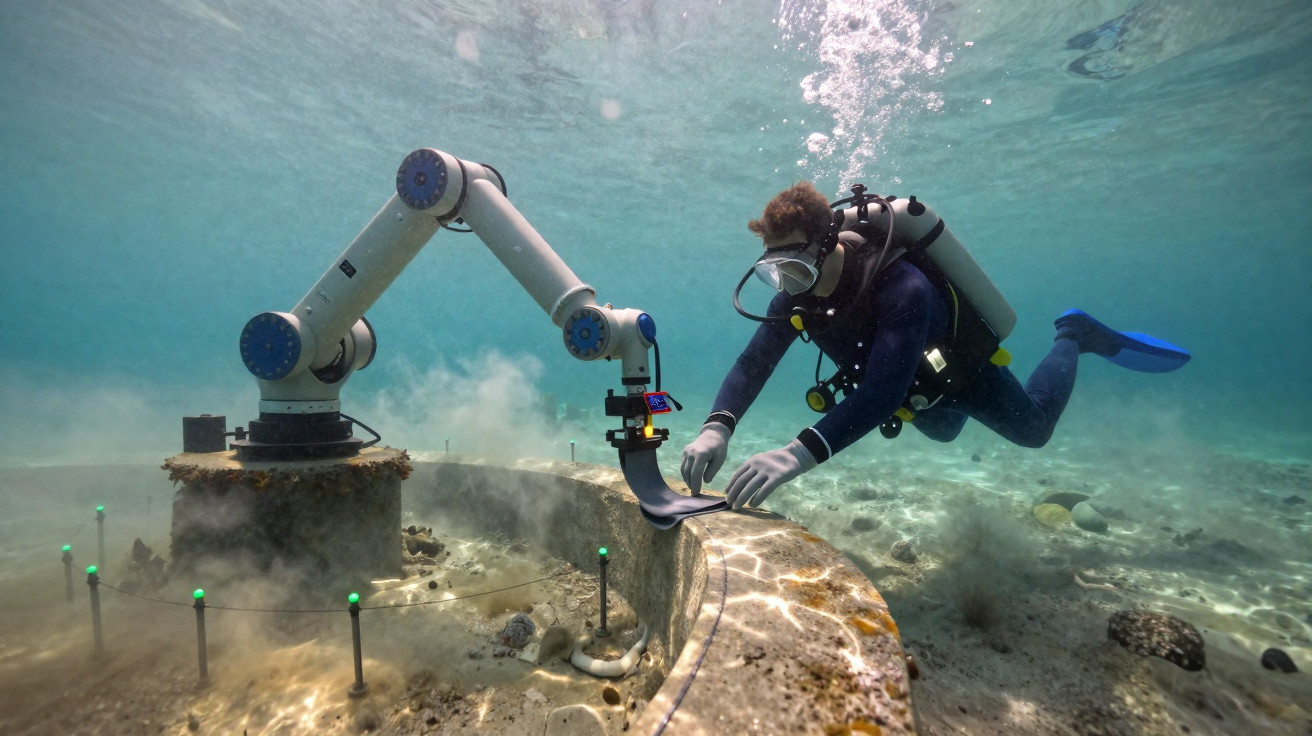
Repairing structures beneath the waterline has traditionally meant work that is time-consuming, costly, and highly disruptive. To reach and fix damaged sections, teams often rely on heavy plant, sealed work areas, and drawn-out schedules simply to restore what already exists.
Researchers are now pointing to an alternative method that could reshape how subsea jobs are carried out.
A new study reports that concrete can be 3D-printed underwater into stable, repeatable forms, suggesting a route to quicker, less intrusive repairs for ports, bridges, and pipelines.
Testing underwater 3D concrete printing
In a submerged testing tank, the earliest printed arches held their profile while fresh layers were added on top.
Building on those initial trials, a Cornell University team demonstrated that the mix could be placed underwater without slumping into the surrounding water.
The advance followed modifications to a large concrete-printing robot so it could operate while continuously exposed to water rather than relying on dry, controlled conditions.
Once basic shape retention was achieved, the tougher problem was still ahead: making sure each deposited layer arrived accurately and fused well enough to withstand real structural loads.
Why 3D printing underwater is hard
Uncured concrete is most vulnerable when it is still soft and its particles have not yet locked together-and water attacks at exactly that point.
Engineers refer to the resulting failure as washout: water can pull cement away before it binds, with degradation starting almost as soon as printing begins.
“When you add those chemicals, it makes your mixture really viscous, and you can’t pump,” said the study’s co-author, Dr. Sriramya Nair, an assistant professor of civil and environmental engineering at Cornell University.
So any workable mix needed to travel smoothly through hoses, then stiffen quickly enough to prevent stacked layers from sagging and separating.
Seafloor sediment changes everything
The Defence Advanced Research Projects Agency (DARPA) increased the challenge by insisting the mixture be made largely from seafloor sediment.
The rationale was practical: using local material could cut shipping demands and reduce disruption, replacing barge deliveries that would otherwise be required on site.
Treating the seabed as a feedstock also altered the underlying science, because grain size, salt levels, and organic content all influence print performance.
Those shifting conditions turned a logistics advantage into a formulation challenge, and that is why the printing system itself needed to adapt.
Control at the final moment
A recent paper outlined a two-stage printing setup that keeps the mix pumpable inside the hose and then alters it at the nozzle.
This last-instant control is crucial because underwater concrete must satisfy opposing requirements: it has to pump easily before placement, yet gain shape rapidly immediately afterwards.
By producing overhanging samples both in air and underwater, the team showed that on-demand adjustments can address issues that older approaches struggled to resolve.
That kind of control also helps explain why Cornell’s method may be more scalable than relying on aggressive chemistry alone, which leads directly to the role of sensing.
Sensors solve murky conditions
As soon as bottom sediment is disturbed, visibility can fail rapidly, turning a precise print into guesswork in seconds.
Researchers describe this clouding as turbidity-water loaded with suspended particles-which can conceal defects long before anyone at the surface is aware.
A 2026 review argued that underwater printing succeeds only when material behaviour and robotic control are engineered as a single system.
For Cornell, that meant integrating sensors into the robot arm so the machine could adjust its path without needing to send divers down.
Where underwater printing fits
The potential applications are concrete rather than theoretical: pier footings, damaged supports, seawall repairs, and other structures that are difficult to access.
In DARPA’s framing, underwater printing is a way to support bridge repair and coastal reinforcement built at the point of need.
On projects like these, in-place construction could eliminate cofferdams, barges, and repeated lifting operations that often consume much of the programme.
Even so, the most straightforward early uses are likely to be repairs and smaller builds, rather than massive tunnels or full seafloor foundations.
Building directly underwater
On-site printing changes the equation because teams can place only what is required, precisely where the design specifies.
A 2024 comparison found that water ingress strongly influences how well printed layers adhere, making placement accuracy critical.
“We want to be constructing without being disruptive,” said Dr. Nair, describing the appeal of deploying a remotely operated vehicle rather than large teams.
Her point was practical rather than futuristic: reducing the amount of equipment above the surface can lessen disturbance at the work site.
Limits of underwater printing
Open water is far less forgiving than a test tank, with currents, waves, pressure, and uneven seabeds all pushing conditions away from the ideal.
A 2025 analysis reported that concrete printed in seawater can come close to in-air strength, although layer performance still fluctuates.
Durability over the long term remains unresolved, because salt, abrasion, and repeated loading could exploit weak interfaces long after printing is complete.
Until these questions are proven beyond controlled tanks, underwater printing remains an encouraging infrastructure technology rather than routine construction practice.
How deadlines shape innovation
Cornell’s effort progressed under a one-year, $1.4 million DARPA grant, with five competing teams pursuing the same targets.
In the Bovay lab, researchers carried out multiple underwater prints each week, using rapid feedback to tune chemistry, hardware, and control together.
Architecture, robotics, materials science, and civil engineering all had to advance in step, or the overall system would stall.
That compressed schedule fuels both enthusiasm and caution: progress accelerates because weaknesses are revealed quickly.
At the same time, Cornell has demonstrated not only that concrete can be printed underwater, but also that material formulation and machine feedback can be coordinated under those conditions.
If the next stages confirm durability in real marine environments, underwater 3D-printed concrete could shift from an impressive demonstration to a regular tool for repairs.



Comments
No comments yet. Be the first to comment!
Leave a Comment