
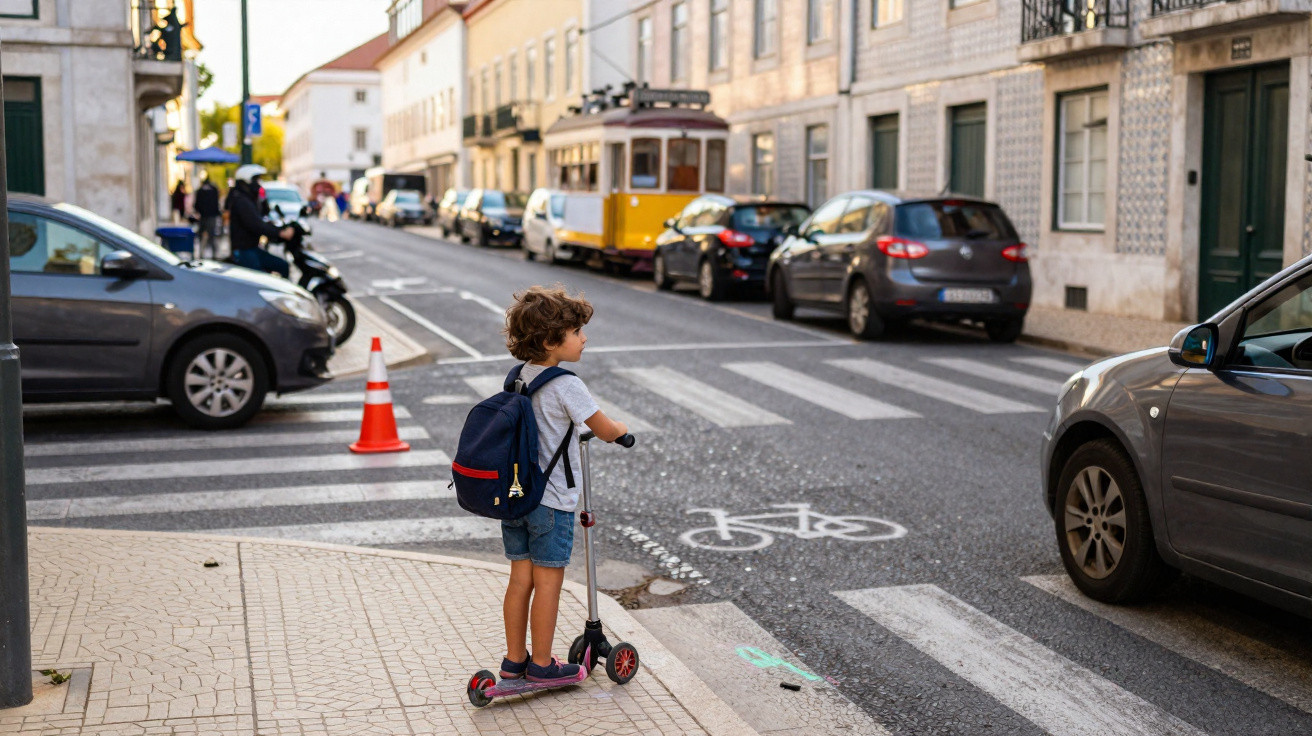
The environmental association Zero has released a study assessing children’s urban mobility across 36 European cities, and the findings are discouraging for Lisbon: Portugal’s capital comes second from bottom in the ranking. Only Sofia, in Bulgaria, performs worse.
Commissioned under the Clean Cities Campaign initiative, the study reviewed three key indicators: the availability of “school streets” (where traffic is removed or restricted near schools), the share of streets with a 30 km/h speed limit, and the provision of segregated, protected cycle lanes.
Lisbon’s results in the Clean Cities Campaign ranking
For Lisbon, the picture is far from positive. The city has no school streets at all, only 5.1% of roads have a 30 km/h limit, and just 6% of streets are fitted with protected cycle lanes.
Paris leads the way
By contrast, Paris tops the ranking, with Amsterdam (Netherlands) in second place, followed by Antwerp and Brussels (Belgium), Lyon (France), and Helsinki (Finland). These cities score strongly because they have introduced substantial measures to improve children’s mobility, including creating school streets and extending protected cycle-lane networks.
Zero notes that cities that put children at the centre of policy choices are typically more inclusive and safer for everyone. On that basis, the association is urging Lisbon’s authorities to implement steps that support children’s active and safe travel.
At present, most children in Lisbon travel to school by car, accounting for 43.9% of school journeys. Only 27.6% walk or cycle, while 25.7% use public transport. These figures remained virtually unchanged between 2019 and 2023.
Simple measures can make a difference
The study also emphasises that rolling out school streets, lowering speed limits, and building protected cycle lanes are three practical strands of action that can significantly reshape children’s urban mobility. Beyond supporting children’s health and independence, these measures can also improve air quality and cut motor traffic.
The environmental association adds that cities such as Paris and London achieved rapid improvements through political leadership and community involvement. Lisbon, it argues, has the potential to follow the same route-becoming safer and more accessible for children and, as a result, for all residents.



Comments
No comments yet. Be the first to comment!
Leave a Comment