
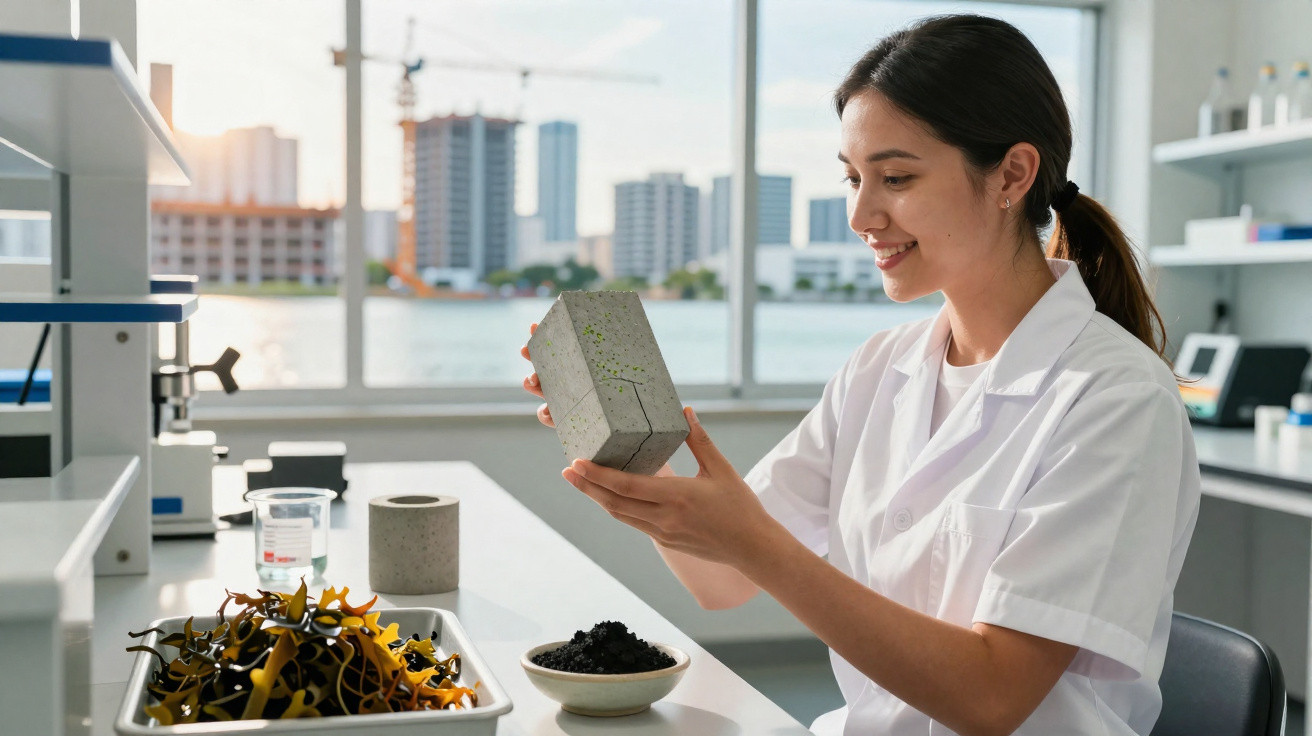
Researchers say seaweed can be processed into a concrete additive that substitutes for a portion of cement, while also locking in additional carbon as the mix cures.
If confirmed at scale, the discovery would turn a familiar coastal crop into a practical tool for cutting concrete pollution even before a structure is completed.
Seaweed powder into wet cement
In the trial batches, the algae started life in hatchery tanks and finished as a dark, fine powder dispersed through freshly mixed cement.
At the University of Miami, civil engineering professor Ali Ghahremaninezhad oversaw adjustments designed to allow a higher cement replacement rate without undermining the work’s main goal.
That goal required more than tipping algae into a mixer, because untreated material can disrupt setting behaviour and weaken the concrete’s internal bonding.
Those steps raise the key issue that follows throughout the piece: can a lower-emissions formulation still perform like the concrete people already rely on?
From algae to biochar
UM’s hatchery on Virginia Key, a barrier island near Miami, cultivates the native algae used for these experiments.
After collection, the algae is converted into biochar - a charcoal-like carbon material - by heating it in low-oxygen conditions so that most gases are driven off.
The resulting porous structure can retain water and create extra surfaces where cement products can form, which is why the treatment process is so important.
At that point, the work becomes less about seaweed as a novelty and more about materials engineering.
Cement and carbon emissions
The bulk of concrete’s climate impact comes from cement, and cement production is responsible for roughly 7 to 8 per cent of global carbon emissions.
Carbon is released both through the fuels burned to run hot kilns and through limestone that chemically breaks down under extreme heat.
Each bag of cement removed from a recipe reduces emissions before a building has even begun its working life.
Because concrete is used at vast scale, even modest changes to the mix design can quickly translate into large overall reductions.
Making more replacement
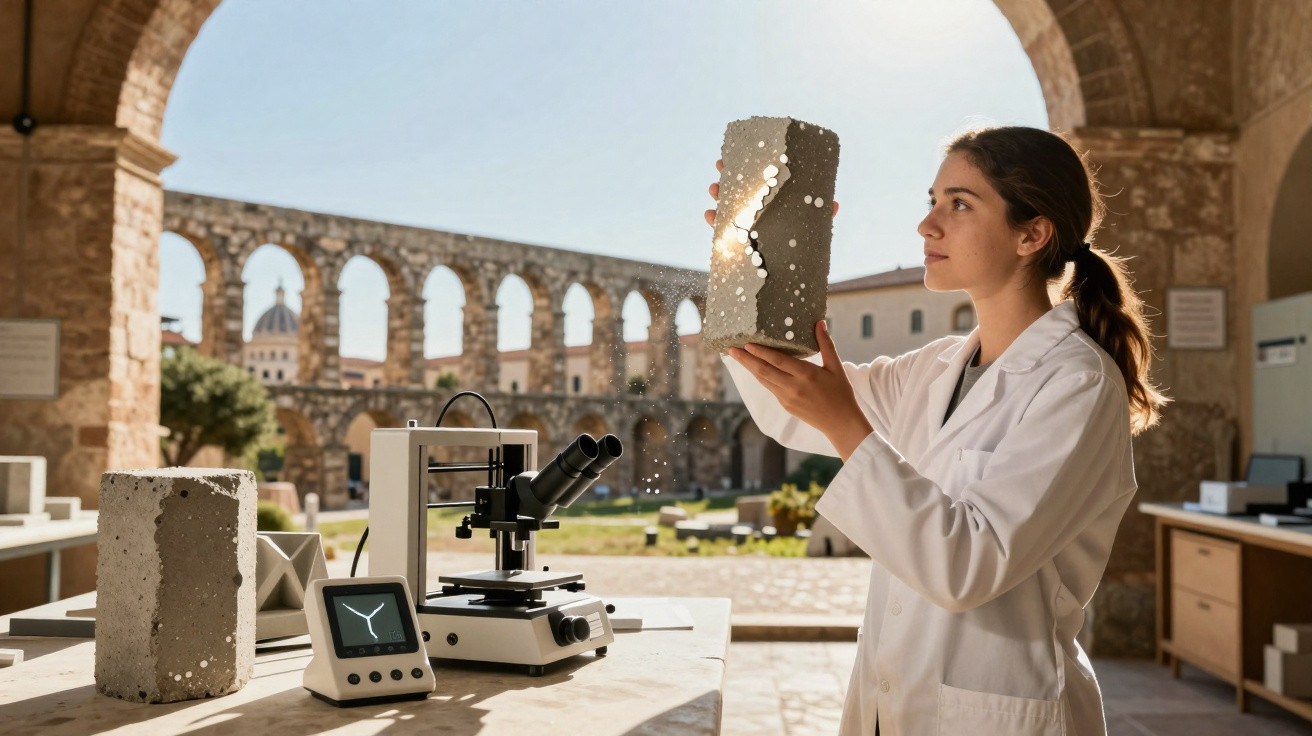
Previous biochar experiments in the same laboratory suggested the amount added can either improve crack healing or, if misapplied, lower strength.
That trade-off helps explain why the Miami team treats the algae char before mixing, rather than simply increasing the dosage.
In separate research on algal biochar, a 30 per cent cement replacement reached comparable strength after several weeks.
Those findings are not a guarantee for this project, but they indicate algae-derived carbon can function as something more valuable than a waste by-product.
Locking carbon inside
The group also applies carbon curing, in which fresh concrete is exposed to concentrated carbon dioxide while it hardens.
The gas reacts with calcium-rich components to create stable minerals, meaning the carbon is fixed into the solid material instead of remaining in the atmosphere.
One recent method retained up to 45 per cent of injected carbon dioxide without reducing concrete strength.
Miami’s approach is to combine that carbon-storage step with reduced cement content, cutting emissions from two directions at the same time.
Seaweed, cement, and Florida
Florida provides a demanding test environment, where salt, heat, humidity and storms can quickly degrade standard concrete.
Any low-carbon alternative has to maintain strength, limit cracking and avoid creating straightforward routes for water ingress and corrosion.
That regional reality is why durability is a central focus, not just a smaller carbon footprint.
If a coastal structure fails early, any climate gains are eroded by repairs, replacements and the need for additional cement.
Award and momentum
The work secured backing after UM researchers presented it at Climate Correction in Orlando in March 2026.
A $25,000 grant will fund equipment intended to give the team more precise control over how the biochar is produced.
“Look at the problems happening in your community and look across disciplines and think creatively,” said Rodriguez.
That emphasis matters here, because progress depends on marine science, materials engineering and construction aligning behind the same solution.
What could scale
Algae may offer what concrete producers urgently need: a local feedstock that is not dependent on dwindling industrial waste streams.
When the raw material can be grown nearby, transport distances fall and supply becomes less tied to sources such as coal plants or steel mills.
“A lot of the solutions that we’ve derived came from things that are right around us,” Rodriguez said.
Even so, scaling up this kind of mix will hinge on consistent quality, affordable production and standards that builders and regulators can rely on.
Limits before launch
It has not yet been demonstrated that algae-based concrete can move from laboratory cylinders to highways, towers and bridges without major changes.
Long-term durability, corrosion behaviour, curing time and cost will determine whether the concept remains niche or becomes mainstream.
Because the treatment stages add complexity, the emissions reduction must outweigh the energy use and expense required to carry them out.
Those uncertainties are typical at this point, and they help explain why even promising concrete recipes often take years to become widely adopted.
What comes next
Miami’s work illustrates how a single approach could serve two functions: replacing a high-emissions ingredient and capturing extra carbon.
Whether algae concrete reaches construction sites soon or not, it has already shifted where engineers are looking for improved cement alternatives.


Comments
No comments yet. Be the first to comment!
Leave a Comment