
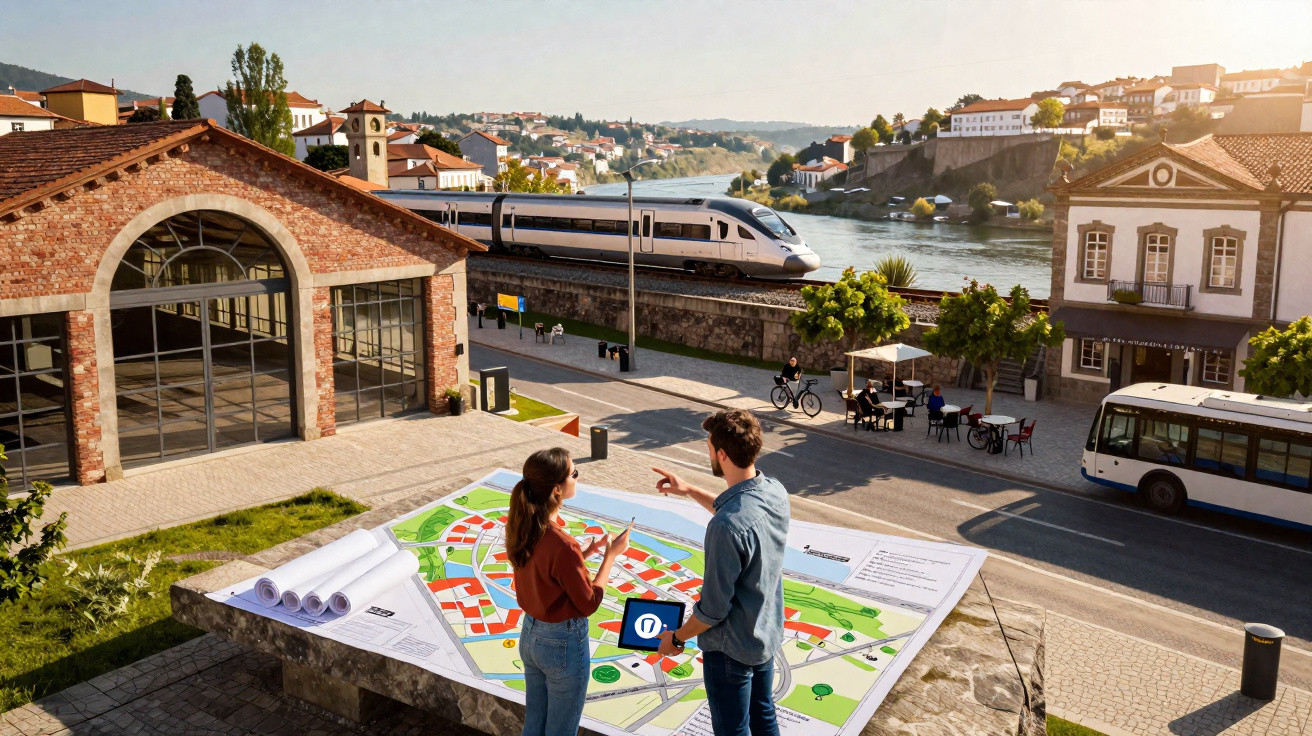
Valença Town Hall already has a plan to breathe new life into the city centre, combining the restoration of landmark buildings with the creation of new urban hubs.
The planned construction of a high-speed rail (TGV) station on the Porto–Vigo line in Valença is expected to change the pace of life in this border city. In anticipation, the municipality is preparing to reshape its urban heart over the coming years by giving new purposes to older buildings and putting in place conditions for more sustainable mobility.
That is the vision set out by Mayor José Manuel Carpinteira, who on Friday presented the Masterplan – Plano Estratégico do Centro Urbano de Valença, designed to “create a new centre outside the fortress” and to offer “a vision of a city of the future, more high-quality and better organised”.
Valença Masterplan: reorganising the urban centre
According to the mayor, the future TGV station was not included in the plan developed by the Carvalho Araújo architecture and design studio because the final location has not yet been confirmed. Along the future route, stations are planned for Porto, Braga, Ponte de Lima and Valença.
Location under study
“At the moment, there are two locations under consideration, in the parish of Gandra: one further upstream from the industrial estate and another between the industrial estate and National Road 13. We don’t know which one will be approved, and only once that location is decided will we understand it fully, but it will clearly generate a lot of momentum there-both in terms of access and in urban planning,” he said.
He argued the infrastructure “will be important, because between Porto, Braga and Vigo, Valença is on the map”, and he expressed the hope that the project will be delivered as soon as possible.
“From the outset, both the Portuguese and the Spanish governments have guaranteed that the Valença station will be built. It’s already slipping-it's not 2030, as they used to say; people are now talking about 2033-but the important thing is to start the work,” he commented.
Railway-area projects: museum, parking and freed-up public space
One of the projects included in the Masterplan is the reuse of a vacant building next to the current railway station to create a Railway Museum. The plan also proposes clearing the area that is currently used for parking and, alongside the tracks, building a two-storey parking structure.
In the mayor’s words, the plan aims to “reduce the impact of car use” by providing “more parking spaces, walking routes and cycle routes”, while also delivering “new urban hubs”.
“We’re making use of the acquisition of the former Colégio Português [near the current station] to create a new centre from there. We also had other buildings that needed urban reorganisation-the municipal market and the [former] customs house-as well as the riverside area,” he said.
He stressed that “many millions” will be required to carry out the planned interventions, but added that, for now, “there is no financial plan”. “We will move forward with the individual design project for each of the buildings that were presented, and only then will we have a figure close to what will be needed for those investments,” he explained.
Colégio and former customs house will take on new roles
According to José Carpinteira, restoring the emblematic Antigo Colégio Português, on the city’s main avenue, “is the top priority”. It will bring together three functions: municipal services, an Intercultural Forum and training workshops.
“We’re going to launch a tender straight away for the architectural design, and from there we’ll see how it develops, because it will be a major investment,” he said, adding that on-site work is likely to progress sooner on the former customs house building next to the iron bridge.
“We already have a project and funding, so that will probably be the first to move forward,” he noted. He said the building will house a creative incubator, facilities to welcome Santiago pilgrims, and spaces for cultural activities-one of which will be dedicated to the Galician–Portuguese project “Ponte...nas Ondas!”
Comments
No comments yet. Be the first to comment!
Leave a Comment