
You reach for the salt and realise it is on the other side of the room. You sidestep the bin, pull open the wrong drawer and knock your hip against the worktop. By the time you have found it, the onions have already gone too dark. The recipe was straightforward; the kitchen layout was not.
In small kitchens, it is easy to fall for attractive jars, stylish racks and the urge to make everything look “Pinterest-ready”. But then real life arrives at 7.38 p.m. on a Tuesday: you are hungry, short on patience and trying to get dinner done. Suddenly, those supposedly clever storage ideas start to feel like barriers.
Professional chefs understand this kind of chaos. They simply refuse to work with it. And there is one modest organising habit they consistently identify as quietly adding time to cooking, evening after evening.
The small habit that quietly disrupts your cooking flow
Ask several chefs what slows home cooks down most, and they will give the same answer: putting ingredients and tools where they look attractive rather than where your hands instinctively reach. In a compact kitchen, each unnecessary step is amplified. Opening the wrong drawer ten times during one meal soon turns cooking into an obstacle course.
The biggest drain on time is not limited storage. It is a kitchen arranged for photographs instead of movement. Salt on an ornamental shelf, oil in a cupboard beneath the oven, knives three steps from the chopping board because “the knife block looks better there”.
It may look aesthetic on screen. On a busy weekday evening, it is a subtle form of sabotage.
Chefs use the opposing principle, known as “mise en place thinking”. In a restaurant kitchen, everything required for a task is kept within arm’s reach of the place where that task is done. Home kitchens, particularly smaller ones, often reverse that approach. We distribute items around the room to make it seem larger or tidier.
One chef I spoke to laughed as he described visiting a friend with a studio flat kitchen in London. She said she “hated cooking here” because every meal took so long. Her spatulas were stored in a drawer below the microwave. Her chopping boards sat in a vertical rack… under the sink… behind the bin bags.
“Watch,” the chef said. He timed her while she made a basic omelette. Of a 12-minute process, five minutes were spent bending down, opening cupboards, looking for items and shutting them again. No chopping. No stirring. Just searching. After he reorganised three drawers and a shelf, she made the same dish in half the time. Same hob. Same pan. Better flow.
These tiny delays mount up, particularly when a small space gives you no room to spread out. A 2023 YouGov survey in the UK found that more than 60% of people who dislike cooking say it “feels messy and stressful.” That is not solely about splashes and spills. It is friction. Each time you stop to wonder, “Where did I put that again?”, your mind shifts out of cooking mode and into problem-solving mode.
From a chef’s perspective, attention is the costliest thing in any kitchen. Not an expensive knife. Not a non-stick pan. It is the mental focus constantly lost because the layout keeps posing small questions:
Where are the tongs? Why is the colander in that cupboard? Why is the chopping board nowhere near the knife?
In a small kitchen, that mental burden is punishing. There are no spare work surfaces for temporarily placing things, and no space for three extra bowls. Your kitchen either functions like a compact cockpit… or feels turbulent every evening.
How chefs organise small kitchens, even cramped ones
Professional chefs begin with one straightforward principle: organise by task rather than category. At home, we tend to prefer “all spices together”, “all utensils together” and “all plates together”. In a tiny kitchen, that is what has you pacing in circles. Chefs approach it differently: one zone = one job.
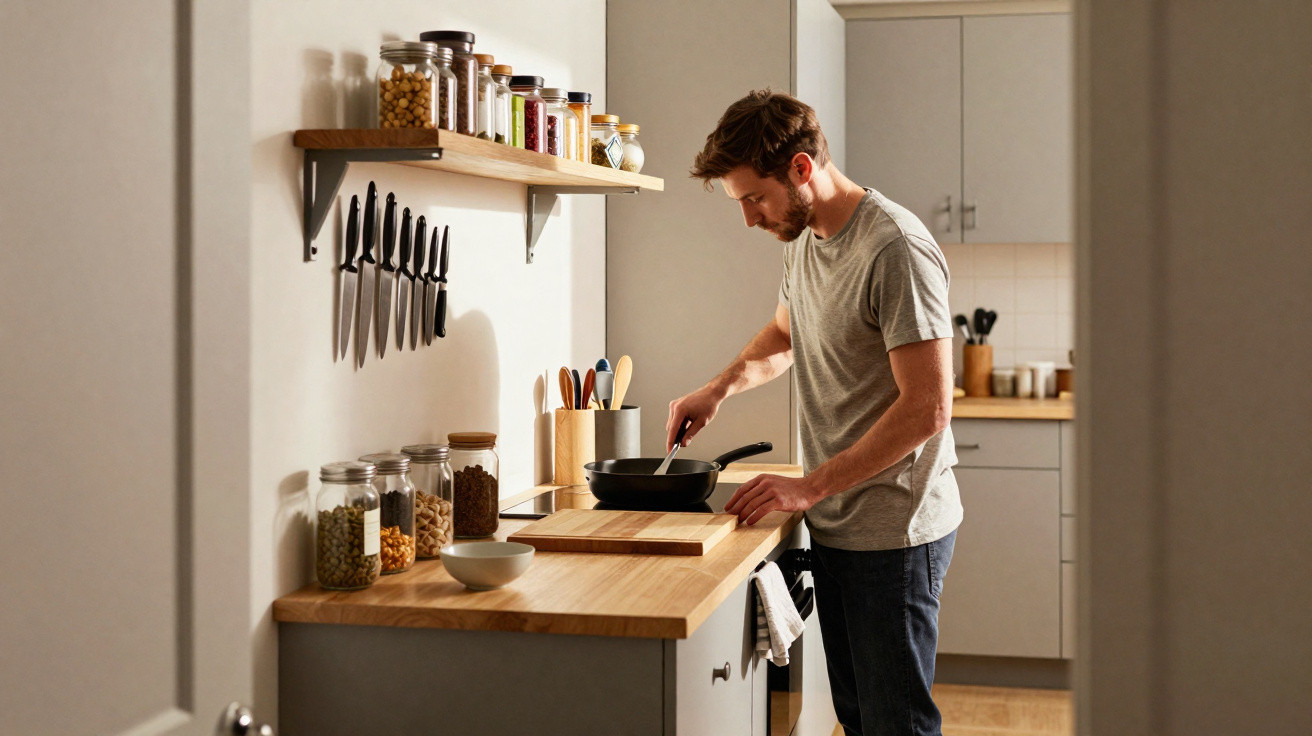
Even a very small kitchen can have three core zones: preparation, cooking and clean-up. Attach the right equipment to each zone as if by magnets. Knives, chopping boards, a peeler and a small bowl or bin for peelings should all stay in the prep zone, rather than being scattered around the kitchen.
Salt, pepper, oil, a wooden spoon, tongs and a spatula belong in the cooking zone by the hob, not in three separate locations. Washing-up liquid, a sponge and brushes should be beside the sink, rather than beneath an already packed worktop. This is where design Instagram gives way to common sense and gravity.
Many of us also fail to make proper use of vertical space. Chefs do not. They might fix a magnetic strip to the wall for knives, install a rail for ladles and spatulas, or keep a small caddy beside the hob holding the three items they use every time: fat, salt and a tool for managing heat. It is not “minimalist”. It is practical.
There is an emotional dimension too. After a long day, your kitchen either welcomes you like a friend or confronts you like another administrative task. When the chopping board is always in the same place, your favourite knife hangs above it and the salt is immediately to hand, your shoulders genuinely ease a little. You move from “Where is…” to “What if I added…”. That is the transition from stressed cooking to proper cooking.
Let us be honest: nobody does this perfectly every day, not even professionals. Yet even a 70% chef-style layout in a compact home kitchen can transform the experience.
One chef I interviewed cooks in a Paris flat so small that he can touch both walls at once. He had one uncompromising rule: “If I use it every day, it cannot be in a drawer.” His cooking zone appeared almost empty… but every essential was within touching distance. Oil and vinegar sat in small bottles on a slim shelf. Two favourite pans were stacked tidily. There was one wooden spoon, rather than seven.
He said his biggest time saving came from one change: relocating the bin and compost container to the prep zone. Previously, he crossed the kitchen with wet hands 15 times while making dinner. Afterwards, he could scrape scraps directly from board to bin. “I didn’t need more space,” he said. “I needed fewer trips.”
That idea resonates throughout small kitchens: fewer trips. Less to-and-fro. Less stooping to reach the colander hidden behind baking trays. When you arrange things by job rather than category, your body follows short, familiar routes. No choreographed routine: simply reach, chop, stir.
Most of us have experienced a simple recipe turning into a 45-minute ordeal because we repeatedly had to stop and locate something. It seldom seems as though organisation is to blame. Instead, you blame the recipe, your tiredness or the size of the worktop. But take a closer look: the main culprit is often sitting in your drawers.
Small changes that cut minutes from every meal
Chefs suggest an easy first move: choose your primary cooking position and create a “golden circle” around it. Stand at the hob with your eyes shut. Picture yourself reaching for salt, oil, your preferred spatula, a tasting spoon and a pan. Everything you need at that point should be kept in a semicircle around the hob.
This may require giving up a decorative plant or a lovely but seldom-used utensil pot. You might need to bring spices nearer and move wine glasses further away. The rule is simple: anything used every time you cook should be no more than one step from where you cook.
That adjustment alone can eliminate dozens of tiny movements during one meal. It does not look dramatic, but the difference feels dramatic.
The next move is to set up an obvious prep station. Choose one clear, flat area where the chopping board can always remain. Store your knife, peeler and tea towel directly underneath or alongside it. Nothing else belongs there: not coffee pods, not the electric whisk, only the things you use whenever you slice food.
A common mistake is treating every work surface as “flexible”. The chopping board then moves about: here one day, there the next. Knives do the same. This is how time slips away through decisions. “Where should I chop?” is one more small question your brain does not need to answer at 8 p.m.
When chefs refer to mise en place, they are not only talking about small bowls arranged for television. They mean cutting down decisions. Fewer questions. More automatic movement. In a small kitchen, a permanent chopping area is like a runway: clear, unmistakable and always available.
One chef I spoke with put it bluntly:
“Home cooks think they’re slow because they’re not skilled. Most of the time, they’re slow because their kitchen keeps getting in their way.”
He recommended a 20-minute “friction audit”, suitable even for the narrowest galley kitchen. Make a regular weekday meal and, every time you must leave your main position, mentally note why. Was there no bin nearby? Was your knife stored in another drawer? Were your spices buried three rows back?
- Bring spices used each week to the front row or put them on a rail by the hob.
- Give the chopping board a permanent home.
- Hang or secure your main knife to a magnetic strip within sight of the prep zone.
- Keep the bin or compost container within arm’s reach of where you chop.
- Move rarely used gadgets to the top shelf or into a box outside the kitchen.
That final suggestion can sting slightly. We become attached to equipment and to the belief that we will eventually use the juicer, ravioli press or oversized blender. But small kitchens are ruthlessly honest. If something is not helping you three evenings a week, it is occupying space that could serve something else.
A small kitchen that works like a larger one
A quiet confidence emerges once your kitchen stops working against you. You open the right drawer straight away. Your hand finds precisely the tool you intended to pick up. Your body learns the routes: this is where I chop, this is where I stir, this is where I discard peelings and trimmings.
You begin to notice different possibilities. Rather than “Where is the garlic press?”, you think, “What if I toasted the spices first?” Instead of “Where did I leave the colander?”, you consider, “I could probably make twice as much and have leftovers.” Space starts to clear in your head, not only on the worktop.
In this respect, professional chefs are not fixated on tidiness. They are focused on flow. They will tolerate a stained wooden spoon, mismatched containers and a cluttered fridge door… provided the route from idea to plate remains short and easy. A small home kitchen can adopt that outlook without becoming a restaurant.
You do not need stainless-steel worktops or a suspended rack of copper pans. You need everyday tools stored in slightly less conventional ways: by task, frequency and reach. Stop “organising for the photo” and start organising for the fifteen minutes between hunger and dinner.
The true test is a bad day: when you are exhausted, irritable, scrolling on your phone with one hand and stirring with the other. That is when an effective layout quietly rescues you. Fewer searches. Fewer sighs. Fewer burnt onions while you look for the lid.
A small kitchen will never feel exactly like a professional line. But it can become a place where you move with some of the same calm certainty. Where “What’s for dinner?” does not prompt dread, but a mental picture of your hand reaching for a knife exactly where you left it and a board already waiting.
| Key point | Detail | Benefit for the reader |
|---|---|---|
| Organise by task | Create dedicated zones for preparation, cooking and cleaning, with the relevant tools within easy reach. | Reduces unnecessary movement and time spent looking for items. |
| Reduce “back and forth” | Keep salt, oil, utensils and the bin/compost container close to the areas where they are used. | Makes cooking smoother while reducing stress and mistakes. |
| Prioritise actual use | Keep only items used every week within reach, and move everything else away from the kitchen’s core working area. | Frees up space in a small kitchen without major work or expense. |
FAQ:
- What is the single biggest time-wasting habit in a small kitchen? Storing tools and ingredients where they look good instead of where you actually use them. That “pretty” layout forces constant extra steps.
- How can I fix my layout if my kitchen is really tiny? Create clear zones: one stable prep spot, one stove zone, one sink zone. Then move your most-used items into arm’s reach of each zone, even if that means your space looks a bit less styled.
- Do I need to buy organisers or fancy racks? No. Start by moving things: swap cupboard contents, hang one rail or magnetic strip if possible, and exile rarely used gadgets. The biggest gains come from placement, not products.
- What should always stay out on the worktop? Anything you touch almost every time you cook: your main knife, chopping board, salt, oil, and one or two heat-safe utensils. Everything else can rotate or be stored.
- How long does it take to feel a difference? Most people feel it in the very next meal. Once your “golden circle” around the stove and a fixed prep zone are in place, everyday recipes start moving noticeably faster.
Comments
No comments yet. Be the first to comment!
Leave a Comment