
The sound arrives before the sight: a dry metallic rattle echoing from the kitchen drawer.
You open it carefully and find the familiar chaos - screwdrivers tangled with loose screws, electrical tape pressed against an old roll of sticky tape, stray batteries that nobody knows whether they still work. At the very back, the tip of a pair of pliers seems to look back at you, slightly embarrassed. You are hunting for one tiny item, a particular small nail, and feel time slipping through your fingers. Improvisation becomes the norm, and the mess starts to feel “normal”. Until one day you realise it is not really about tools: it is about how your home responds when you need it. What if a simple method could change everything?
Why small tools disappear from our lives - and our memories
Small household tools have a remarkable ability to vanish. The Allen key from the shelving unit, a hinge screw, wall plugs for the drill: they arrive in perfectly arranged kits, then seem to dissolve within a few months. We promise ourselves we will “put them somewhere safe”, toss everything into a random little box and, just like that, create a future problem. Oddly, almost no one thinks about organising at the point when they are assembling furniture or replacing a socket. Yet that quiet second of laziness creates ten minutes of frustration later on. Even so, we repeat the same pattern.
We have all been there: the cupboard door starts sagging and you know precisely what is missing - one small, particular screw that originally came in a plastic bag. You remember holding that bag months earlier. You may even remember the sound it made. What you cannot remember is where it ended up. You go to the utility room, open a box marked “general bits”, then a drawer, then an old biscuit tin. Eventually, you give up, buy another kit, use two pieces and throw the rest in “with the tool things”. The cycle starts again, like a repeated television serial.
There is a less romantic explanation for this chronic disappearing act: the human brain dislikes vague categories. When you think of “tools”, you picture a hammer, pliers and a drill. You do not picture M4 washers, 6 mm wall plugs or electrical terminals. Without a clear category, they become drawer-bottom clutter. The house conspires too: flimsy packaging, bags that tear and boxes far too large for tiny items. Without a straightforward physical and visual system, your mind switches into “memory game” mode whenever you need something. And memory games are tiring.
The simple method for small tools: one box, clear dividers and a visual map
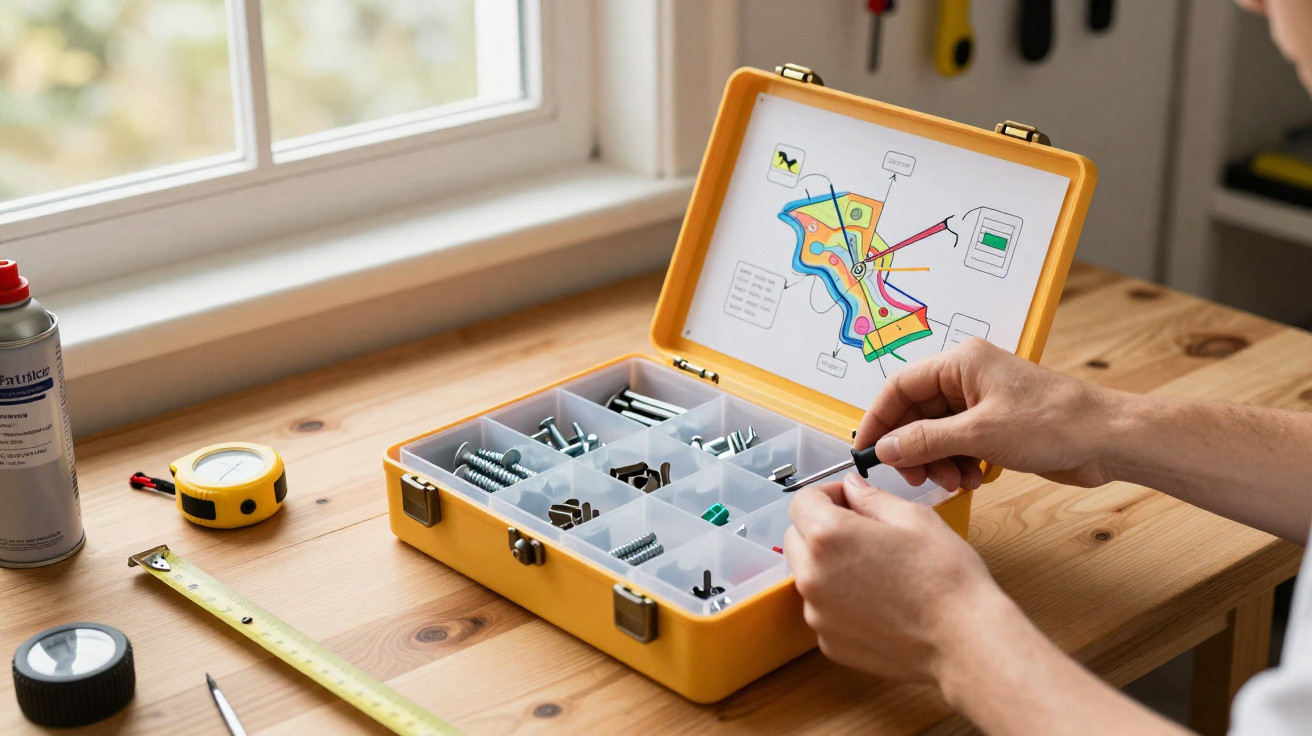
The most effective method I have found in real homes begins with an almost childishly simple choice: one main box or tray with dividers. It does not need to be expensive or Instagram-worthy. It could be a tool case, a compartment organiser or even a drawer with reused pots. The important thing is not appearance but logic: each kind of small item gets a permanent place. Screws in one section, wall plugs in another, Allen keys somewhere else. Once every category has a “home”, the clutter starts to lose ground.
It works even better when the box itself communicates with you. Simple handwritten labels can work wonders: “wood screws”, “wall plugs”, “electrical”, “assembled furniture”. Suddenly, your brain no longer has to guess. It simply looks and recognises what it needs. Empty spice jars, small sweet tubs or vitamin containers can all be used. If there are children in the house, you have extra materials available: broken toy boxes make excellent dividers. Opening the box and seeing everything quietly sitting in its own section feels almost childlike.
Let us be honest: nobody does this every day. Organising tools is not a daily habit; it is a quick ritual at useful moments. This simple method succeeds because it has one rule, almost brutally straightforward: every small household item that is difficult to find goes into the same box, divided into broad categories. There is no need to create complicated systems with twelve layers of labels or impossible colour codes. The simpler it is, the better it withstands tiredness, rush and the thought of “I’ll sort it later”. Your home needs to cope with you on your worst day, not your best one.
How to put the simple method into practice in 30 minutes - without drama
The action that changes everything is very practical: take a box, gather a handful of smaller containers and decide that, from now on, it will be the main archive for small tools. Put the box on the table, empty drawers, search through jars and face the limbo of accumulated “tool bits”. You do not need to sort every screw by millimetre; simply arrange them into families: metal items, wall fixings, electrical parts and furniture pieces. Write quick labels, even if they are a little crooked, and stick them on with tape. All at once, that shapeless mixture gains physical and visual definition.
A powerful trick is to set one silly, almost childish rule: whenever you finish assembling something, any bag containing leftover pieces goes straight into this box, with no stop in between. It prevents the usual fate of orphaned packets, which is to move from one corner of the home to another until they disappear. When you feel too tired to bother, remember this: ten seconds of action versus half an hour of exhausted searching on a Saturday afternoon. If you want to take it a little further, attach a sheet of simple notes inside the lid: “bed Allen key – right-hand corner”, “shelving unit parts – red pot”. It becomes a domestic treasure map.
“What really works is not the perfect box, but the decision to have one single place for small things that are difficult to find.”
- One central box: Choose a fixed place in the home for this box, preferably near the utility area or kitchen, where problems tend to begin.
- Reused dividers: Use pots, packaging, empty medicine boxes or similar containers to separate simple categories without overdoing the detail.
- The leftovers rule: Every small piece left over from assembly, repairs or DIY work goes directly into this box, even when you are tired.
- A map on the lid: A sheet with a few specific notes prevents a treasure hunt and saves your memory six months from now.
- An occasional review: Every few months, spend ten minutes throwing away the obviously useless items and putting back anything that has moved out of place.
When your home works with you, the day feels lighter
Organising small tools may seem like a technical detail, something only highly methodical people would care about. In reality, it affects a much more human part of everyday life. It is the Saturday when a shelf comes loose and you fix it in five minutes, without any drama. It is the table lamp working again because the right connector was exactly where it should be. It is a child watching you open that organised box and understanding, without a lecture, that things can have a stable place in the world. A small repeated action gradually changes the atmosphere of a home.
There is also something quietly freeing about no longer buying the same sort of screw, wall plug or adaptor again and again because “I don’t know where I put the other one”. The savings are real, but what stands out most is the feeling of household competence. You stop being the person who always improvises with masking tape and become someone who deals with small problems accurately. You do not need to become the king of DIY or collect professional tools. You only need to know where those tiny pieces are - the ones that make the difference between a solid door and a wobbly one.
Perhaps sorting out this box today will not solve a major conflict, pay the bills or cure deep exhaustion. Even so, it creates a small space where things work. A part of the home that responds when you call on it. And it is curious how, after a while, this simple method begins to spread: a box for cables appears, then a box for medicines, then one for chargers. Every small island of order takes a little weight off your mind. In the end, it is not about the lost Allen key. It is about not feeling as though everything is constantly slipping through the cracks.
| Key point | Detail | Value for the reader |
|---|---|---|
| One central box | One designated place for all small tools and tiny parts | Cuts search time and frustration when a problem arises at home |
| Division into families | Separate into broad groups (screws, wall plugs, electrical items, furniture) | Makes it easier to find the right type without remembering the technical detail |
| The leftovers rule | Assembly and repair leftovers always go straight into the box | Prevents waste, repeat purchases and the classic disappearance of little packets |
FAQ:
Question 1: Can I use a drawer instead of a box?
Answer 1: Yes, provided the drawer has dividers or internal containers and is the only place in the home for these small items.Question 2: How should I organise things if I have many different types of screw?
Answer 2: Group them by use - wood, walls and furniture - rather than exact size; you can add more detail later if you feel you need it.Question 3: Do I need to buy specific organisers?
Answer 3: No. Glass jars, plastic packaging, small medicine boxes and reused containers work very well.Question 4: How often should I review this box?
Answer 4: A quick review every few months is enough to discard broken items and return anything that has moved out of place.Question 5: What if other people in the house do not cooperate?
Answer 5: Show them where the box is, make the categories clearly visible and accept some degree of mess: the method still works with 70% participation.


Comments
No comments yet. Be the first to comment!
Leave a Comment