
A parcel arrives, and the box is left in the hallway “for later”. Two laundry baskets sit in the corridor: one contains clean clothes, while the other… nobody is quite sure. Nothing looks severely untidy, but the whole place feels a little out of sorts and a little behind schedule.
Then you open Instagram and find serene, nearly bare living rooms. There are no toys in sight, no stacks of paperwork and no unexplained cables. The contrast is not simply about money or floor space. It is about how a home is managed.
Some households seem to remain quietly below the chaos threshold. They are not immaculate or styled like show homes, yet they feel noticeably lighter. They have a hidden advantage that most of us were never taught at school.
Less stuff… or better systems?
When you enter a genuinely low-mess home, you will not necessarily find beautiful storage solutions. Instead, you notice patterns. Shoes are put in the same place every evening. Post follows a defined route: “arrives here / dealt with here / leaves here”. Washing-up is never left for 24 hours before being handled.
The shelving might be plain or slightly mismatched. What sets it apart is that the items on it are moving through a process rather than being left behind. Each category has its own small narrative: where it belongs, when it moves and who deals with it. That narrative is the system.
We often mistake tidiness for concealment: shut cupboards, oversized baskets and Instagram-worthy pantries. But homes with less mess usually ask a more unusual question: how does this item travel through our day? Storage holds things still. Systems help them keep moving.
Consider a young couple in a two-bedroom flat with a toddler and a dog. It is hardly a large home. Their sitting room contains one toy basket, a narrow bookcase and a compact media unit. Nothing more. There are no enormous cupboards or fashionable organisers from an expensive catalogue.
Their “secret” is a strict toy-rotation system. Just one basket of toys is available at any time. Every Sunday evening, once their son is asleep, they exchange half the toys for ones kept in a box beneath the bed. Their child is delighted by the “new” toys, while the sitting room avoids becoming a sea of plastic.
They also follow a two-day laundry cycle: all clothes go into one hamper, the wash goes on at night, items are hung up in the morning and folded after dinner. There is no “laundry chair” and no partly dry, forgotten load. Their storage has stayed the same since moving in; the flow has changed.
Research into clutter and stress repeatedly points to a similar pattern: when jobs build up out of sight, our brains retain them on an unspoken to-do list. Households that have fewer mess “flare-ups” lower this mental burden by automating tiny decisions. Where does this belong? When will it be dealt with? Who is responsible?
Think of your belongings as a public transport network. There is a timetable for laundry, set stops for the post tray, outbox and shredder, and clear routes: children’s artwork goes fridge → box → photo → recycling. That is a system. Storage is simply the bench at the station.
Clutter, then, is not solely about owning too much. It is also about possessions without a dependable route. When that route is unclear, every surface becomes a parking space. Before long, the kitchen island has turned into a lost-property office.
How low-mess households quietly design systems
An easy place to begin is by choosing one cluttered hotspot and creating a “default route” for every item that lands there. You do not need ten rules; you need one small flow. Take the dining table that becomes Paper Mountain.
You might establish a three-step route. First, at the end of the day, put everything into one tray rather than leaving it scattered across the table. Second, twice a week, sort the tray while standing at the table for 15 minutes. Third, use only three destinations: the recycling bin, a “to pay/to act” folder and a “to file” folder.
Nothing should live on the table permanently. It is either travelling somewhere else or leaving the home. That is a system, rather than another cupboard.
Low-mess homes frequently use what I would describe as “lazy-friendly” systems. They account for people being exhausted, distracted, carrying bags or holding a phone. They use hooks by the door at a child’s height, a shoe basket instead of separate shoe shelves, and a laundry hamper exactly where clothes are removed rather than in an attractive corner.
Even on a difficult day, you can follow the system while half-asleep. That is what separates an imagined routine from one that works in real life. Let’s be honest: nobody truly does those huge, perfect Pinterest tidying sessions every day.
They treat friction as useful information, too. If bags repeatedly land on the floor beside the sofa, they do not keep telling the family off indefinitely. They put a hook or bench in that spot instead. The system adapts to reality, rather than demanding reality adapt to it.
“Our home finally felt calmer when I stopped asking: ‘Where can I hide this?’ and started asking: ‘What’s the next step in this object’s life?’”
Three approaches that many low-mess households keep ready to use:
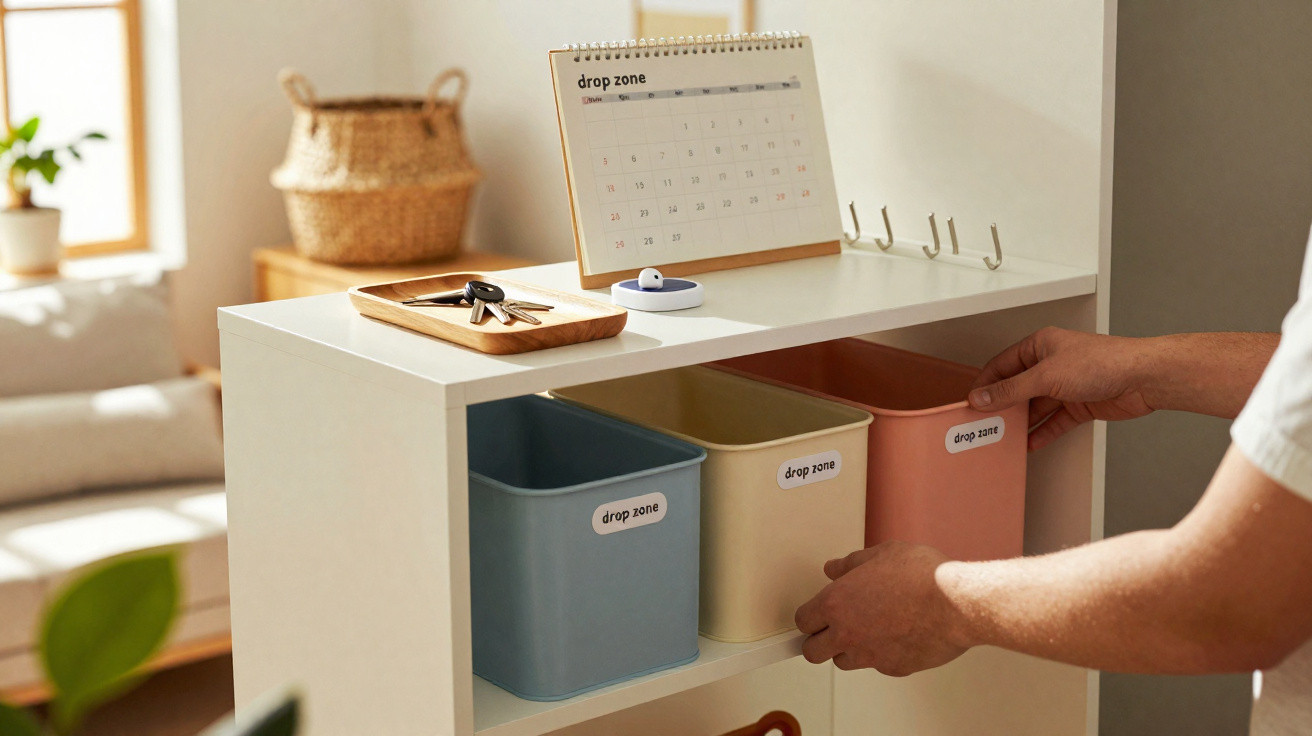
- Default drop zones: designated places where items may land in a rush, but only as an initial stop rather than a permanent home.
- Light routines: brief, repeatable jobs attached to something you already do, such as after coffee, after the children’s bedtime or before Netflix.
- Clear exits
The final one is easily overlooked: a system is not only about what enters the home. Things need to leave as well, whether as rubbish, donations, items to “give back to neighbour” or archived materials. Low-mess homes understand both how possessions come in and how they go out.
From “where do I put this?” to “what’s the system?”
The subtle change in low-mess households is an improved question. Rather than asking, “where could I stash this?”, they ask, “what is the smallest system that would stop this issue happening again every week?”. The mess is the same, but the way of thinking is different.
This does not call for a complete personality change. Begin by watching your own habits without judgement. Where does clutter build up fastest? At what point in the day are you least likely to put things “back properly”? Build the system around that tired future version of yourself.
At times, the best solution is not another shelf but one fewer choice. One hamper rather than three. One shared family calendar instead of sticky notes and group chats. One home for every charger, even if the basket is not especially attractive.
| Key point | Details | Why it matters to readers |
|---|---|---|
| Create “default drop zones” | Allocate clear places for keys, post, school bags and receipts, such as a tray, hook rail or one basket by the door. Keep these spots accessible and free from overcrowding. | It cuts down the daily search for essentials and stops random clutter spreading over every surface. |
| Use short, repeating routines | Link 10–15-minute tasks to existing anchors: a five-minute kitchen reset after dinner, laundry running overnight or a quick paper sort twice weekly. | Tidying becomes more automatic instead of feeling like an overwhelming weekend task that never quite happens. |
| Design exits for stuff | Keep a donation box, a “return to others” bag and a bin for broken items near the door or in a cupboard opened regularly. | It stops unused belongings hanging around for months and gradually becoming background clutter. |
FAQ
- Do I need to declutter first, or can I start with systems right away? You can put systems in place immediately, even before undertaking a major declutter. Start with one hotspot and create a straightforward flow: where items land, when they are dealt with and where they go afterwards. As the system develops, it becomes easier to identify what you truly do not need, and decluttering feels less painful.
- What if my family never follows the system? Systems break down when they are built around ideal behaviour instead of actual behaviour. Notice what your family already does, then shape the system around it. If shoes consistently end up in a hallway corner, place a large basket there rather than insisting everyone walks to a faraway wardrobe.
- How many systems does a home realistically need? Most homes work well with only a small number of clear systems: the entrance area for keys, bags and post; dishes; laundry; paperwork; children’s belongings; and outgoing items such as returns and donations. Begin with two: the entrance area + dishes. Once they become habitual, introduce another.
- Isn’t this just another word for routines? Routines are the actions repeated over time. Systems are the framework supporting them: the tools, places and rules that make those routines simple to follow. You may miss a routine, but the system remains in place and ready for the following day.
- What if my home is really small and has almost no storage? Small homes benefit most from systems because there is less room for error. Make use of vertical space with hooks and over-door racks, choose one or two open baskets instead of closed cupboards, and keep flows short: anything that comes in must leave or find a purpose within days, not months.


Comments
No comments yet. Be the first to comment!
Leave a Comment