
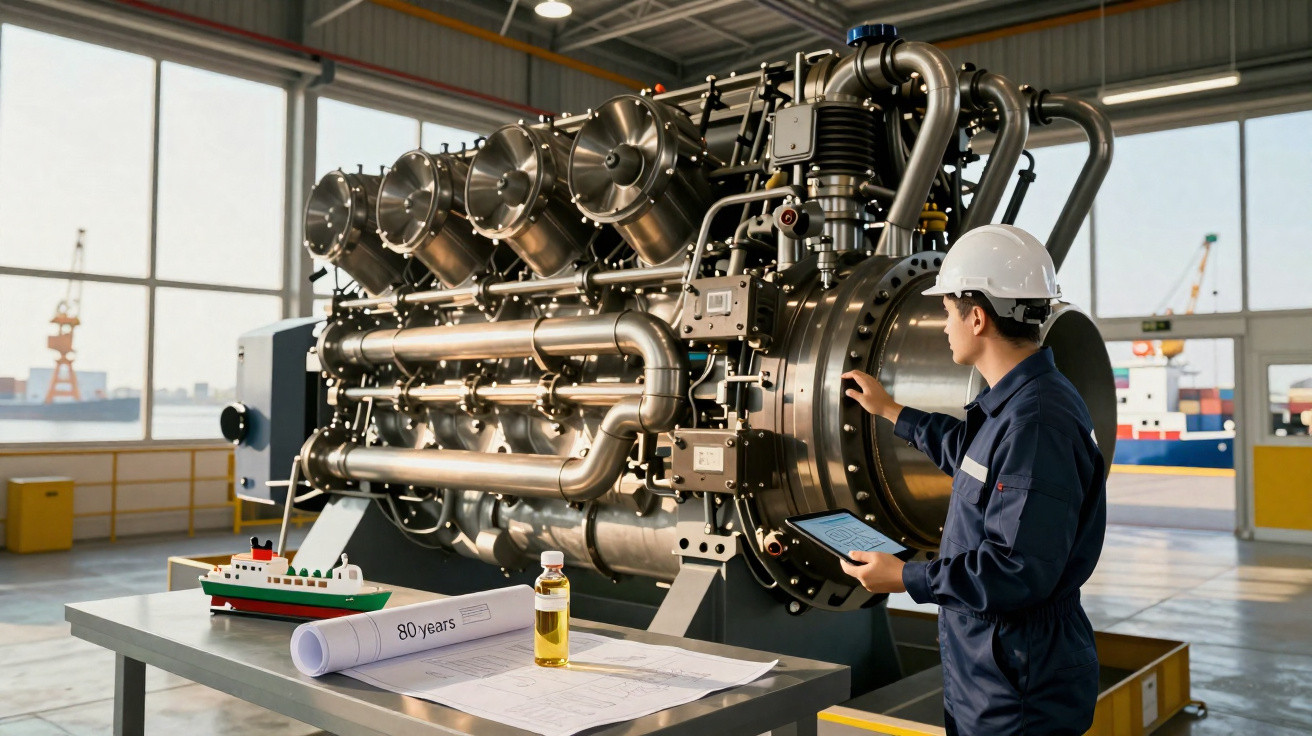
On France’s Atlantic shoreline, a long-established works that once stood for brute diesel muscle is now gearing up, almost unnoticed, for a new industrial chapter.
In Saint-Nazaire, an engine factory with deep roots is being reshaped into a strategic base for nuclear safety systems, lower-emission shipping and next-wave biofuels. Its German owner, Everllence (previously MAN Energy Solutions), is pairing fresh capital with bigger plans as the site approaches its 80th anniversary.
A historic giant of diesel power gets a second life
The Saint-Nazaire story begins in 1946 with the founding of S.E.M.T., the Company for the Study of Thermal Machines. From the post-war expansion through to the mid-2000s, S.E.M.T. became synonymous with high-output diesel engines for vessels and power generation, built on France’s Atlantic coast.
Although S.E.M.T. ceased to exist as an independent company name in 2006, the plant’s industrial know-how remained intact. Now under Everllence, the site continues to turn out engines so enormous they require a dedicated quay for dispatch.
By 2026, the factory has about 600 employees and produces huge four-stroke engines weighing up to 320 tonnes apiece. To mark 80 years, Everllence is lining up what managers describe as a “nice gift”: a major investment push, a stronger order book, and a comprehensive modernisation of both production areas and administrative spaces.
Everllence expects around 40% growth by 2028 at Saint‑Nazaire, driven by a surge in nuclear safety equipment and cleaner maritime propulsion.
Nuclear boom: engines built for the worst‑case scenario
Backup power when everything else fails
Within a nuclear power station, Everllence engines are not there to drive the main turbines. Instead, they perform a quieter but crucial function: acting as the ultimate fallback when external electricity is lost.
These large sets are used as:
- emergency diesel generators,
- backup power systems,
- standalone electricity supplies if the outside grid collapses.
If the station’s normal supply fails, the engines must start automatically within seconds. They then keep essential systems operating, including:
- reactor cooling systems,
- safety pumps,
- control and monitoring equipment.
They are engineered for the situation every operator hopes never happens: a major grid outage or incident where time is critical. That drives requirements for exceptionally high reliability, built-in redundancy and the ability to run for hours or even days under demanding conditions.
Everllence’s timing in doubling down on Saint-Nazaire is deliberate. The International Atomic Energy Agency (IAEA) forecasts that global nuclear capacity could rise from roughly 377 gigawatts today to close to 1,000 gigawatts by 2050. New-build projects, lifetime extensions and small modular reactors all increase demand for emergency power packages.
Nuclear expansion does not only mean more reactors; it also means more ultra‑reliable backup engines, control systems and safety layers.
Maritime pressure: regulations force cleaner propulsion
A shipping industry under climate constraints
At sea, the regulatory landscape is shifting rapidly. The International Maritime Organization (IMO) is aiming to reduce shipping’s carbon intensity by 40% by 2030 and 70% by 2040, with a goal of climate neutrality around mid-century. Meanwhile, the European Union is bringing shipping into its carbon market, progressively charging for emissions from large vessels above 5,000 tonnes, which are responsible for most of the sector’s pollution.
The cost implications are substantial:
- new low-carbon ships can cost 30–50% more than conventional designs,
- low-carbon fuels are often two to five times more expensive than standard fuel oil,
- fleet renewal could require up to 28 billion dollars per year,
- fuels and infrastructure might demand up to 90 billion dollars annually.
This leaves owners with a difficult decision: retire ships earlier than planned or adapt existing propulsion to cleaner fuels. Everllence is positioning itself firmly on the conversion side rather than the scrap-and-replace route.
The 320‑tonne engine built for multi‑fuel futures
Central to that approach is the 51/60DF engine range, manufactured and upgraded in Saint-Nazaire. The “DF” label means dual fuel, yet in real-world terms these machines offer broader capability.
- Configuration: 6L, 12V or 18V
- Maximum power: up to 20,700 kW at 500/514 rpm
- Fuel flexibility: diesel, heavy fuel oil, natural gas, liquid biofuels
- Combustion: can start directly in gas mode with roughly 1% “pilot” fuel
- Bore and stroke: 510 mm x 600 mm
- Weight: up to about 416.8 tonnes for the 18‑cylinder version
That adaptability matters for operators facing uncertain fuel availability and pricing. Ships can begin on conventional fuels and transition progressively to gas or biofuels as supply chains become reliable.
Everllence also intends to rework more of these extra-large engines so they can operate on liquid fuels derived from biomass. In many cases, this is faster and less expensive than commissioning entirely new vessels, while still delivering a meaningful reduction in emissions.
Converting a 320‑tonne engine to burn biomass‑based fuels can sometimes cut lifetime emissions far more cheaply than building a new low‑carbon ship from scratch.
The practical effect is rising workload in Saint-Nazaire. Everllence plans to lift annual output from 48 to 72 engines, increasing production by about 24 units a year as early as 2025. That expansion gives the French facility a global part to play in helping shipping meet tightening climate requirements.
Beyond machines: 6,000 m² of offices revamped
A factory upgrade that targets brains as much as steel
The spending is not confined to tooling, machinery and test facilities. Everllence has also started a two-year refurbishment of around 6,000 m² of office accommodation on the Saint-Nazaire site.
The renovation is designed to:
- improve day-to-day working conditions for existing employees,
- help recruit hard-to-find engineering and technical specialists,
- underpin a move towards more design, digitalisation and innovation.
This repositioning is important. Coming contracts are increasingly about configuring sophisticated multi-fuel systems for nuclear sites, LNG terminals, ferries or cruise ships operating under strict emissions limits-rather than repeatedly producing standard diesel units.
The “gift” for the site’s 80th anniversary is not only new orders but a structural move up the value chain, from heavy metal to high‑value engineering.
Saint‑Nazaire: an Atlantic energy crossroads
An industrial hub plugged into global trade
Everllence operates within a tightly connected industrial and port environment. The Nantes–Saint-Nazaire seaport handled 26.4 million tonnes of cargo in 2025, up 2.6% year on year. About 18 million tonnes of that total were energy-related flows such as oil and liquefied natural gas.
Approximately 3,068 ships call at the port each year, supporting close to 28,700 direct jobs across 1,460 hectares. The area also hosts the well-known Atlantique Shipyards and major customers including EDF, TotalEnergies and ArcelorMittal.
A dedicated quay allows Everllence to load its 48/60 and 51/60 engines-some of them weighing up to 320 tonnes. Only a small number of locations worldwide can build, test and ship equipment of this size.
The factory is also linked to France’s “France 2030” strategy via the Loire Estuary ZIBaC initiative, which directs 8.2 million euros into projects spanning hydrogen, carbon capture and biofuels. This gives Saint-Nazaire an arena for trialling future low-carbon solutions around the engines themselves, including fuel handling, storage and integration into port energy systems.
What biomass‑based marine fuels actually mean
“Biofuel” in shipping can refer to several different products. For marine use, it ranges from derivatives of used cooking oil (such as HVO) to more advanced bio-oils produced from forestry residues or agricultural waste. These fuels are intended to reduce lifecycle emissions, although the real benefit depends on how the feedstocks are sourced and processed.
- Short term: blending biofuels with conventional marine diesel to reduce emissions without modifying equipment.
- Medium term: retrofitting engines and fuel systems so vessels can run largely on biofuels or biomethane.
- Long term: moving to synthetic fuels such as e‑methanol or e‑ammonia, made using renewable electricity.
Engines like the 51/60DF serve as a bridging solution, coping with different fuel blends while regulators, ports and suppliers settle on which low-carbon pathway can scale most quickly.
Scenarios: what if shipping goes faster than planned?
Should regulation tighten sooner than expected, owners may be forced to speed up retrofit schedules. That scenario could create a queue of conversion work for sites like Saint-Nazaire-not just for new builds, but also for existing fleets in Europe, Asia and the Middle East.
However, constraints are possible: shortages of skilled labour, limited components or restricted test capacity could delay deliveries. Manufacturers also carry technology risk if policy and fuel choices swing rapidly towards a single option-ammonia, for example-faster than product ranges can be adjusted.
There is also a potential upside. If multi-fuel, high-efficiency engines are adopted successfully, benefits accumulate: ports reduce local air pollution, operators cut carbon-related costs, and countries such as France strengthen energy and industrial sovereignty by keeping critical capabilities anchored at home.
By renewing its 80‑year‑old engine factory, Everllence is betting that heavy industry still has a future in a low‑carbon economy, as long as it can adapt fast enough.




Comments
No comments yet. Be the first to comment!
Leave a Comment