
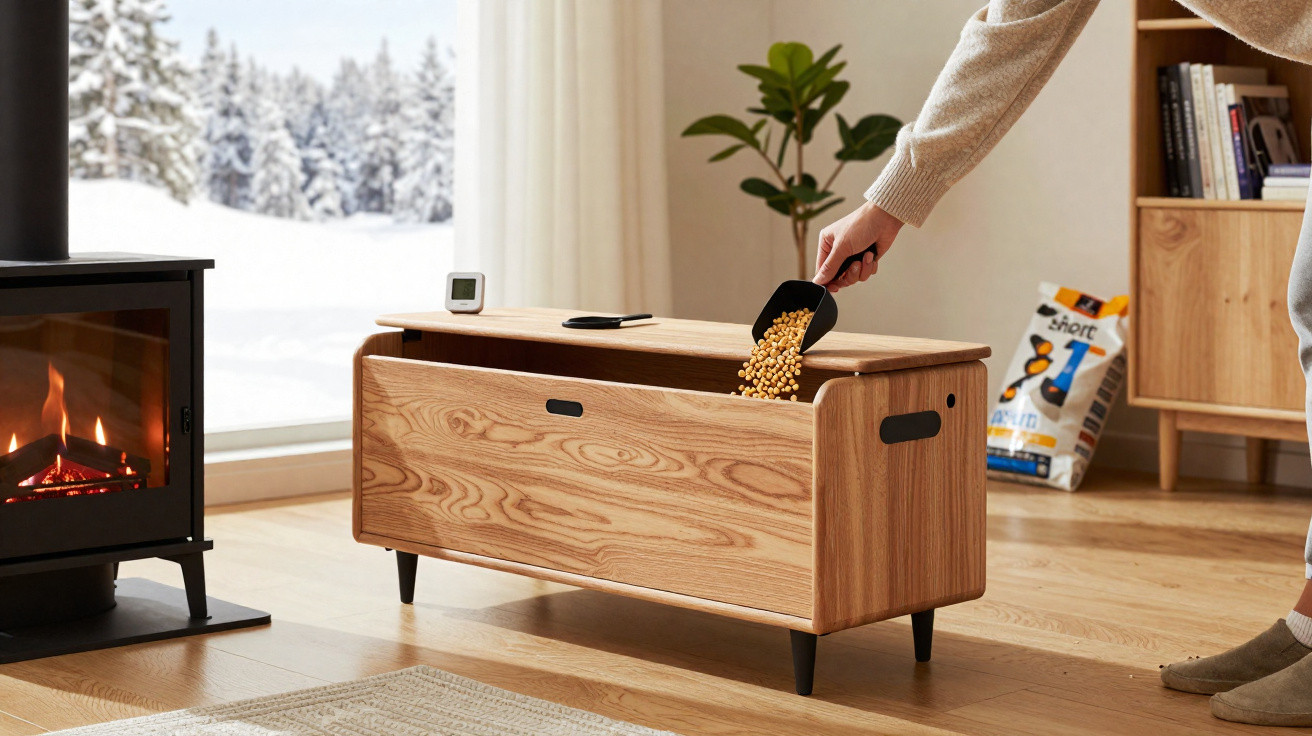
More and more households are turning to pellet stoves for reliable, cleaner heat, but many are still lugging hefty sacks in from the garage every few days. A newer wave of smart pellet storage boxes is designed to take that hassle out of the routine and make pellets feel like a genuine “load once, forget for a while” fuel.
Why pellet storage suddenly matters this winter
Pellet heating has been steadily expanding across Europe and, increasingly, in the US and the UK. With gas prices climbing and greater pressure to cut carbon, plenty of homeowners have shifted to stoves that burn compressed wood pellets efficiently and with comparatively low emissions.
In practice, the stumbling block is rarely the stove. It is the packaging.
- Each standard bag weighs around 15 kg, which many people find difficult and awkward to handle.
- Bags are often piled up in garages or cellars where damp and humidity are common.
- Having to go and fetch fuel every day can turn a cosy winter rhythm into unpaid weight training.
Unprotected pellets soak up moisture, crumble to dust and burn badly, turning a supposedly clean system into a frustrating one.
This winter, manufacturers are betting that buyers want the same sort of ease they associate with mains gas or electricity: fuel stored close to the stove, ready when needed, with less strain and far less mess. That is the niche dedicated pellet storage boxes are now filling.
From ugly bags to furniture: the rise of “design” pellet boxes
A decade ago, pellet storage often meant a basic plastic tub tucked out of sight. Now, it is increasingly styled like a piece of furniture you would not mind leaving on show. Makers are designing these containers to sit in the living space rather than being treated as purely back-room kit.
How design meets daily life
Across brands, the latest boxes tend to share several familiar design choices.
- Clean lines: squared-off or gently rounded forms that sit neatly by a stove.
- Neutral finishes: black, anthracite, white or pale wood to suit common interiors.
- Practical access: hinged lids or front-opening flaps so you can refill without shifting the box around.
The point is straightforward: replace the industrial look of printed plastic sacks with something that blends into the room. Instead of a stack of bags, you get a solid container-sometimes with a tray-like top that can double as a perch for books, firelighters or a plant.
The box does two jobs at once: it stores fuel and it behaves like a discreet sideboard, softening the presence of the stove in the room.
What a “good” pellet storage box actually does
A tidy exterior is only part of it; the practical engineering matters. Pellets are small, dense, very dry cylinders. They need to stay dry, and they also need to pour and flow easily when you tip them into a bucket or scoop.
| Key feature | What it changes in daily use |
|---|---|
| Capacity around 40–50 kg | Several days to a week of heating without refilling for many households. |
| Rigid, sealed body | Shields pellets from damp floors and air, limiting crumbling and dust. |
| Easy access system | Top lid or lower chute that lets you load a scoop or bucket quickly. |
| Stable base, sometimes wheels | The box stays put but can move for cleaning or rearranging the room. |
Taken together, these elements cut down how often you have to wrestle full sacks, help preserve combustion quality, and reduce clutter around the stove. There is also a real mental benefit: the routine stops feeling like a job and becomes a quick, repeatable action.
Inside the XL trend: larger boxes for fewer trips
As more people gain experience with pellet heating, many decide they do not want to top up constantly. The preference is to empty several bags at once and then leave it alone for a while. That shift has driven demand for “XL” boxes that store about 45 kg at a time, and sometimes more.
The Jura-style format: 45 kg in one go
One attention-grabbing approach seen in parts of continental Europe this season is a large-capacity steel box built to take up to three full sacks of pellets-around 45 kg. It aims for a compromise between autonomy and floor space: large enough to reduce refilling, but compact enough to sit beside a typical stove without overwhelming the room.
- Generous storage: 45 kg typically covers several evenings of heavy use in a well-insulated home.
- Robust body: thick steel panels stand up to knocks from buckets or vacuum cleaners.
- Protected closure: a tight lid limits dust and moisture ingress.
- Controlled outlet: a lower trap lets pellets slide directly into a container without spillage.
Moving three light scoops from a box next to the stove feels very different from wrestling a 15 kg bag in from the shed at night.
It reflects a pattern seen with other household items: once something purely utilitarian is given a bit of design thought, it becomes acceptable-甚至 welcome-in a main living area.
How to choose the right box for your home
There is no one-size-fits-all solution, either for room layouts or for what your body can comfortably manage. A few simple checks can narrow the options before you order something substantial.
1. Match capacity to your consumption
Work out roughly what you burn on a normal cold day. A smaller stove might get through 10–15 kg in 24 hours, and more in severe cold. With a 45 kg box, that can translate into about three to five days of autonomy. In a compact flat, a 30 kg box may make more sense if you want to preserve floor space.
2. Look closely at materials
- Steel: durable, steady and often the smartest-looking when powder-coated, though heavier to shift.
- Reinforced plastic: lighter and usually cheaper, but often less pleasing in a living room.
- Wood or wood-clad: visually warmer, but it must have proper internal sealing to keep moisture out.
Whatever you choose, it helps if the base is not sitting directly on a cold, potentially damp floor. Small feet or a slightly raised plinth can reduce moisture wicking up through tiles.
3. Test usability in your head
Before buying, run through the day-to-day routine mentally:
- Where will the box sit in relation to the stove’s hopper?
- Can you stand in front of it comfortably while scooping pellets?
- Will the lid open fully beneath a mantelpiece or wall shelf?
- Do you need wheels so you can move it for cleaning once it is empty?
A box that looks great but forces awkward lifting angles will become irritating very quickly.
Health, safety and clean-air angles people often forget
Pellet storage is not only about convenience. If handled poorly it can lead to dust and mould problems; if done properly it supports both health and performance.
- Less dust airborne: a sealed box reduces the fine sawdust that can escape when bags are opened, which may irritate lungs.
- Fewer trip hazards: piles of bags, torn plastic and makeshift containers near a stove increase the chance of slips, falls and spills, particularly for children and older adults.
- More predictable combustion: intact, dry pellets burn as the stove is designed to, improving heat output and emissions.
Keeping pellets dry does not just protect their appearance; it keeps their energy content stable and reduces incomplete combustion and smoke.
For anyone with back pain, arthritis or reduced strength, the difference between lifting a heavy sack once a week and doing it daily can determine whether a pellet stove remains a workable long-term option.
Costs, payback and who benefits most
A solid pellet box costs far less than a stove, yet some households still treat it as a “nice-to-have”. The value proposition changes once you consider the time saved and the waste avoided.
- Pellets damaged by moisture may end up thrown away, or they burn poorly and create extra ash.
- Repeated trips outside in miserable weather have a genuine cost in effort and comfort, even if it is hard to put a price on.
- Being better organised can make bulk buying more realistic, because handling and storing the fuel feels manageable.
Those who heat mainly with pellets, people in remote homes fed up with night-time trips to the garage, and older users aiming to stay independent are likely to see the biggest gains. If you only light the stove at weekends, a smaller and cheaper box by the hearth may still deliver a noticeable improvement.
Pellet storage as part of a broader heating strategy
Once you start thinking seriously about where pellets should live, it often prompts a wider look at the entire setup. Many installers now include storage planning as part of the initial stove discussion rather than leaving it as an afterthought.
That can involve:
- Planning a clear route from bulk storage (garage, shed or delivery point) to the indoor box.
- Checking floor loading where several bags might temporarily be stored before decanting.
- Confirming safe clearances from hot surfaces, sockets and upholstered furniture.
Some owners also build a small toolkit around the storage box: a metal scoop with a comfortable grip, a compact vacuum for ash and dust, or a moisture meter to monitor humidity. Combined, these small additions can move pellet heating from merely “manageable” to something closer to fully integrated home infrastructure.





Comments
No comments yet. Be the first to comment!
Leave a Comment