
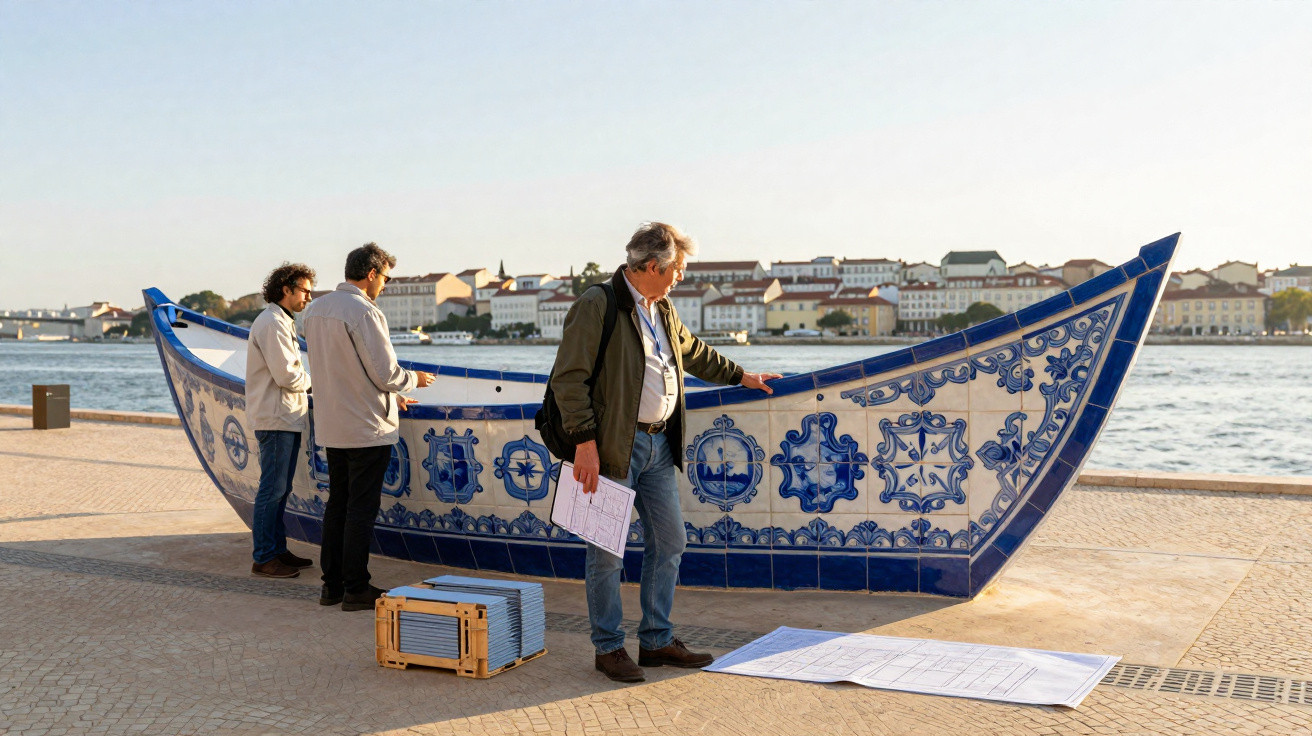
Vizinhos em Lisboa asks Joana Vasconcelos for clarity on the tiles used in “Real Embarcação”
Vizinhos em Lisboa has asked visual artist Joana Vasconcelos to clarify where the tiles used in the work “Real Embarcação” came from, warning of possible risks to cultural heritage and of encouraging a market in stolen tiles.
In a request for information emailed to the artist on Wednesday, the residents’ association says it wants “public and transparent” information about the provenance of the tiles included in the installation currently shown in the exhibition “The Absurd and the Dreamlike”, at the Citadelle de Villefranche-sur-Mer, France, until 31 October.
According to the request shared with the Lusa news agency, the move follows the circulation of a video on social media in which Joana Vasconcelos describes the work as being made from “hand-painted ceramic tiles”, reinterpreting “a familiar Portuguese icon”.
While acknowledging “the artistic value” of the artist’s career and “the international relevance she gives to Portuguese art”, the association argues it is “relevant and urgent” to clarify the origin of the tiles used in the “Real Embarcação” installation.
Heritage protection and legal framework highlighted by the association
Vizinhos em Lisboa notes that historic Portuguese tiles form part of cultural heritage protected under Portugal’s Basic Law on Cultural Heritage. It also points out that, since 2017, Lisbon City Council has required authorisation for the removal and transport of tile panels and tiles from façades and interiors, given their heritage value.
Among the questions raised, the association asks whether the tiles used come from historic façades or interiors and, if so, whether incorporating them into the work “contributes to the definitive uprooting of these elements from their original context, culturally and historically impoverishing the buildings and the places from which they were removed”.
If the materials were bought through auction houses, antique dealers or other commercial channels, the association also asks whether such demand could become “an additional incentive to the market in stolen tiles or tiles illegally removed from Lisbon buildings”, with the risk of fuelling “the spiral of theft and vandalism”.
Vizinhos em Lisboa further cautions that the installation could act as a “precedent or symbolic justification” for future removals of tile heritage for artistic or commercial purposes.
In its message to the artist, the association also requests “detailed” information on the provenance of every tile used, including origin documentation, acquisition dates and, where applicable, evidence of the legal authorisations for their removal.
Atelier response on provenance and additional concerns about handling
In reply to Lusa by email, the artist’s studio says the work “Real Embarcação” includes “remaining parts of tile panels from a private residence” which “remained stored for several years before being donated to the Atelier by the owner”, adding that their use was carried out “with the greatest respect for their historical, cultural and heritage value”, seeking to give them “a new artistic context”.
Joana Vasconcelos also states that “safeguarding Portuguese cultural heritage is a collective duty and a shared responsibility” and argues that the use of tiles in her work aims to “recognise and value this element as a major expression of Portuguese material culture”. She says this approach is compatible with heritage protection “when developed responsibly, with respect for the legal framework and with appreciation for the materials used”.
The artist adds that her studio “bases its practice on respect for the legal framework and on the use of materials obtained in compliance with the applicable legislation”, and thanks the association for “the interest shown”. She maintains that protecting heritage depends on “an informed and participatory society” and on a commitment grounded “in dialogue, rigour and responsibility”.
In its statement, the association also says the published images show people “stepping directly on the tiles” during installation and asks whether that practice “irreversibly compromises the physical integrity of ceramic pieces from the 17th and 18th centuries”, whose fragility it says is widely recognised by conservation specialists.
At the end of the document, Vizinhos em Lisboa argues that “transparency on these issues does not diminish the artistic value of the work, but instead reinforces the responsibility any creator assumes when working with materials of collective heritage value”.
Vizinhos em Lisboa is a residents’ association focused on representing and defending the interests of people living in the municipality of Lisbon in areas such as urban planning, built heritage, mobility, the environment and quality of life, according to its website.





Comments
No comments yet. Be the first to comment!
Leave a Comment