
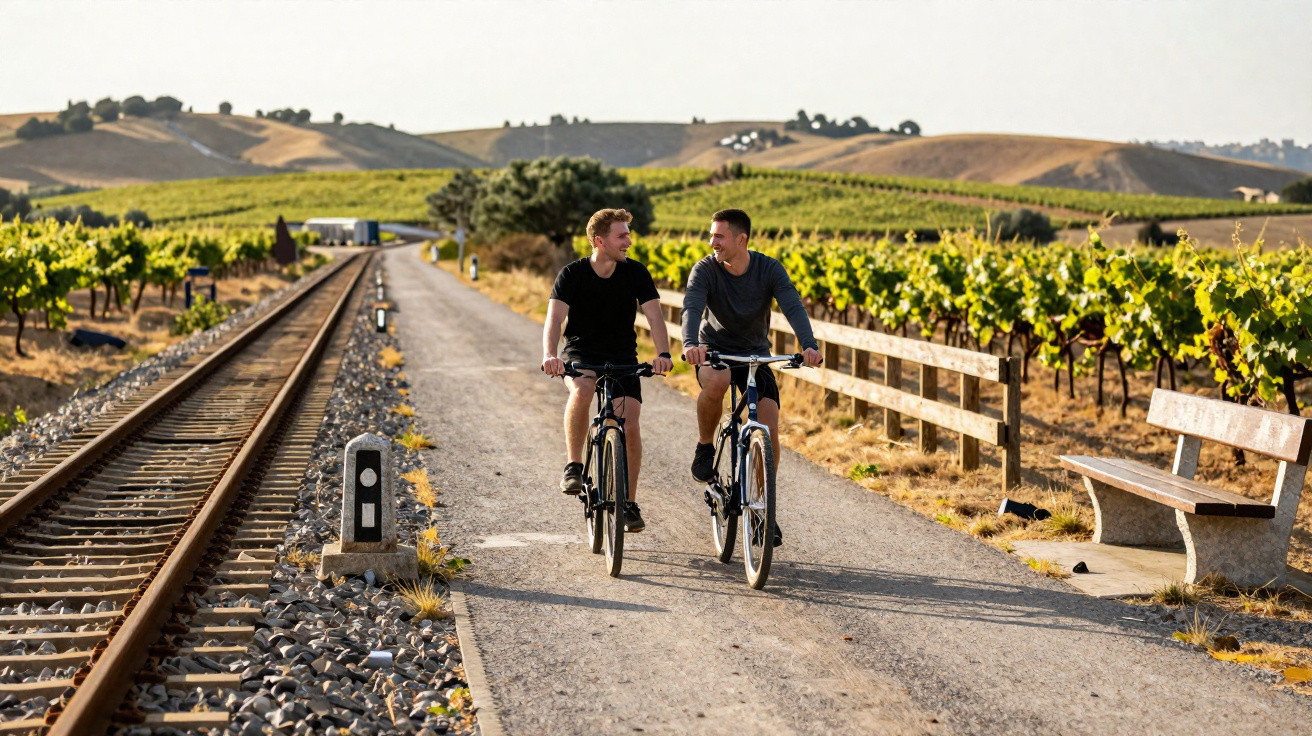
Residents in Vila Real are asking for a better surface, continuity and safer conditions along the former Corgo Line, so they can make the most of a flat, traffic-free route-without erasing the railway’s memory.
A corridor that still moves people in Vila Real
The former Corgo Line no longer carries trains, yet it still carries people. Early in the morning, or later in the day, some step onto the corridor as if finding a quiet break inside the city. Some run, others cycle, others walk. There are no cars and no traffic lights-just the path and each person’s pace.
Runners and cyclists on the former Corgo Line
Rui Gonçalves runs there “about three times a week”. He usually starts near the old city station and heads north or south for as long as the surface allows. In the direction of Régua, there are stretches where stones and uneven ground force him to watch his stride. “From the UTAD campus onwards, it’s almost overgrown-good for trail running,” he says. He is not asking for tarmac, but for a “smoother” surface that helps runners without stripping the route of its natural character.
Tiago Fraguito knows the same ground from a bicycle saddle. In sections that have not yet been treated, “the terrain is uneven”, which reduces comfort for cyclists and runners alike. Where work has already been carried out, the difference is immediate. “Here it’s spectacular, it’s great.” The gentle gradient of the former railway makes it possible to keep moving without major climbs or descents-something rare in a municipality shaped by constant ups and downs. “We’re very lucky here in Vila Real,” he admits.
Marina Tavares also runs on the old line and has noticed more and more people using it for sport. Renovating the former railway corridor will be “an added value”, especially because it enables training away from traffic. While preparing for a marathon, when routes reached 25 or 30 kilometres, Marina and a friend would head out along the “line”, leaving the city towards Vila Pouca de Aguiar. The sessions were not bad, but once the route is in better condition “it will be much more practical”.
This is how the future greenway is already entering people’s lives before it features in official speeches. It is not just a project shared between municipalities, or a line drawn on a map. It is a place where someone can prepare for a marathon, where a family can walk without fearing cars, and where a bicycle can roll for kilometres without fighting for space with urban traffic.
Advantages
For those who use the former corridor, success is measured in a more even surface, better continuity, cleanliness, signage and safety. Rui wants to run without tripping over stones. Tiago wants to cycle with greater comfort. Marina wants a long, flat route. None of them is asking for an artificial track. They simply want a path that allows them to keep going.
Improving the route without losing the railway’s memory
Altino Cunha also runs there and supports the work, while warning that “one thing doesn’t cancel out the other”. In other words, upgrading the eco-trail can encourage physical activity, but it “should not erase the memory of the railway or close the debate about the train’s return”.


Comments
No comments yet. Be the first to comment!
Leave a Comment