
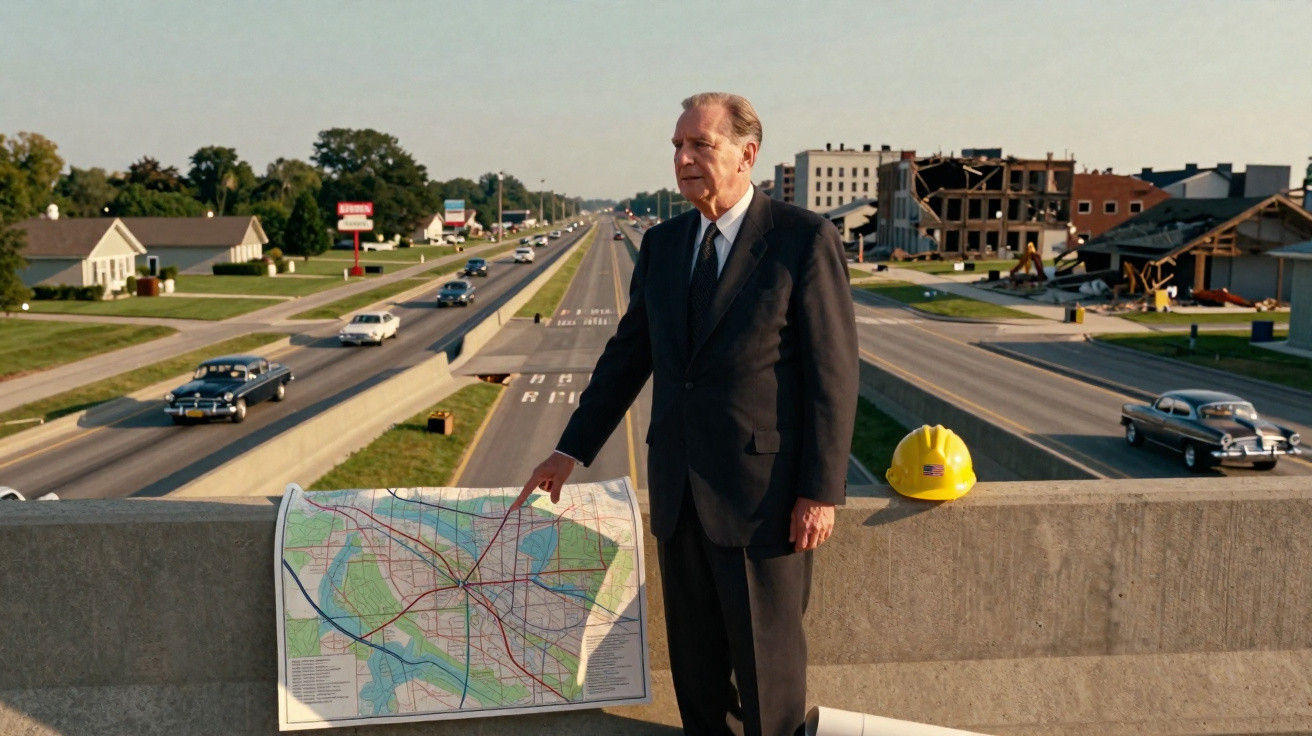
In 1919, a US military convoy needed 62 days to cross the United States, with vehicles bogging down, bridges collapsing, and roads simply vanishing along the way. Decades later, Dwight Eisenhower would turn that memory into a network able to reshape the country, drive its economy, and make the car a central part of American life.
Did Eisenhower copy Germany’s motorways?
Germany’s autobahn network impressed Eisenhower during and after the Second World War. Wide carriageways, controlled access, and the ability to move vehicles quickly demonstrated what modern roads could achieve. Even so, saying the president merely copied an idea from Hitler reduces a story that began much earlier.
Back in 1919, while still a lieutenant colonel, Eisenhower joined a military convoy travelling from Washington to California. The journey took 62 days and ran into mud, sand, mechanical breakdowns, and weak bridges. That experience underlined how poor roads constrained trade, civilian movement, and national defence itself.
The plan started before 1956
The United States had already been debating a national motorway network since the 1930s. A federal report in 1939 set out inter-regional corridors, and a 1944 law authorised the designation of up to 40,000 miles. The sticking point was that there still was not a financial system capable of turning maps into continuous, built routes.
Eisenhower did not single-handedly invent the Interstate system, but he applied the political pressure needed to get it built. On 29 June 1956, he signed the Federal-Aid Highway Act, which initially authorised 41,000 miles and launched the largest public works programme in US history up to that point.
How did the United States pay for such a vast project?
The federal government typically covered 90% of project costs, leaving roughly 10% to the states. Funding was then managed through the newly created Highway Trust Fund, supplied mainly by taxes on fuel and products connected to road transport.
The approach combined national planning with state-level delivery. Among the features that gave the programme its scale were:
- Long-term federal funding;
- Similar engineering and safety standards;
- Motorways with controlled access;
- Links between state capitals, ports, and industrial centres;
- Integration of roads into national defence planning.
The Interstate highways changed American life
The new network shortened journey times, made freight movement easier, and brought industrial centres, rural areas, and consumer markets closer together. Businesses began placing factories and warehouses near major junctions, while hotels, restaurants, petrol stations, and suburban neighbourhoods expanded around the exits.
Progress came at a steep cost as well. Urban motorways cut through established neighbourhoods, demolished homes, and split communities-especially Black and low-income areas. A recent Department of Transportation report estimates that the network’s expansion displaced more than one million people over the course of its construction.
The biggest programme left a conflicted legacy
Interstate highways helped turn the United States into a road-based logistics power, but they also deepened dependence on the car, encouraged sprawling development, and created barriers inside many cities. A system meant to bring the country together ended up connecting regions while dividing entire communities.
Understanding this history matters when deciding the future of major infrastructure. Roads can speed up economies and shrink distances, yet their consequences last for generations. Planning with urgency, transparency, and public participation is the only way to prevent the next monumental project from repeating the human costs of the last.


Comments
No comments yet. Be the first to comment!
Leave a Comment