
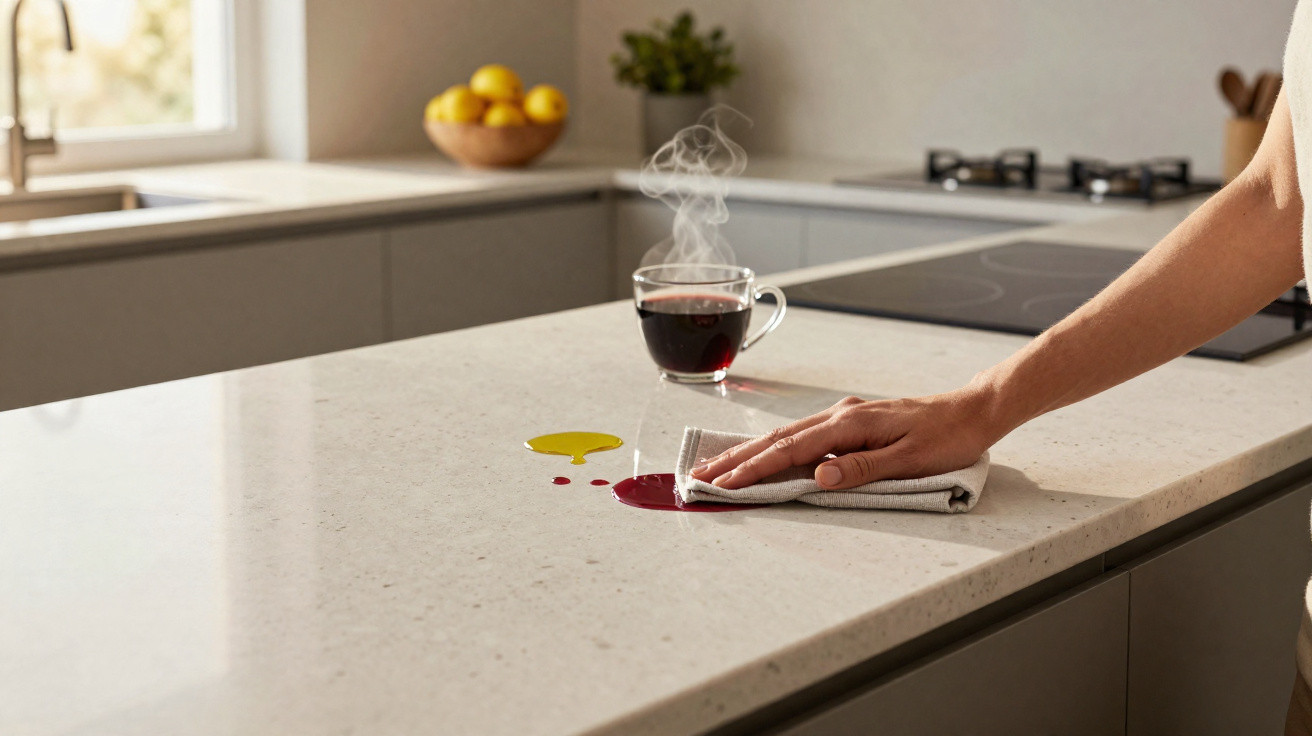
Synthetic quartz remains one of the most in-demand materials for kitchen worktops in 2026. Made from mineral particles combined with resins and pigments, it delivers an even finish, very low porosity and a wide colour palette-qualities that suit open-plan kitchens and contemporary-looking projects.
Why has synthetic quartz become so popular in kitchens?
Its appeal largely comes from pairing a controlled, consistent look with straightforward upkeep. Because the slabs are factory-produced, you can select patterns that closely match one another, avoiding the pronounced shifts in shade and veining that can naturally occur between different granite slabs.
- Provides more consistent colours and patterns;
- Includes options that replicate marble and natural stone;
- Works well in open-plan kitchens connected to the living area;
- Does not require regular sealing;
- Makes day-to-day cleaning of spills and food residues easier;
- Can be used for worktops, islands and upstands/splashbacks.
What is a synthetic quartz worktop made from?
The material often referred to as engineered stone is produced using ground quartz (or other minerals) bound together with resins, polymers and pigments. Some established ranges use around 90% mineral content, although the exact recipe differs by manufacturer, and newer products may contain lower proportions of crystalline silica.
Despite the name, the worktop is not cut as a single, natural slab. The quartz is processed and blended with other ingredients to form dense sheets, which are then cut to the kitchen’s required dimensions.
Does quartz really not absorb coffee, wine and oil?
Because the surface has extremely low porosity-and unlike many natural stones-synthetic quartz typically does not need sealing. This helps prevent liquids from soaking in, and most everyday marks can usually be removed using water, mild washing-up liquid and a soft cloth.
- Wipe up spills as soon as you can;
- Use mild washing-up liquid and a non-abrasive sponge;
- Avoid wire wool and harsh scouring powders;
- Do not use solvents unless the manufacturer approves them;
- Use a chopping board for food preparation;
- Follow the specific guidance for the brand you choose.
What care is needed to keep the worktop in good condition?
Synthetic quartz stands up well to normal daily use, but it is not indestructible. The resins in its makeup can be harmed by concentrated heat or sudden temperature changes, so pans, baking trays, air fryers and other hot appliances should not be left directly on the surface.
It is also sensible to protect edges and corners from knocks and to avoid long periods of direct sunlight if the product is not rated for outdoor use. Pan trivets, chopping boards and gentle cleaning help preserve the finish and reduce the risk of marks, chips and colour changes.
Has synthetic quartz really replaced granite in 2026?
Granite has not disappeared and is still chosen for its heat resistance, distinctive natural appearance and long service life. Quartz is particularly attractive when the priority is a uniform worktop that does not need periodic sealing and fits a planned, coordinated interior-although it can cost more and may demand extra care around hot items.
The right choice should be based on budget, day-to-day habits and preferred style, rather than following a trend alone. As with other shifts expected in kitchens in 2026, the move towards a quartz worktop reflects a desire for practical, visually continuous surfaces, without making natural stones obsolete.






Comments
No comments yet. Be the first to comment!
Leave a Comment