
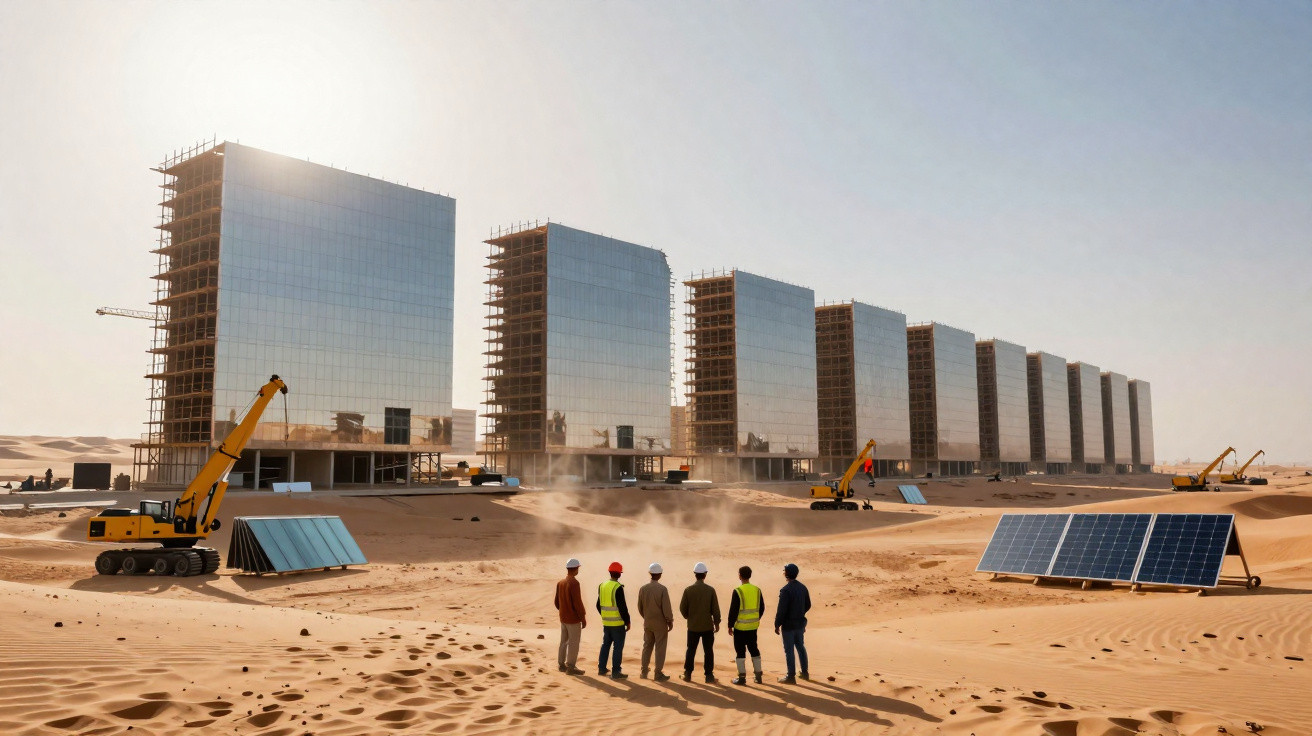
Just after sunrise, the desert outside Tabuk can seem almost gentle. The light arrives in a soft wash, the air is still cool, and for a short hour it is possible to forget you are standing in one of the most punishing landscapes on the planet. In the distance, cranes sit like insects caught mid‑crawl, lined up along the route where a 170 km mirrored wall was meant to rise and split the dunes. Nearby, workers drink sweet tea from plastic cups, waiting on instructions that keep shifting with each fresh directive from Riyadh.
This is NEOM’s The Line in 2025: neither fully abandoned nor truly underway - simply… contracting.
The promise of a 9‑million‑person desert megacity is being quietly folded into something smaller: an opening section, a pilot, a “proof of concept”.
Call it pragmatism. Or call it a pull‑back.
From trillion-dollar fantasy to shorter, sharper reality
When Saudi Arabia first unveiled The Line, it read less like a conventional masterplan and more like science‑fiction fan writing. A settlement without cars or streets, powered by 100% clean energy, running in a razor‑straight band for 170 km across the desert. The glossy renders looked like a Blade Runner set, drenched in sand‑gold light.
Today, Saudi officials are discussing only a slice of that original idea: an initial phase. A much shorter stretch that could house a few hundred thousand residents rather than millions.
Out in the sand, reality has not advanced at the speed the PowerPoint decks implied.
On site, the distance between marketing and climate is obvious. Bulldozers have bitten into rock faces to shape the first foundations, and a scattering of support buildings and worker camps already sits in the dust. But many of the images that travelled fastest online - flying taxis, suspended stadiums, artificial moons - remain confined to screens.
The Line was once meant to receive its first residents by 2030. Now, even the most upbeat people close to the project murmur that only a limited portion could be ready by then: a trial city instead of a world‑changing leap.
Few people want to use the words “scaled back”. Instead, you hear softer language such as “phased development” and “strategic focus”.
This contraction is not only a financial story, although the sums are eye‑watering. The original NEOM budget hovered around the US$500 billion mark, at a time when the world is already struggling to fund basic climate adaptation for countries most at risk. With construction costs rising and oil revenues less steady, Saudi planners are responding the way any ambitious homeowner does when the estimate comes in twice as high: keep the kitchen, lose the rooftop pool.
It is also a matter of physics and biology. Creating a glass‑walled, climate‑managed corridor in a place where summer temperatures now reach 50°C is a savage engineering task. Keeping millions of people comfortable inside it for decades - powered by renewables alone - is an entirely different challenge.
The Line’s story is beginning to resemble something less like a moon landing and more like a familiar lesson: the desert gets a vote.
Climate moonshot or monument to denial?
The core case for The Line has always been tempting. Dense, linear urban living can be more efficient, cleaner, and less dependent on cars. Concentrate residents into a tight footprint, stack services vertically, run the system on renewables, and emissions fall. On a whiteboard in an air‑conditioned meeting room, the argument practically sings.
From that angle, a cut‑down version feels like a loss. The project was an audacious - if excessive - wager that a country could skip years of incremental reform and build a new way of life from scratch. A post‑oil urban prototype, pressed into sand using oil wealth.
There is an odd kind of poetry in that tension.
But speak to climate scientists and urban planners privately and the mood changes. Many never saw the 9‑million‑resident pledge as realistic, either environmentally or socially. Constructing a brand‑new megacity in the desert requires huge emissions from steel, cement, desalination, aviation, and perpetual cooling. In other words: you release a lot of carbon in pursuit of a carbon‑neutral ideal.
Consider Dubai’s Palm Islands, where shifting sand into a symbol left a lasting ecological scar in the Gulf. The Line threatened to amplify that logic dramatically: a vast, delicate monument assembled by workers enduring 45‑degree heat.
Most people recognise that feeling - when a bold idea you secretly wanted to believe in cannot survive contact with the real world.
The more unsettling question is this: was The Line a serious climate bet, or a polished diversion from the slower, duller work of genuine change? It offered a frictionless future - no cars, no pollution, no sprawl - without demanding that existing cities confront their own disorder.
In that context, shrinking the plan might actually be a victory for common sense. Fewer kilometres can mean fewer emissions, less displacement of local tribes, and a lower chance of producing an expensive, glittering ghost city. It may also function as a quiet acknowledgement that mega‑projects cannot replace the unglamorous grind of insulating homes, electrifying buses, and repairing water networks.
Be honest: hardly anyone wakes up every day excited to retrofit older buildings and rewrite planning rules. Yet those ordinary fixes are what turn climate pledges into something people can live with.
What shrinking The Line means for the rest of us
For observers beyond Saudi Arabia, The Line’s retreat offers a straightforward lesson: do not pin an entire climate narrative on visions that are unlikely to be delivered. Many of the tools we need already exist in more modest, proven forms - dense, mixed‑use neighbourhoods; rail services that run reliably; shade trees and cool roofs rather than mirrored walls and drones.
From Seoul to Paris, cities are steadily doing what NEOM tried to turn into a game: reducing commute times, restricting cars in key areas, adding cycle lanes, and reshaping streets for people instead of engines. None of this travels online like a 500‑metre‑tall desert wall. But it does change everyday life in ways that endure.
Making dreams human‑sized is not the same as abandoning ambition. It is about placing ambition where people actually live.
The biggest danger for policymakers now is binary thinking. Either we back audacious mega‑projects that “change everything”, or we accept defeat. The Line played into that frame: if a futuristic desert city cannot save us, what will?
The reality is messier. A world with slightly better homes, far better transport, and cleaner power grids will still feel imperfect and compromised. It will also be much safer than a world that waits for a miracle megacity while sea levels rise.
That is the emotional sting for many who bought into NEOM’s glossy videos. It was never only about Saudi Arabia. It was about wanting to believe there was one final, decisive swing that could fix everything in one go.
Saudi architect and researcher Sara Nasser told me, “The Line was sold as a revolution, but real climate courage is investing in regular, unsexy cities where people already struggle with heat, rent, and pollution. You don’t need a mirror wall to do that - you need political stamina.”
- Watch the ratio
If ministers spend more effort on slogans and renderings than on bus routes, insulation, and grid upgrades, take it as a warning. - Follow the money
Track where climate funding really goes: towards symbolic showpieces, or towards cutting day‑to‑day emissions in housing, transport, and energy. - Listen to who moves
If a scheme forces communities or workers to relocate without giving them real influence over the design, it is closer to branding than a solution. - Respect the limits
Deserts, coastlines, and forests have ecological boundaries; plans that pretend otherwise rest on wishful thinking. - Protect the boring wins
A new bus lane is far less glamorous than a flying taxi - yet it can save more emissions, more time, and more lives.
Retreat, betrayal, or a rare adult moment?
Saudi Arabia’s quiet move to shorten its desert vision pushes an awkward question into view: what do we truly want from climate action? Do we need hope at any price, even when it comes wrapped as shiny delusion? Or are we finally ready to accept that the real gamble is not one mega‑city in the sand, but millions of smaller choices made across ordinary streets?
Maybe the courageous move is not clinging to fantasy, but accepting that the planet is indifferent to our renderings.
If an era of megaprojects is slipping into an era of repair, it will feel less like heroism and more like duty - less viral, more essential. And still, there is real grief in releasing a vision that, for all its flaws, dared to insist that cities could be entirely different.
Whether you read The Line’s retreat as sanity or surrender likely says less about Saudi Arabia, and more about what you still - quietly - want the future to look like.
| Key point | Detail | Value for the reader |
|---|---|---|
| Desert mega-dreams have hard limits | The Line’s 170 km concept is being reduced to a smaller, phased segment | Helps you notice when climate promises collide with physics, money, and time |
| Symbolic projects can mask real needs | High‑tech renderings draw attention away from upgrades to everyday transport, housing, and electricity grids | Encourages you to question where leaders invest - and what genuinely improves your life |
| Scaled-down ambition isn’t always defeat | A reduced scope can cut emissions, risk, and human cost while preserving useful ideas | Invites a more nuanced reading of “failure” in climate politics and urban design |
FAQ:
- Question 1 Is The Line project cancelled or just reduced in size?
It has not been officially cancelled. Recent reporting and leaks indicate it is being trimmed to a shorter initial section, while any long‑term expansion remains unclear and dependent on funding, politics, and real‑world results.- Question 2 Why was The Line scaled back if it was supposed to be climate-friendly?
Because constructing a brand‑new desert megacity consumes vast quantities of steel, concrete, energy, and water. As analysts worked through the figures, the environmental, financial, and social costs looked far higher than the marketing suggested.- Question 3 Could a smaller version of The Line still teach us something useful?
Yes. A limited section that actually operates could act as a testbed for dense design, walkable infrastructure, and renewable‑powered services. The key question is whether the lessons are shared and adapted for existing cities, rather than kept as a luxury experiment.- Question 4 Does scaling back mean countries should stop dreaming big on climate?
Not necessarily. It means large visions need clear limits, community input, and a serious assessment of life‑cycle emissions. Grand plans that ignore basic urban realities can slow the quieter transformations that matter most.- Question 5 What can ordinary readers take from this story for their own lives?
Treat it as a filter: be wary of glossy “future city” promises, and pay more attention to changes near you - public transport, housing, and energy bills. That is where the real climate wager is being made every day.

Comments
No comments yet. Be the first to comment!
Leave a Comment