
The first thing that hits you isn’t the temperature.
It’s the colour green.
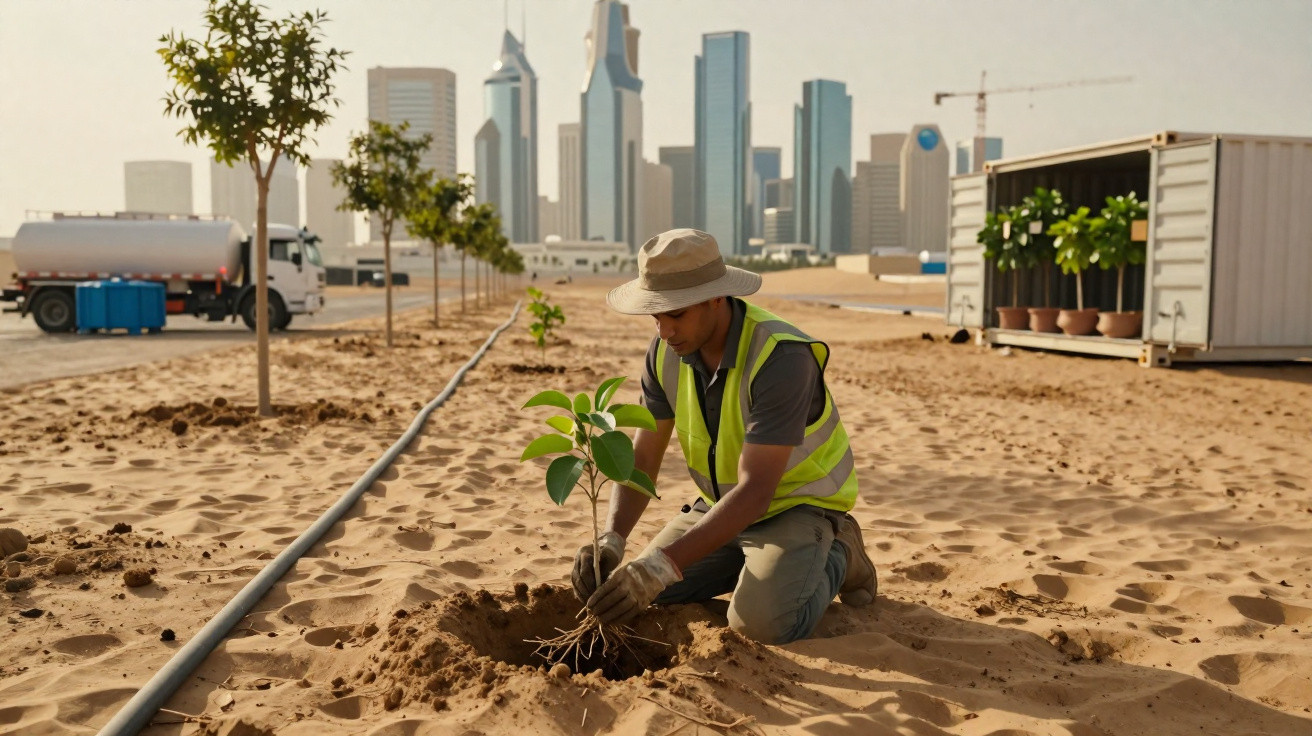
On Riyadh’s outer edge-where sandy, beige apartment blocks blur into open desert-long flatbed lorries inch along carrying stacks of trees bundled in burlap. Young labourers in dust-coated high-vis hop down, faces slick with sweat, and steer palm after palm into holes already cut into the sand beside a freshly laid boulevard that, for now, seems to lead to nowhere. Diesel fumes mingle with damp earth and a scent that feels out of place here: a faint hint of woodland.
A few hundred kilometres away in Dubai, cranes hover over a new waterfront park as hoses hammer reclaimed water into trenches. Under shade cloths, imported saplings from Africa and Europe wait like delicate VIPs.
This is the look of climate policy when a desert city grows into a mega-city-and then discovers the air is becoming too hot to comfortably live in.
Desert nations racing to plant forests of shade
Saudi Arabia and the United Arab Emirates are bringing in millions of trees each year, attempting to cool urban areas that have expanded faster than shade ever could. Broad motorways, glass-clad towers and concrete villas have intensified the urban heat island effect, turning late-afternoon strolls into something closer to an endurance test.
Under pressure from residents as well as international investors, planners are placing huge bets on greenery. In meetings, the language is “urban forests” and “climate resilience corridors”. At street level, it’s far simpler: lines of exhausted men cutting pits into sand, trying to grow a cooler future one young tree at a time.
Riyadh’s King Salman Park shows just how vast the plans are. Still being built, it is intended to rank among the world’s biggest urban parks-so large it is almost city-sized in its own right. Saudi officials also say the broader Saudi Green Initiative will plant 10 billion trees across the country over the coming decades.
Across Dubai and Abu Dhabi, municipal nurseries are packed. Cargo ships deliver container loads of seedlings from Spain, Italy, Kenya and even Australia, selected for their ability to tolerate fierce sun and saline soils. One Dubai landscaping manager quipped that his day-to-day work has become “traffic control for trees”, directing drivers where to drop the next shipment of living freight.
The reasoning is uncomplicated: more trees should mean more shade, and more shade should mean less heat. Research from Gulf universities suggests shaded streets can feel around 5 to 10 degrees cooler than exposed ones, while satellite imagery often shows neighbourhoods with thick canopy registering sharply lower surface temperatures.
There is, however, more going on than microclimates. As Saudi Arabia promotes futuristic projects such as NEOM and The Line, visuals of green valleys running between glass structures help soften international criticism linked to fossil fuels. The UAE-fresh from hosting COP28-leans on images of leafy boulevards and newly planted mangrove belts to market itself as a climate-aware hub. In that sense, trees operate both as cooling infrastructure and as PR symbols, taking root in sand and in global narratives at the same time.
The hidden cost of importing a forest into the desert
Putting trees into the Arabian Peninsula is nothing like planting them in a damp European suburb. Each sapling arriving by ship or plane requires its own miniature support system: drip irrigation, treated wastewater, and often protective mesh to defend against wind and blowing sand. Many landscape teams now spend more time discussing pipe diameters and salt tolerance than debating what looks attractive.
The approach is engineered to the hilt. Crews lay out “cooling corridors” along main roads and pedestrian routes, linking parks, shopping centres and metro stations so people can stay under shade for as much of a journey as possible. The priority is less about prettifying the city and more about making it usable after 3 pm in August.
People are gradually adapting to this new rhythm of green infrastructure. In Abu Dhabi, a Filipino delivery rider explained that he now plots routes that stick to streets lined with neem and ghaf, cutting a few degrees off a punishing shift. In Jeddah, families plan late-afternoon trips to recently opened coastal parks where foreign nursery imports stand beside tough local species, both sustained by greywater routed from nearby buildings.
Even so, the effort can feel uneven. Some newly planted boulevards appear lush in official Instagram posts yet look parched on the ground, because irrigation networks have not been completed or funding has been held up. And, frankly, not every sapling gets checked once the ribbon-cutting photos are taken. Plenty quietly fail in the sand-proof that rapid planting is far easier than long-term care.
The rush for shade has also triggered uncomfortable questions inside planning circles. Why spend money on thirsty, non-native species when the region already has trees-such as ghaf or sidr-that have endured drought for centuries? Why pursue a “European park” look in cities that receive very little rainfall?
Specialists flag risks including groundwater stress, the energy costs of desalination, and the danger of building thirsty urban forests that survive only with continuous pumping. The emerging view is that trees help most when they sit alongside other measures: cooler building materials, reflective roofs, shaded footpaths and fewer expanses of dark asphalt. Without that broader package, greenery risks becoming decoration placed on top of an extremely hot underlying problem.
Between ambition and reality: how the Gulf is learning to green wisely
Away from the glossy renderings, a quieter turn towards more practical-and sometimes surprisingly modest-methods is taking place. In Riyadh, engineers are designing tree pits to capture and hold every rare burst of rain, allowing water to soak down to roots rather than vanishing into drainage channels. Irrigation is increasingly paired with sensors, releasing water at night when evaporation is lower.
On the UAE’s fringes, trial plots combine imported species with native plants to see which can cope with less water and harsher winds. Often, the strongest performers are the plain local shrubs that do not photograph well for brochures but handle August conditions with ease.
Planners are also acknowledging something that rarely appears in public announcements: not every street needs to be green. Some districts are now earmarked for dense canopy, while others rely on lower vegetation and shade structures that demand less water. Attention is shifting towards cool bus shelters, arcades and covered walkways that remain effective with-or without-trees.
Many residents feel conflicted. They enjoy the new parks and tree-lined promenades, yet they also worry about the hidden water costs in a region heavily dependent on desalination plants. There is a familiar moment: stepping into the shade of a young tree, feeling the instant relief, and then wondering what it takes to keep that small comfort alive.
“Planting trees in the desert isn’t about copying Europe,” a landscape architect in Dubai told me. “It’s about designing shade that respects where we live. If the tree doesn’t make sense with our water, our soil, and our lifestyle, it’s just a very expensive decoration.”
- Choose hardy species first – Ghaf, sidr, date palm, and acacia cope with heat, salt, and wind far better than fragile imports.
- Use treated wastewater – Both Saudi and UAE cities increasingly divert recycled water to parks, road medians, and street trees.
- Think shade, not just beauty – Branch form, leaf density, and canopy height matter more than flowers when the aim is cooler streets.
- Cool the ground too – Lighter paving, permeable surfaces, and narrower roads reduce heat stored in the surface beneath the shade.
- Plan for maintenance – A dead tree is worse than no tree: it wastes water, money, and public trust in climate projects.
What kind of future grows out of a million imported trees?
Saudi Arabia and the UAE are attempting something bold: reshaping how desert cities relate to the landscapes they occupy. Rapid mega-city growth made daily life more modern, then more draining, and now authorities are trying to soften the consequences with green belts, shade tunnels and enormous urban parks that barely existed ten years ago.
A central tension runs through the whole strategy. These oil-wealthy states are financing imported trees and desalination-powered irrigation in order to cool the same urban lifestyles that fossil fuels helped enable. Yet inside that contradiction sits a live test case for other hot, crowded places. From Phoenix to New Delhi, city leaders are watching how the Gulf experiments with water recycling, species selection, and the basic, human-centred decision to put shade exactly where people need it.
The real measure of success will not be this year’s satellite images or polished climate pledges. It will be whether, two decades from now, a child walking to school in Riyadh or Sharjah remembers streets that offered mercy-summer still fierce, but with enough planned shade to keep moving.
| Key point | Detail | Value for the reader |
|---|---|---|
| Tree imports at massive scale | Millions of saplings shipped into Saudi and UAE cities to line roads, parks, and mega-projects | Helps understand how fast-growing cities react when heat becomes a daily obstacle |
| Water and species choice matter | Shift toward native or hardy trees, treated wastewater, and smart irrigation instead of “European-style” lawns | Shows what actually works in hot, dry climates instead of just looking good on social media |
| Shade as infrastructure | Trees integrated with cool pavements, covered walkways, and urban planning rules | Offers practical ideas that any hot city can adapt to make streets more livable |
FAQ:
Question 1 Why are Saudi Arabia and the UAE importing so many trees instead of only planting local ones?
Native species are included, but the demand for fast, dense shade around new mega-projects has grown faster than regional nurseries can supply. Imports cover that shortfall while programmes to scale up native planting are expanded.Question 2 Does planting all these trees actually cool cities down?
Yes at street level: shaded roads and parks can feel several degrees cooler for pedestrians in summer. Trees are not a solution to the climate crisis, but they can make everyday life more manageable in extreme heat.Question 3 Isn’t this approach wasting scarce water in the desert?
That is the biggest criticism. Authorities are trying to reduce the impact through treated wastewater and drip irrigation, but the overall water footprint remains significant and is widely debated locally.Question 4 Which tree species are proving most successful in Gulf mega-cities?
Tough species such as ghaf, sidr, date palms and acacia, along with carefully chosen imports that tolerate heat and salinity, tend to perform best with lower water use and less maintenance.Question 5 Could other hot cities copy what Saudi and the UAE are doing?
Yes, with local adaptation. The underlying principles-shade trees, recycled water, cooler materials, and designing streets around comfort-are already influencing thinking from southern Europe to North Africa.

Comments
No comments yet. Be the first to comment!
Leave a Comment