
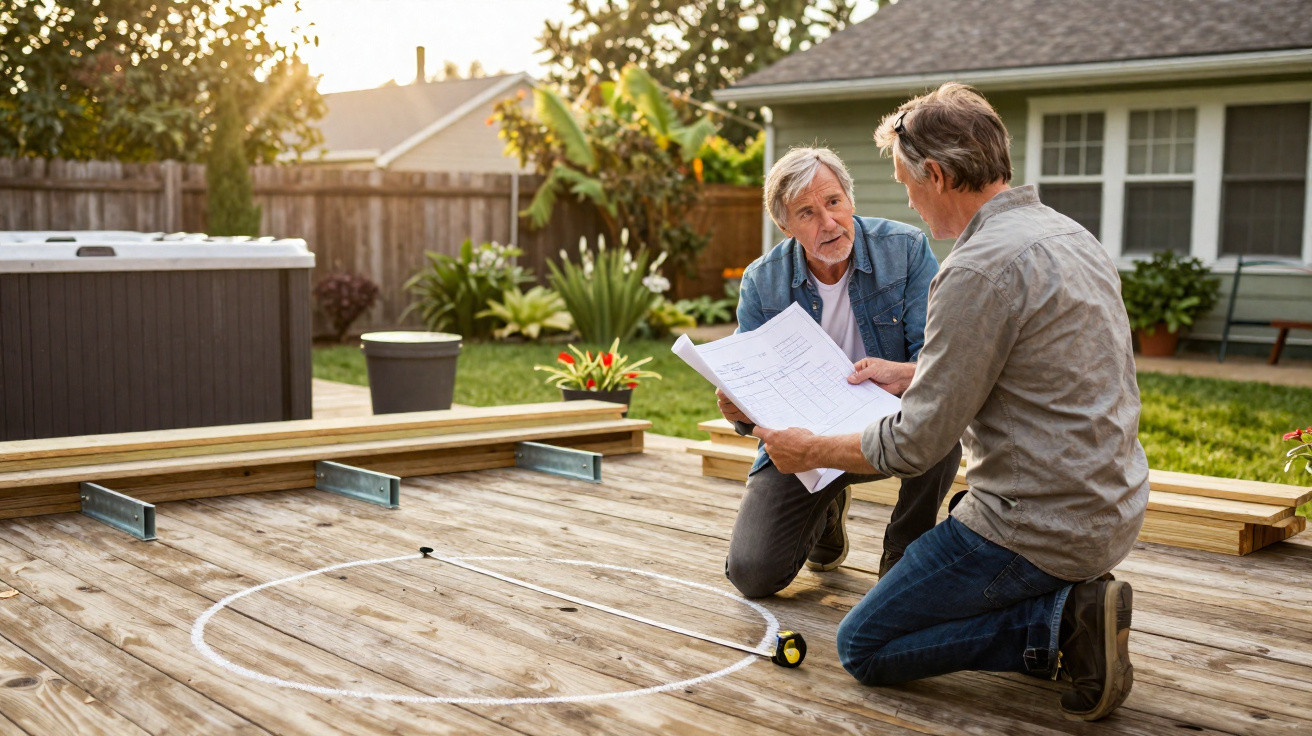
On a chilly Saturday morning, Mark stood on his weathered timber deck with a mug of coffee, looking at the exact patch where he imagined the hot tub would sit. At 58, with a stiff back and children who’d long since grown up, he wasn’t fantasising about a flashy car. What he wanted was a garden spa: a little steam, a bit of peace, and somewhere to soak the strain out of decades of long working days. The glossy catalogue shots made it all seem effortless - smiling couples, sunset lighting, crystal-clear bubbles. Just plug it in… right?
Then the contractor paced the boards, crouched beside a slightly springy joist, and delivered the line that hit like a lump of concrete: “You know this deck can’t hold that spa, right? Structural reinforcement is required in 8 out of 10 decks when people add a hot tub.”
All at once, the dream came with maths, weight limits, and a cost Mark hadn’t planned for.
That heavy dream sitting on old wood
The picture is familiar: you, a hot tub, a nice drink, and a quiet evening sky. It’s especially tempting around 55, 58, 60 - when your body starts dropping small reminders, day after day, that you’re not 30 any more. A backyard spa stops feeling like a treat and starts feeling like long-overdue self-care.
But under the warm bubbles is a hard truth. A filled spa can weigh about as much as a small car. The water, the pumps and equipment, the people inside, even the cover - all of it bears down on timber that may already be split, decaying, or simply not built for heavy loads. To the eye, the deck looks neat and sturdy. To a load calculation, it can look like a potential failure point.
A structural engineer I spoke to put it bluntly: “Most people underestimate weight by half.” He’s more often called after installation than before it. One job still sticks with him - a couple in their early 60s who set a four-person spa on a 20-year-old deck. It coped for a few weeks. Then, one evening, with two friends round, the frame let go on one side. No one died, but there were broken ribs, smashed boards, and a hot tub jammed up against the house cladding.
After that, he began noting what he found on site. Around 8 out of 10 existing decks he assessed for hot tubs needed major strengthening. Not a quick tidy-up. Proper work: new beams, new posts, new footings.
So why is it so common? Because most decks were never intended for this kind of concentrated load. A typical residential deck is often designed for live loads of roughly 40–60 pounds per square foot (about 195–293 kg/m²). A medium-sized hot tub, once filled with water and people, can easily push beyond 100 pounds per square foot (around 488 kg/m²) over the area it sits on. Add in older timber, dubious fixings, footings lifted by frost, and the odd “weekend warrior” DIY build, and what you’ve got is a quiet structural time bomb.
A deck can feel fine underfoot. You walk across it, maybe give it a little bounce, and it barely shifts. Then you place roughly 3,000 to 5,000 pounds (around 1,360–2,270 kg) in one concentrated spot. That’s when the weaknesses you couldn’t see start to show - and sometimes, they show up suddenly.
How to prepare your deck before the spa arrives
The safest approach begins well before delivery day. Start with a proper inspection - not a mate who’s “handy”. You need a licensed contractor, a structural engineer, or a building inspector who understands load paths, spans, and local requirements. They’ll assess joist size and spacing, beam dimensions, the condition of the posts, the fixings and connectors, and the footings.
They may have to get under the deck, tap the timber with a hammer, scrape soil back from footings, and measure spans. It can feel intrusive, almost like your home is having a medical check-up. Still, that hour or two often makes it clear whether you’re looking at minor strengthening or something closer to a rebuild.
The mistake that comes up again and again is buying the spa first and calling in expertise afterwards. The showroom is warm, bright, and designed to sell a feeling - music, scents, soft lighting. In that moment, nobody wants to think about galvanised joist hangers and load calculations. You sign the paperwork, book the delivery slot, and picture the first soak. Then comes the awkward message: “Your deck won’t take it without major work.”
The disappointment is real. You planned for the hot tub, not the extra £3,000–£8,000 of hidden structure. Some homeowners argue, some take a chance, and some try a temporary platform. And let’s be honest: hardly anyone reads the installation manual cover to cover. Yet that dry booklet is often much clearer about weight and requirements than the sales pitch.
“I wish someone had told us earlier,” says Lisa, 59, who ended up postponing her spa for a full year while they rebuilt their deck. “We had the money for the tub, not for tearing half the backyard apart. If we’d known reinforcement was almost always needed, we’d have planned it very differently.”
- Get the spa’s full weight specifications: empty weight, water capacity, and maximum occupancy.
- Ask a professional to calculate the true load per square foot on the deck area where it will sit.
- Make sure they examine joists, beams, posts, and footings - not just the surface decking boards.
- Compare what’s already there with what local rules require for that weight.
- Arrange reinforcement or a new support base before you order the spa, not afterwards.
Living with the idea that your deck must change
Once you’ve heard the line “structural reinforcement is required in 8 out of 10 decks”, it’s difficult to forget. The garden you thought was finished suddenly feels temporary. The rail you’ve leaned on for years, the platform where you’ve cooked, talked, and laughed, is now an engineering question. There can be a strange sense of being let down when you realise the deck was never designed for this next stage of life.
At the same time, it can be a turning point. Strengthening work often becomes a chance to redesign things properly - moving the steps, improving lighting, making treads wider for ageing knees, and adding handrails where they should have been in the first place.
For some homeowners, it also brings up a quiet, practical worry: will this home still suit me as I get older? A spa might be part of the answer - but only if reaching it is safe and straightforward. At 58, you might cope fine with narrow steps and slightly uneven boards. At 68, you may not. The most valuable structural upgrade is the one that supports you quietly ten years from now, not only this summer.
A lot of people ultimately move the tub to ground level or place it on a dedicated concrete base right alongside the deck. The deck then connects to it or wraps around it, rather than trying to carry it. It might be less dramatic in photos, but it’s often kinder to both your budget and your peace of mind.
| Key point | Detail | Value for the reader |
|---|---|---|
| Don’t trust appearances | A deck that “feels solid” can still be structurally under-built for a spa | Helps avoid dangerous assumptions and costly disasters |
| Get weight numbers early | Know the spa’s full load and compare against deck capacity before ordering | Lets you budget realistically and negotiate with contractors |
| Think long-term comfort | Plan for ageing, access, and safety, not just the first photo of the install | Turns a simple purchase into a true lifestyle upgrade |
FAQ:
- How heavy is a typical backyard spa?
A mid-sized 4–6 person spa can weigh 3,000–5,000 pounds when filled with water and people. Larger models can exceed that. The total depends on water volume, the shell material, and any added features.- Can any existing deck support a hot tub without reinforcement?
Some can, but they’re usually newer, intentionally overbuilt, and properly anchored with substantial beams and sound footings. Many decks built for light, everyday use were never designed for such concentrated weight.- Who should I call to check my deck?
Begin with a licensed contractor experienced with decks and spas, or a structural engineer. Your local building inspector can also advise on code requirements and safety expectations.- Is a concrete pad better than placing the spa on the deck?
A reinforced concrete base on firm ground is often the safest and simplest choice. The deck can meet it or frame it, keeping the “outdoor room” feel without overloading the structure.- What happens if I ignore the reinforcement advice?
The risk ranges from gradual sagging and distorted boards to sudden joist or beam failure. Beyond injury risk, you could also invalidate the spa warranty and end up paying for expensive repairs to the deck and the house.




Comments
No comments yet. Be the first to comment!
Leave a Comment