
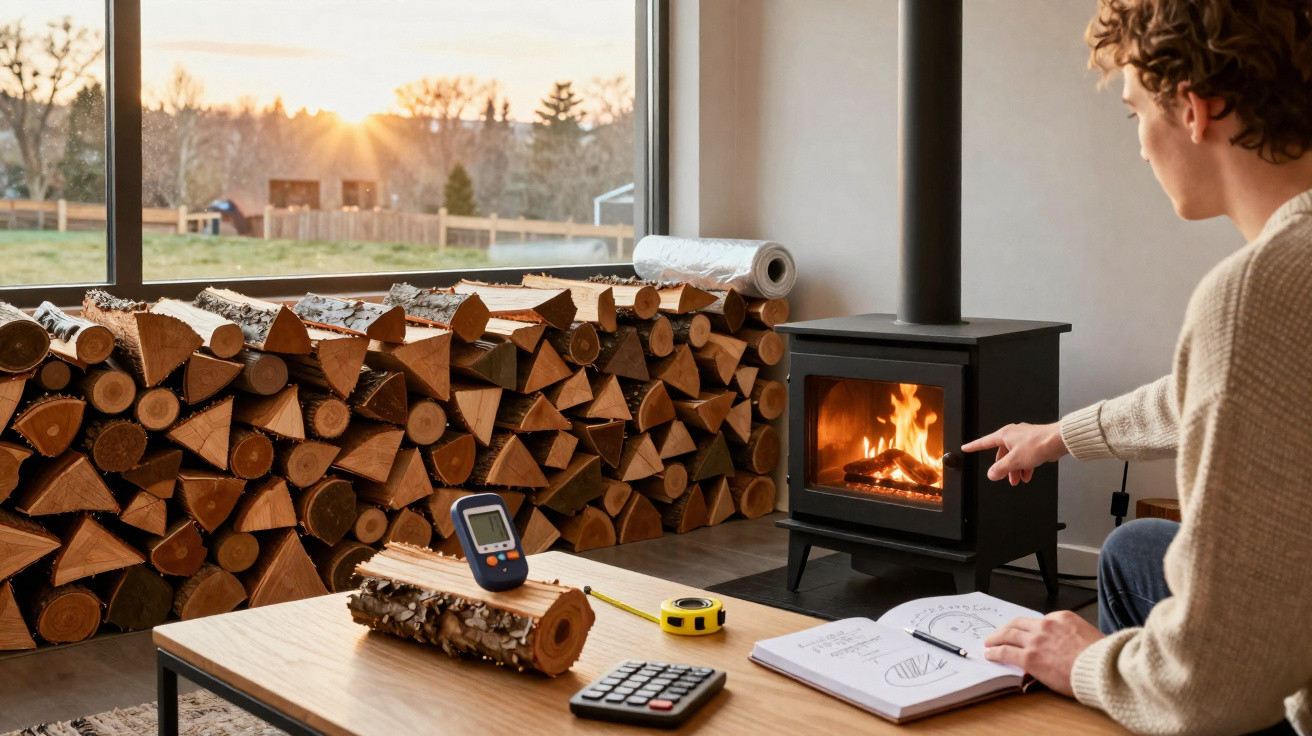
If you heat your home with wood, you can often cut your bills - but only if you plan enough for the whole winter season.
More and more households are switching back to wood as a heating fuel. The reasons are obvious: comparatively low running costs, a pleasant indoor feel, and a degree of independence from oil and gas. The key question remains the same, though: how much wood should you allow for a home of roughly 80 to 120 m² so it doesn’t suddenly turn cold between November and March?
How much wood does a house really need?
There isn’t a single, simple answer because usage depends on several factors. If you work purely from floor area, you can be wildly out. What matters most is:
- Floor area: 80 m² will need noticeably less wood than 120 m² - obvious, but often underestimated.
- Insulation: a well-insulated home holds on to heat; poor insulation effectively “burns” your logs straight out through the windows.
- Appliance type: a modern wood-burning stove, a closed fireplace with an insert, or an open hearth - consumption can differ dramatically.
- Location and winter severity: a mild Rhine Valley plain versus a windy upland ridge - the number of heating days varies a lot.
- Wood species and quality: hardwood provides more energy per stacked cubic metre than softwood; damp wood provides far less than dry wood.
“As a rough rule of thumb: for a well-insulated detached house of around 100 m², many households use 4 to 8 stacked cubic metres of wood per heating season.”
With weak insulation or outdated kit, this figure can easily rise to 10 to 15 stacked cubic metres - and your costs rise with it.
Stacked cubic metre, loose cubic metre, solid cubic metre: what do these terms mean?
As soon as you order firewood, you run into different units. In practice, three are most common:
- Stacked cubic metre (rm): wood stacked neatly - including air gaps - to 1 × 1 metre with a length of 1 metre.
- Loose cubic metre (srm): logs tipped loosely into a 1 m³ container - it holds less wood than a stacked cubic metre.
- Solid cubic metre (fm): pure wood volume with no air gaps, used more in forestry.
Most private customers buy stacked or loose cubic metres. One loose cubic metre is roughly equal to about 0.7 stacked cubic metres, depending on log length and how evenly it’s cut and sorted. When comparing prices, always check which unit the seller is quoting.
Consumption by heating technology: stove, insert or open fire?
Efficiency is what decides how much of the energy stored in the wood actually ends up heating your rooms. The differences are significant.
Modern wood-burning stove for 80–120 m²
A modern stove with good combustion technology can achieve efficiencies of 75% or more. For a typically well-insulated home, a realistic seasonal range is:
- 80 m², well insulated: about 3 to 5 stacked cubic metres per season
- 100 m², well insulated: about 4 to 6 stacked cubic metres
- 120 m², well insulated: about 5 to 7 stacked cubic metres
If the stove sits centrally in the main living area and you can keep internal doors open, heat usually spreads through much of the home - and the lower end of the range is often enough.
Fireplace insert or closed fireplace
Inserts tend to sit slightly below the best modern stoves, but they are still far better than an open hearth. For a 100 m² home with average insulation and a fireplace insert, you can expect roughly 6 to 9 stacked cubic metres. With 80 m² and good insulation, 4 to 6 is often sufficient; with 120 m² in an older building, demand typically shifts towards 8 to 10 stacked cubic metres.
Open fireplace - the wood guzzler
An open fireplace may look atmospheric, but from an energy point of view it’s a disaster. Most of the heat goes straight up the chimney. For 100 m² of floor area with only modest insulation, 12 to 15 stacked cubic metres of wood is not unusual - and with poor insulation, even more. For 80 to 120 m², an open fireplace is hardly sensible as a primary heat source.
“If you genuinely want to heat with wood, it’s worth considering a modern stove or a fireplace insert - it saves wood, money and effort.”
Insulation: the hidden lever for using less wood
Even the best heater won’t help much if the building can’t retain warmth. Insulation acts like an invisible stockpile of logs: the better it is, the less you need to feed the fire. The biggest drivers of higher consumption include:
- uninsulated lofts
- old single glazing or draughty windows
- uninsulated cellar ceilings
- gaps around doors and roller-shutter boxes
Even small upgrades can reduce usage noticeably: sealing strips on windows, insulating the cellar ceiling, or adding insulation to the roof. If your home has been refurbished - or it’s a newer build - you can often get through winter with far less wood; compared with an older, uninsulated property, demand is frequently halved.
Which wood species are worth burning for heat
Not all logs deliver the same energy. Hardwoods are denser, burn more slowly and give off more heat. Particularly popular choices are:
- Beech: very high calorific value, steady flame, ideal for long burn times.
- Oak: also high in heat output and long-burning, but needs a well-adjusted stove because it produces lots of embers.
- Ash and hornbeam: similarly strong performance, often a little more expensive, but highly efficient.
Softwoods such as spruce or pine catch quickly and are great for lighting the fire, but they burn through faster. If you rely mainly on softwood, you’ll need more stacked cubic metres to achieve the same heat.
“Dry hardwood with less than 20% residual moisture offers the best mix of heat output, clean combustion and low consumption.”
Correct storage: how to keep your firewood properly dry
Wood that sits in the rain or lies directly on the ground loses a large part of its potential. For an efficient winter supply, a few straightforward rules apply:
- Stack the wood so air can circulate; don’t pack it too tightly.
- Keep it off the ground by using pallets or battens.
- Protect it from rain from above, while leaving the sides as open as possible so wind can pass through.
- Allow at least one to two years for drying, depending on species and how finely it’s split.
A moisture meter costs very little but helps stop you burning half-dry logs. If you regularly heat with damp wood, you’ll use far more fuel, create lots of smoke, and increase the risk of deposits in the flue.
Practical examples for 80, 100 and 120 m²
To make the range more tangible, here are a few typical scenarios with realistic spans:
| Floor area & condition | Heating technology | Estimated need per winter |
|---|---|---|
| 80 m², well-insulated flat | modern wood-burning stove | 3–5 stacked cubic metres |
| 100 m², detached house, average insulation | fireplace insert | 6–9 stacked cubic metres |
| 120 m², older house, poor insulation | open fireplace | 10–15 stacked cubic metres |
| 120 m², well-insulated house | high-output wood-burning stove | 5–7 stacked cubic metres |
These examples underline the point: the same floor area can burn twice as much wood - or only half as much - depending on insulation and the appliance.
Planning before winter: how to calculate your stock
If you’re new to heating with wood, you almost always misjudge the first winter by a bit. A rough approach helps reduce the risk:
- Work out the floor area (for example, 100 m²).
- Judge the insulation level: good, average, poor.
- Classify the appliance: modern stove, insert, open fireplace.
- Use the ranges above and choose a mid-point.
- Add a safety margin of 20 to 30%.
If you end the first winter with wood left over, you’ve built a buffer for next year - and leftover dry logs usually improve over time rather than deteriorate.
Health, comfort, costs: what else households should consider
Wood heating creates a cosy atmosphere, but it also comes with responsibility. A stove that’s too small gets pushed constantly at its limit; a stove that’s too large often ends up slumbering. Both are bad for the appliance, the chimney and local air quality. Specialist installers can calculate the right output for your floor area and insulation level, and a chimney sweep can also advise on appliance safety.
People who use wood effectively usually combine several steps: improved insulation, up-to-date technology, careful storage, and a realistic view of their own heating habits. That keeps the living room warm, wood use manageable - and winter far less daunting.




Comments
No comments yet. Be the first to comment!
Leave a Comment