
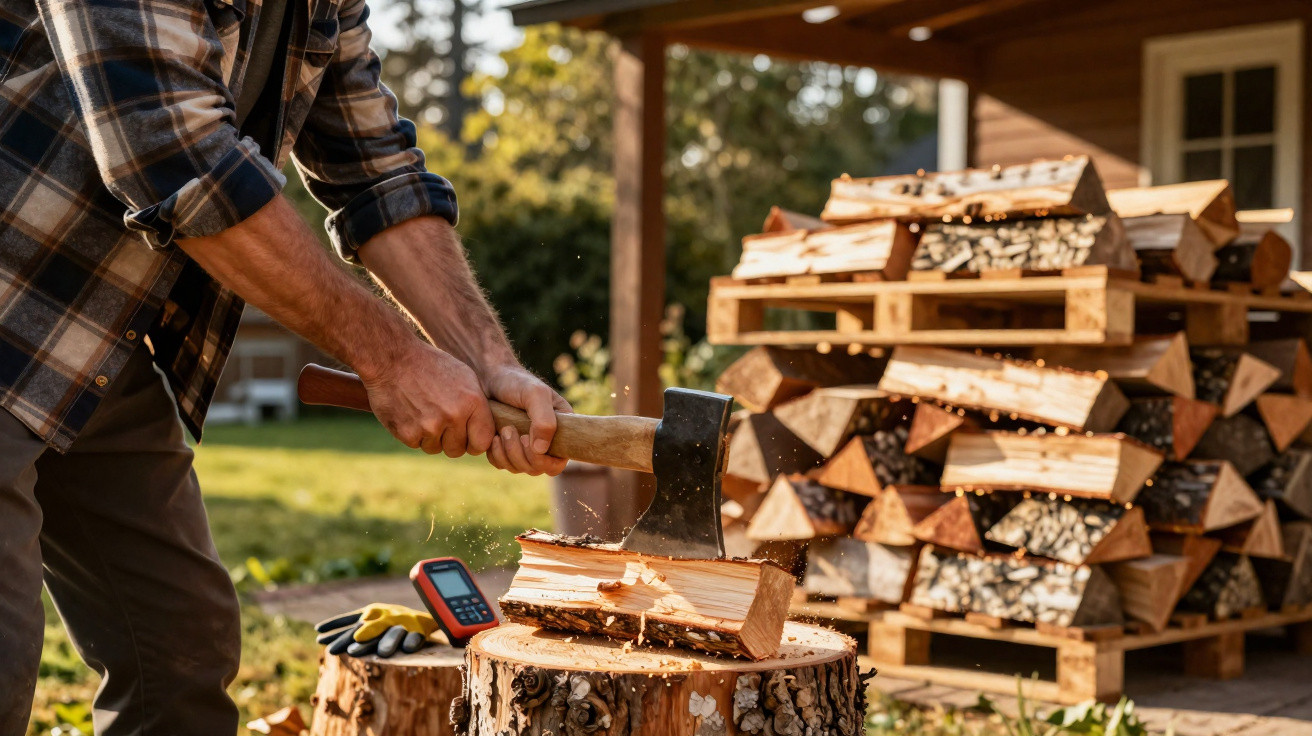
A small tweak can make all the difference.
On cold evenings by the fireplace, you’re expecting crackling flames and proper warmth. In reality, many people get little more than a few sparks and a lot of smoke. The cause is rarely the stove itself; it’s almost always the wood - more specifically, how the logs were prepared and stored. Follow a few trade tips here and you can noticeably increase the heat you get from each log and bring your living room up to temperature much faster.
Why properly dried wood burns much hotter
Freshly felled wood can contain up to 50% water, depending on the species. If you burn it too soon, the stove first has to “evaporate” that moisture before any useful energy reaches the room as heat. You’ll notice it straight away: the flames look weak, the wood hisses, and the stove soots up.
"Well-dried firewood with less than 20% residual moisture delivers almost twice as much usable heat as damp wood of the same amount."
There’s also a safety angle. Wet logs produce a lot of smoke, soot and tar deposits that build up inside the chimney. That means more maintenance - and a higher risk of a dangerous chimney fire.
How to tell whether your wood is truly dry enough
You can often judge whether firewood is ready just by looking, plus a bit of experience. If you want to be precise, use a moisture meter from a DIY store. Key signs include:
- Colour: Dry wood looks more grey or dull, no longer freshly glossy.
- Cracks: Small drying cracks on the end grain are a good sign.
- Weight: A dry piece of the same size feels surprisingly light.
- Sound: Knock two dry logs together and you get a bright, clear sound. Damp wood sounds dull.
- Smell: A strong resin or forest-floor smell usually suggests remaining moisture; dry wood hardly smells at all.
If you do use a meter, take readings in several places on a freshly split face. If it shows under 20%, the wood is ideally prepared for a fireplace or stove.
The trick that noticeably increases heat output
The heart of the “heat trick” is straightforward, but it’s ignored in many homes: wood doesn’t just need to be stored dry - ideally, shortly before burning it should be split again and set aside in the right size.
"The smaller the logs and the more freshly they’re split, the greater the surface area - and the faster, hotter and cleaner the wood burns."
Plenty of people stack big blocks in the log store and put them straight into the stove. They will burn eventually, but you’re giving up a huge amount of heating performance. Instead, split your supply into stove-ready logs around 30 to 50 centimetres long and of moderate thickness, then make part of that batch smaller again a few days before you plan to use it. That change alone produces noticeably more intense flames.
Why this step makes such a difference
Splitting the wood again opens up the grain. Any remaining moisture can escape more easily, and the freshly exposed faces take the flame’s heat far more quickly. The result:
- The stove reaches operating temperature faster.
- The logs burn more evenly and hotter.
- There is less smoke and soot.
Many stove owners say that after switching to this approach they use noticeably less wood, even though the room ends up warmer.
How to store your firewood correctly
This heat trick only pays off if the wood has been able to dry properly beforehand. Storage is what makes the difference - and it matters from day one.
Split the wood straight away instead of waiting weeks
As soon as it’s sawn, the wood should be cut and split into stove-sized pieces. Large rounds only dry on the surface; the core can stay wet for a long time. Smaller logs expose much more surface to the air, so moisture escapes far faster.
Never store it directly on the ground
Moisture rises from below. If you lay logs straight on soil, you’re inviting mould and rot. Better options are:
- stacking on pallets,
- laying cross-battens under the first row,
- keeping an air gap to the ground of at least 10 centimetres.
That way, air can move underneath as well, which speeds drying considerably.
Air, light and a bit of sun
The best spot is open to the wind and gets as much sun as possible - for example, against a south- or west-facing wall. Keep the front face clear so the wind can blow through the stack. A roof or a sloping cover protects the top from rain while leaving the sides open.
Don’t stack the logs too tightly
If you cram the logs together, you shut out the airflow. Narrow gaps between rows work better. A simple method is to lay each layer slightly offset so small channels form automatically for the wind to pass through.
How long firewood really needs to dry
Many sellers advertise “air-dried” after just one summer. For best heating performance, you should plan more generously. A practical rule of thumb:
- softwoods such as spruce or pine: at least 1 year, preferably 1.5 years,
- hardwoods such as beech or oak: around 2 years, sometimes more.
If you put away a supply each year for the winter after next, you create a small buffer. That means what goes into the stove is almost never fresh, but consistently well-seasoned - a noticeable advantage when heating.
Which wood species give the most heat
Softwood is excellent for lighting the fire, but it burns down quickly. Hardwood takes longer to get going, but then provides strong, long-lasting heat.
| Wood species | Drying time (approx.) | Burning behaviour |
|---|---|---|
| Spruce / pine | 1–1.5 years | burns quickly, lots of flame, shorter ember phase |
| Beech | 2 years | high heat, long embers, ideal for stove fireplaces |
| Oak | 2–3 years | very long-lasting embers, slightly slower to catch |
| Birch | 1.5–2 years | attractive flame, pleasantly scented, medium ember duration |
In day-to-day use, a mix works well: use a few thin pieces of softwood to get it going, then add moderately sized hardwood logs on top. That way the temperature rises quickly and then holds for a long time.
A few extra practical tips to get more warmth from every log
To get the most out of your firewood, don’t just focus on storage and split size - pay attention to how you run the stove too:
- Bring wood indoors the day before. Indoor conditions draw out a bit more remaining moisture.
- Clean the stove regularly. Ash and soot reduce heating performance noticeably.
- Provide enough air. Throttling the air supply doesn’t save wood; it worsens combustion.
One more thing: oversized logs may look rustic in a fireplace, but they’re poor for heating. Several medium pieces usually provide more usable heat than one thick block that only smoulders in the centre.
Terms like “residual moisture” or “ember bed” may sound technical, but they’re simple in practice. Residual moisture is just the water still left in the wood, which gets in the way of efficient heating. A good ember bed is the evenly red-glowing layer at the bottom of the stove where new logs catch quickly. When you’ve got both under control, you’ll notice the difference: the fireplace stops being just a nice feature and becomes a serious source of heat - and every log does noticeably more work.





Comments
No comments yet. Be the first to comment!
Leave a Comment