
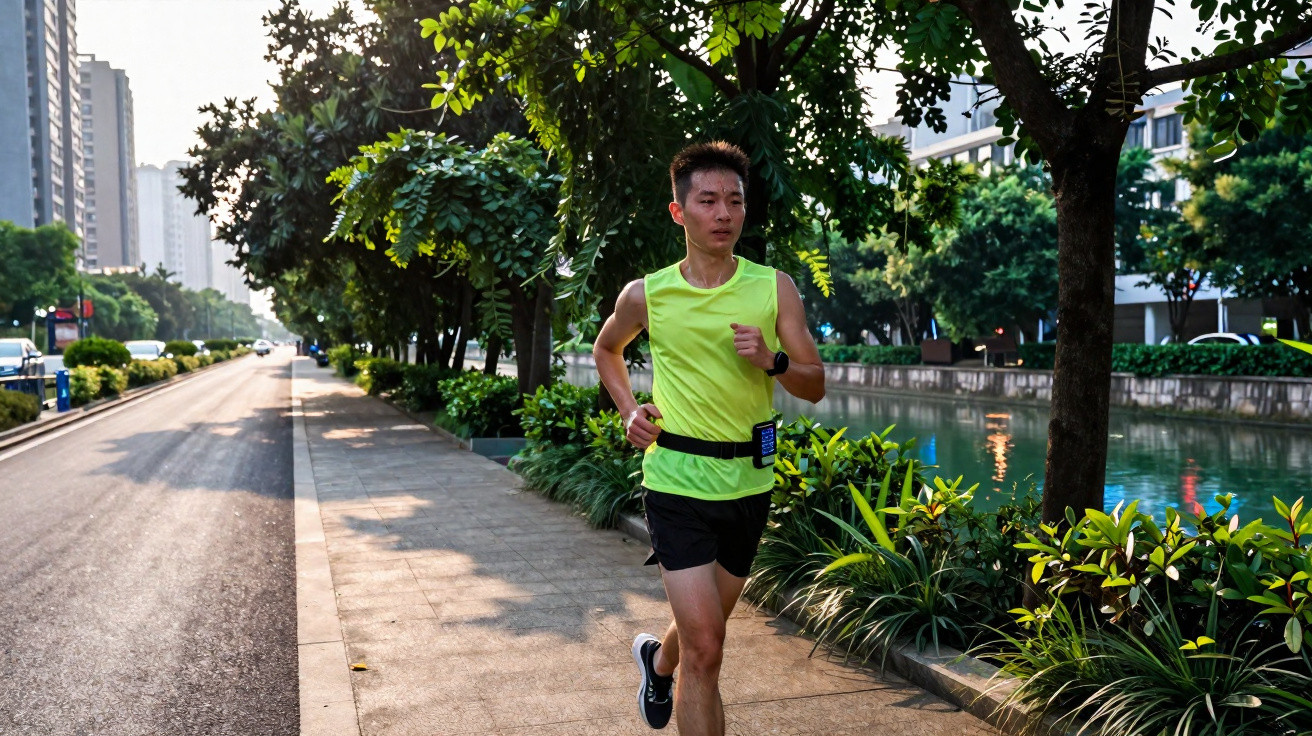
City planning departments often judge urban greenery from a bird’s-eye view: how much parkland there is, what share of the city sits under tree canopy, and how far each street block is from the nearest open space. For many local authorities, that’s the standard way to decide whether a neighbourhood is set up for outdoor living - and on paper it can look perfectly sensible.
A new analysis based on 20,000 GPS-tracked runs in a subtropical city in China argues that this overhead snapshot misses key details. The places people actually chose to run depended heavily on factors that typical park maps don’t capture - and rising urban heat appeared to be clearing out public spaces more than many planners have assumed.
Reading a city’s runs
The setting was Fuzhou, a dense subtropical city on China’s south-eastern coast. With sticky summers, more than a thousand parks, and a web of rivers and lakes, it provides a useful real-world test case.
Jian Sun at Fuzhou University (FZU), working with colleagues, compiled over 20,000 anonymised running records from Keep, a popular Chinese fitness app, during a single hot September. Each entry contained only basics: a start location, a pace, and a distance - coordinates and numbers, with no personal details.
Instead of picking a few likely explanations in advance, the researchers tested roughly three dozen potential influences - including temperature, vegetation, road density, air quality, and other features - across nine different predictive models. The best-performing model accounted for most of the observed clustering of runs.
Urban heat wins
The standout driver was urban heat stress. The team represented it using land surface temperature - the heat of the ground as detected by satellites - and they found that as surface temperatures rose, the number of recorded runs in those areas fell.
That pattern will feel familiar to anyone who has tried to run on a sweltering afternoon, and it aligns with earlier findings on heat and outdoor activity. One study covering parks across China reported that outdoor leisure declined once temperatures climbed beyond about 30 °C (86 °F).
Land surface temperature is an imperfect proxy. It reflects how hot roofs and paving become, rather than what a runner experiences directly - which also depends on shade, wind and humidity. Even so, the central message is clear: cooler ground conditions matter.
Greenery at eye level
If heat tends to drive people inside, green surroundings seem to tempt them back out - but not the kind of greenery you mainly detect from satellite imagery. The most influential “green” measure was street-level greenery: the foliage visible to a runner moving through a street block.
A sense of openness overhead also played a role. Routes with broader sky views - fewer tall buildings looming close and less of a canyon effect - were associated with more runs starting nearby than tighter, more enclosed streets. Taken together, visible greenery and open sky outweighed almost every other variable the team examined.
Previous studies have pointed in the same direction. An expanding research base links greenery seen at eye level with more walking, because it reflects what people encounter on the street more accurately than a purely aerial tally of park area.
Blue-green spaces
Proximity proved important as well. The nearer a run’s starting location was to water - rivers, lakes, or waterfront trails - the more runs tended to begin in that area, and a similar relationship appeared for sports facilities.
Water kept emerging as a consistent attractor. The researchers treated rivers, lakes, parks and vegetation together as blue-green spaces: natural and semi-natural areas that can cool the surrounding air and offer inviting places to be active.
When the team examined how these elements worked together across the city, the same story held. Green space and blue space each pushed jogging upwards, while heat stress pulled it down - all captured within a single model.
Greenery access gap
One finding initially seemed counter-intuitive. Several of the most active running start points were located further from the nearest vegetation patch rather than closer - the opposite of a straightforward “more greenery equals more runners” narrative.
The researchers interpret this as a gap in provision, not an odd preference. Many runs appear to begin in dense, heavily built-up districts with little nearby greenery, before continuing towards parks or riverbanks elsewhere. The starting point can therefore look green-poor even if the route quickly becomes greener.
That mismatch carries an understated warning. The places with the strongest appetite for outdoor exercise may be the same neighbourhoods with the least immediate access to nature. Motivated runners are effectively required to travel to reach pleasant routes - a blind spot that becomes visible when demand and green access are mapped together.
Greenery cools routes
The practical implications follow directly from these results. In the city’s hottest zones, planners can prioritise shaded running corridors, street trees and waterfront paths to keep outdoor space workable when heat builds.
Where there isn’t space for a large new park, smaller interventions can still make a difference: trees along pavements, vertical planting, and pocket parks fitted into tight street blocks. Given that visible greenery correlated with where more people ran, even modest planting at kerbside level may have meaningful impact.
The relevance extends well beyond a single Chinese city. As hotter seasons lengthen, similar pressure on outdoor activity is spreading across warm regions. One study reported trail use declining as temperatures rose.
What we now know
The novelty here is not the idea that heat discourages exercise or that greenery encourages it - both points were already documented. What this work adds is evidence of how these two forces operate together across a functioning city.
It also shows where the strain concentrates. Dense districts with high demand for outdoor activity and sparse nearby greenery become clearer targets for intervention, offering a more precise guide than broad calls to “add more parks”.
This does not change the underlying physiology of heat exposure or the benefits of trees. Instead, it gives urban design a practical rule for a warming climate: cool the ground, keep greenery within sight, and place both where runners already are.


Comments
No comments yet. Be the first to comment!
Leave a Comment