
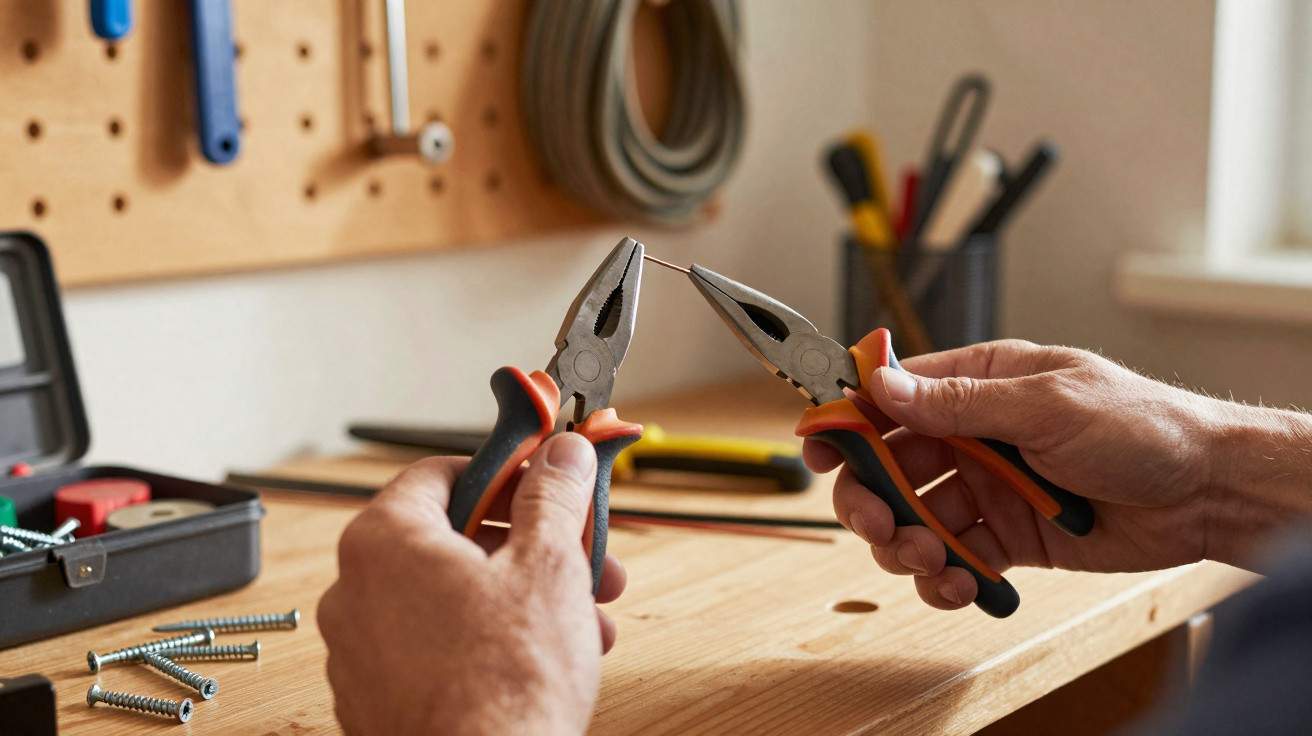
Universal pliers and needle-nose pliers can look as though they do similar jobs, but they are designed for different kinds of work. One is built to deliver strength and all-round usefulness, while the other is made for reach, accuracy and control in tight and delicate spaces.
What is the main difference between universal pliers and needle-nose pliers?
Pliers are hinged tools that increase the force your hand applies to an object. That basic principle is why there are so many versions, each shaped for gripping, cutting, squeezing or forming materials in specific situations.
Universal pliers have wider, serrated, sturdier jaws, making them suitable for holding, twisting, bending and cutting wires or assorted parts. Needle-nose pliers, by contrast, are slimmer and longer, which helps you reach awkward points and carry out tasks requiring precision and control.
The contrast is easiest to see here:
- Universal: used to hold, twist, cut and crimp a range of parts.
- Needle-nose: reaches narrow areas and makes small adjustments easier.
- Strength: the universal type is better for larger, more solid pieces.
- Precision: the fine nose helps with electronics, jewellery-making and small wires.
- Maintenance: cleaning and lubrication extend the tool’s working life.
What are universal pliers used for?
Universal pliers are the most familiar type found in home toolkits. They help you grip parts securely, twist wire, bend leads, cut light materials and crimp small components-always staying within the tool’s capacity.
Because the head is more robust, they are often handy for general repairs, minor fixes, simple installations and routine maintenance. Even so, they should not replace specialist tools when the job calls for a delicate finish, a clean cut or excessive force.
What are needle-nose pliers used for?
Needle-nose pliers-also known as fine-point pliers-are intended for places your fingers or a wide tool cannot reach. Their long shape lets you hold small wires, bend terminals and adjust parts with delicacy and precision.
Precision in small spaces
A slim shape changes the kind of work you can do
Where universal pliers prioritise strength, needle-nose pliers prioritise reach and control in narrow areas.
They are useful for electronics, crafts, jewellery-making, small repairs and handling thin wire.
In electronics and jewellery-making, needle-nose pliers make it easier to position tiny parts without crushing them or letting them slip. The narrow tip also helps with pulling, aligning and curving lightweight materials-provided you do not push beyond the limits of the tip and the joint.
They are commonly used for:
- Holding wires in tight spaces.
- Bending terminals and small metal rods.
- Jewellery-making and fine craft work.
- Delicate adjustments on small components.
How do you choose the right pliers for each task?
If the task involves gripping firmly, twisting something tougher or cutting everyday wire, universal pliers are usually the more practical option. If you need to reach into a cramped corner, handle small parts or fine-tune details, needle-nose pliers are the safer and more efficient choice.
It is also worth checking the handles. For electrical work, the tool must have proper insulation and be in good condition-no cracks, looseness or exposed metal where you hold it. Using unsuitable pliers as a stopgap can damage parts and increase the risk of household accidents.
Before you start, consider:
- The size of the part you need to grip or bend.
- Whether the space allows a wide jaw or requires a fine point.
- Whether you will be cutting, twisting, applying pressure or simply positioning.
- Whether the tool is clean, solid and free from play in the joint.
How do you look after pliers so they last longer?
Care begins with cleaning after use. Dust, metal debris and moisture speed up wear and rust, so it helps to dry the tool thoroughly, apply a small amount of lubricant to the joint and store it somewhere protected. A few at-home ideas-such as the aluminium foil trick to sharpen pliers-can sound appealing, but they do not replace careful inspection when a tool is heavily worn.
When the cutting edge becomes blunt, it is best not to force the handles or use the pliers on harder materials than they are designed for. Keeping the tool clean, aligned and stored correctly helps maintain bite, cutting performance and safety during each repair.



Comments
No comments yet. Be the first to comment!
Leave a Comment