
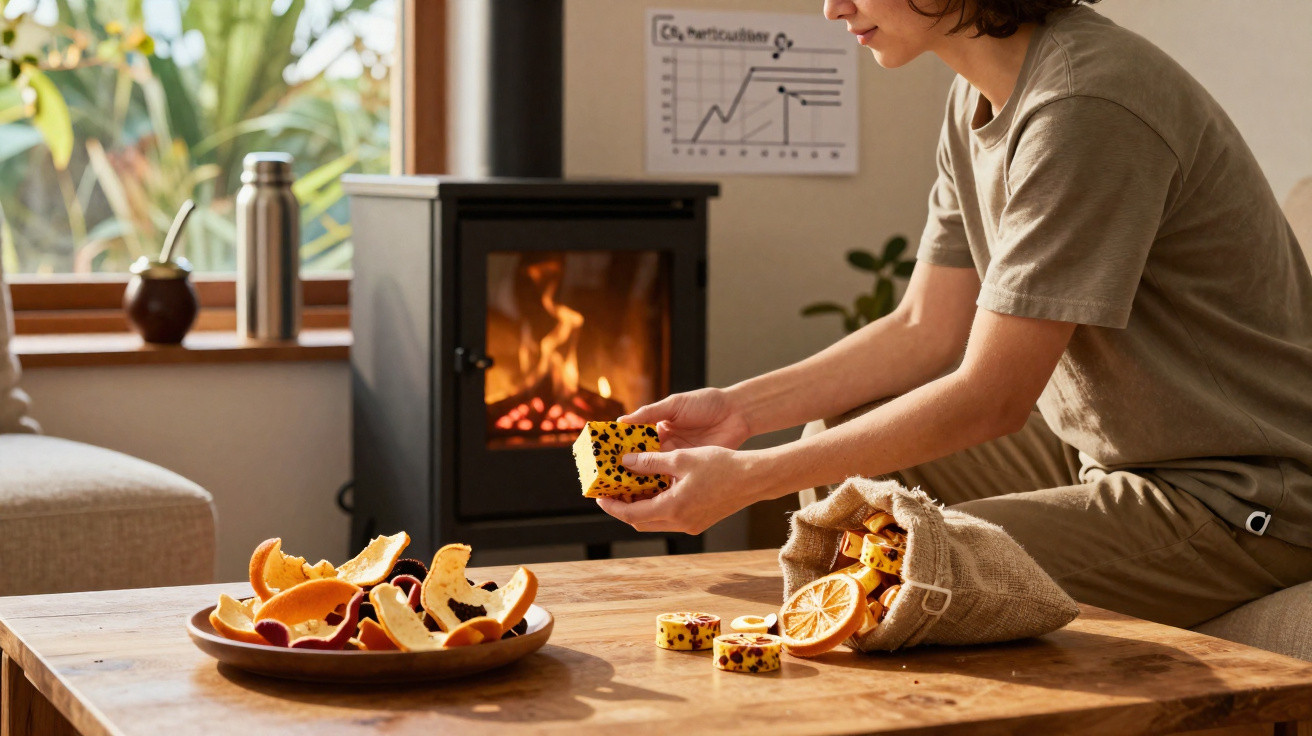
In many homes, wood is now seen as the “green” alternative to gas and oil. But a closer look makes one thing clear: logs and pellets come with real costs - to household budgets, to air quality and to forests. An inventor from Argentina wants to shift that balance by swapping traditional firewood for dried, compressed leftovers from fruit processing. It may sound odd, but it could turn into a genuinely viable model for the future.
Why heating with wood is so popular right now
The logic can seem compelling at first glance: electricity and gas prices rise, while firewood looks relatively affordable and is considered a renewable resource. Millions of households already rely on wood-burning stoves, tiled stoves or pellet boilers, aiming to reduce dependence on the grid and cut their energy bills.
Using wood for heating appeals for several reasons:
- When forestry is genuinely sustainable, wood comes from renewable sources.
- A modern stove can generate heat without using a single kilowatt-hour of electricity.
- Many families save several hundred pounds a year compared with purely electric heating systems.
- Fuel can be stored, which brings a sense of reserve and security.
There is also the emotional pull: a flickering fire, visible flames and that familiar scent all create a cosy atmosphere, especially in winter. In day-to-day use, though, many people overlook the knock-on effects that burning wood can bring.
The downside of the wood boom
As soon as wood burns, it produces fine particulate matter, soot and CO₂. Open fireplaces and older stoves in particular can emit large quantities of pollutants that linger in the air, especially in towns, cities and valleys. Health authorities have warned for years about particulates from wood stoves, because the tiny particles can penetrate deep into the lungs and may increase the risk of cardiovascular disease.
"Wood heating is considered climate-friendly, but in reality it contributes noticeably to air pollution and the greenhouse effect."
At the same time, pressure on forests is increasing. The more households demand wood and pellets, the more harvesting rises. Even where forest operators are officially working sustainably, ecosystems can be pushed out of balance if too much deadwood is removed or replanting happens too quickly. Forests are expected to supply fuel, provide habitat and function as CO₂ stores - and those aims only partly align.
There is another factor: wood also follows supply-and-demand dynamics. Over recent years, prices for logs and pellets have climbed significantly. Anyone without their own woodland feels that directly in their bill. Transport, storage space and drying add further costs and emissions.
A radical idea: heating with fruit waste
This is exactly where an unusual innovation from Argentina comes in. Cider producers and other fruit-processing businesses generate vast quantities of residues: skins, seeds, stems and pulp. Typically, these end up as waste or are used as animal feed. One entrepreneur saw an opportunity to turn this mountain of material into an energy source.
The basic concept is surprisingly straightforward: instead of cutting down trees, fruit residues are dried, shredded and compressed into briquettes. These resulting “fruit logs” can be used in a stove much like standard firewood or pellets.
"What used to be seen as a worthless leftover is turned into a usable fuel - without felling a single tree."
How the fruit briquettes work
At its core, the process follows a series of steps:
- Fruit processors collect skins, seeds, pomace and leftover pulp.
- The moist residues are dried using solar energy or waste heat.
- The dried material is shredded and mixed into a uniform mass.
- Hydraulic presses shape it into compact briquettes or elongated “logs”.
- The finished fruit fuels are kept dry in storage and can be transported much like conventional firewood.
According to the developers, the energy content and burning behaviour are very close to that of traditional wood. In tests, the briquettes light quickly, produce an even ember bed and work both in closed wood-burning stoves and in barbecues and fire baskets.
Less fine dust, less CO₂, less waste
The biggest advantage lies in the emissions profile. When fruit briquettes are burned, they generate significantly fewer fine particles than wood. That eases pressure on the respiratory system and lowers air pollution in densely populated areas. Because no additional trees need to be cut, forests - as CO₂ stores - are largely left intact.
At the same time, the approach tackles a second issue: agricultural by-products are put to productive use. Waste volumes fall, and fruit businesses gain an additional source of income. What was previously a disposal cost becomes a product that can be sold.
From a climate perspective, this creates a double lever:
- Less energy is required to produce conventional solid fuels.
- Fewer organic residues rot unused and release methane or CO₂.
- Forests retain their role as a natural carbon sink.
Could fruit briquettes also work in Germany?
The question is obvious: could a similar system be established in Central Europe? There would be no shortage of raw material. Cider presses, apple juice producers, fruit growers and wine producers all generate substantial quantities of pomace, seeds and skins. Some of it is already used for animal feed, fertiliser or biogas - but by no means all of it.
A regional approach could be particularly appealing: in fruit-growing areas such as the Old Land, around Lake Constance or in parts of Austria, small or medium-sized plants could turn fruit residues into fuel. The briquettes could then be sold locally, for example to households with wood-burning stoves or to municipal facilities with suitable boilers.
"Regional circular systems linking waste, energy and income - that is where the appeal of fruit-based fuels could lie."
From a technical standpoint, stove and boiler manufacturers would need to assess what modifications are required. Combustion chambers, feed systems and controls are currently optimised for wood and pellets. Approved standards, certifications and support schemes also matter if a new fuel is to make the jump into the mass market.
Opportunities and risks at a glance
| Aspect | Opportunity | Risk / barrier |
|---|---|---|
| Environment | Less fine dust, reduced pressure on forests | Emissions must be measured reliably and regulated |
| Economy | New income streams for agriculture and cider presses | Investment costs for presses, drying and logistics |
| Technology | Usable in existing stoves with minor adjustments | Approvals, standards and safety testing required |
| Society | Growing acceptance of recycling and circular-economy ideas | Possible scepticism about “waste” as a fuel |
What consumers should know about alternative fuels
Anyone planning to run a stove on alternative briquettes in future should understand a few basics. The key term is calorific value: it indicates how much energy is contained in 1 kilogram of fuel. The moisture content is particularly important. The drier the material, the more efficiently it burns and the cleaner the combustion.
For fruit briquettes, drying is therefore central. If most of the drying comes from solar energy or waste heat, the CO₂ balance remains attractive. If, however, large amounts of fossil energy are used, the environmental advantage shrinks. Certifications could provide transparency here, similar to schemes for sustainable wood or green electricity.
Storage is also practical reality: like wood, the briquettes are sensitive to moisture. They must be kept dry and well ventilated, otherwise mould and quality loss become a risk. For households with limited space, this remains an issue - even if briquettes are more compact than traditional logs.
How heating could change in the future
The direction of travel is clearly towards a mix rather than a single dominant option. Many experts expect households and cities to combine multiple energy sources: heat pumps, solar thermal, district heating, biogas - and innovative solid fuels made from residues. In that landscape, wood could gradually move from a mass-market fuel to a premium product used more selectively and sparingly.
Fruit briquettes are only one example. Similar concepts exist using rice husks, olive stones or nutshells. The shared principle is to use existing waste rather than cutting or extracting new raw materials. For consumers, that means: anyone investing in a new stove today should prioritise flexibility and choose appliances that can handle more than one type of fuel.
Whether and when fruit briquettes appear on shop shelves in German-speaking countries remains uncertain. The Argentine idea does, however, demonstrate how much room for change there is in what looks like the traditional world of wood heating - and how radically perceptions of “waste” can shift when it suddenly becomes a way to heat living rooms.





Comments
No comments yet. Be the first to comment!
Leave a Comment