
Each tread along the landing coaxed out a thin, offended squeal from the boards, like an elderly relation grumbling to themselves. Try sneaking to the kitchen in the small hours and the entire house suddenly performs like a haunted ship. New visitors offer a courteous smile. Anyone staying longer starts drifting in odd zigzags, hunting for the one quiet route that won’t give them away.
People will happily discuss double glazing, insulation and smart heating, but almost nobody mentions the sound a home makes. And yet few things age a place faster than a floor that objects every time you move. It seems trivial, but it alters your habits: where you place your feet, when you risk getting up, and how carefully you tread in your own bedroom.
Those squeaks have a cause - and the fix can be so straightforward it borders on comical.
Inside the world of squeaky floorboards
Walk through an older British hallway and it’s hard not to hear the past: work shoes, school bags, and late returns. That squeak just by the bedroom door when you step with your left foot? It’s probably been there longer than some relationships. What comes across as random noise is actually a recurring little drama of timber, nails and trapped air, played back every time you pass.
Beneath you, floorboards shift in tiny, barely visible ways. A nail has worked loose by half a millimetre. One board has curved just enough to rub its neighbour. A gap widens in dry weather, then tightens when the damp sets in. The sound is simply friction, but to your ears it can feel like judgement - and once you clock it, you can’t stop hearing it.
One quiet evening in a semi-detached in Leeds, a couple ran a small test. They dotted the landing with tiny sticky notes wherever it squeaked. Within ten minutes, the carpet looked like a crime scene. Fifteen squeaks between the bedroom and the bathroom. Three sharp pops by the top step. And one dreaded patch near the airing cupboard that groaned like a sitcom sound effect. They even kept score: just walking that route woke the baby in the next room 4 nights out of 7.
They’re far from the only ones. Some surveyors estimate that in older UK homes, almost 7 out of 10 timber floors they examine have at least one stubborn squeak. It’s not a structural emergency. It’s not headline material. But it still quietly dictates day-to-day life. One dad stopped his late-night gaming sessions purely to avoid waking the kids with the “squeak run” to the kitchen. A nurse on night shifts developed a strange hopping routine so she could get to bed after 3am without alerting the entire flat. These are the small compromises we end up making with our floors.
If you strip away the human annoyance, the explanation is fairly dull. Timber expands and contracts with humidity. Years of minute movement can loosen nails. Sometimes a board isn’t properly supported by the joist beneath, so it flexes more than the boards around it. Flexing leads to rubbing. Rubbing makes noise. Now and then it’s wood on wood; other times it’s a nail sliding in its hole with a faint metallic chirp. You step, the board bends, something shifts that shouldn’t - and the sound gets out. No ghosts, no mystery: just physics at ankle height.
The unexpectedly effective way to quieten squeaky floorboards
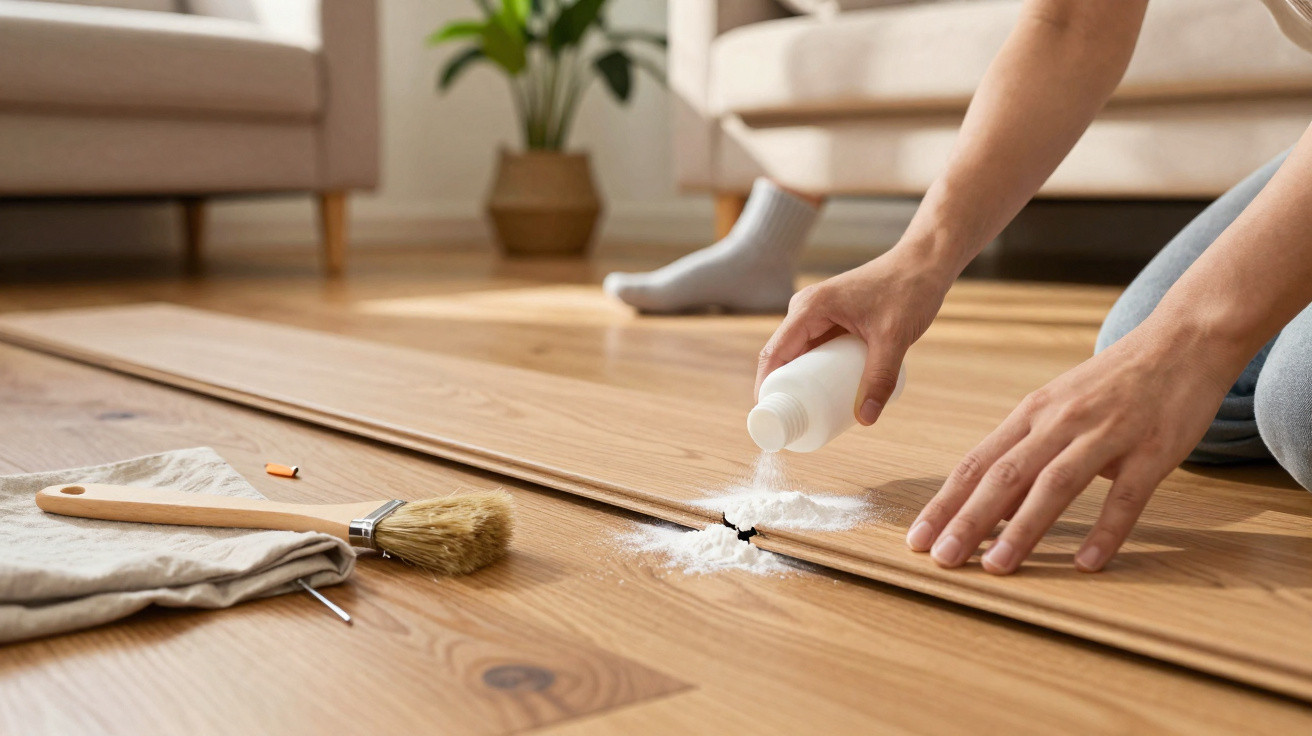
Here’s what tends to surprise people: one of the most reliable ways to hush squeaky floorboards is a dry lubricant. No full refit. No lifting half the house. Just a simple, slightly messy, oddly satisfying dusting of fine powder worked into the gaps between boards. Graphite powder, talc, or even a good powdered lubricant made for locks can make a noticeable difference.
The reasoning is straightforward. If the squeak is caused by boards rubbing, your job is to lower the friction. Powder falls into hairline gaps, coats the edges, and forms a smooth layer between them. Next time the boards shift, they slide rather than complain. It feels almost too simple, like one of those “nan’s tricks” you side-eye… right up until you try it. Plenty of people start with one noisy patch and then, slightly stunned, end up treating the entire landing on a Sunday afternoon.
A few details matter. Start by locating the precise source of the squeak, rather than guessing the general vicinity. That can mean stepping slowly - heel then toe - and listening carefully as you move. Then shake the powder directly into the narrow seams between boards, pushing it down with a soft brush or an old credit card. With carpet, access is harder but still doable: some people carefully lift a strip near the worst area, treat it, and put it back. Let’s be honest: nobody does that every day.
The most common error is expecting one casual sprinkle of talc to silence a floor that’s been grumbling for twenty years. Often you’ll need to do it more than once: walk on the spot to work the powder in, then add a little more. Another frequent mistake is reaching for oil. It sounds smart, but it stains, attracts dust, and doesn’t age well. Keep it dry. Treat it as a way to take the bite out of the worst noises, not a five-minute personality transplant. You’re training the floor to whisper where it used to shout.
There’s a particular satisfaction when that change takes hold. One homeowner in Bristol described the instant her upstairs landing finally went quiet:
“It was like someone had turned off a noise I’d been ignoring for years. I walked to the bathroom at night and… nothing. No squeak, no complaint. I honestly felt a bit emotional, which sounds ridiculous for a floor.”
After you’ve given the powder method a go, this quick checklist helps:
- Test each noisy spot slowly until you pinpoint the exact board.
- Use a fine dry powder: graphite, talc or a purpose-made dry lubricant.
- Brush it deep into the gaps and walk on it to help it settle.
- Repeat on stubborn areas after a day or two.
- If squeaks remain, look at loose nails or screws as the next step.
What it’s like to live in a quieter house
There’s an odd moment after treating a squeaky floor: your brain doesn’t quite believe it. You step gingerly, waiting for the familiar protest, almost bracing for it. Then nothing happens - just the soft sound of your own weight moving through the room. The house feels calmer, and you notice how much those tiny complaints had been shaping the evening soundtrack.
In practical terms, the trick isn’t a cure-all. If the joists are warped, or the boards were poorly laid from the start, bigger problems will still be waiting down the line. But this small fix can buy time, peace and sanity. Parents who used to dread the “post-story bedroom escape” can suddenly glide out like stage magicians. Flatmates stop flinching when someone crosses the landing for a 2am glass of water. One small domestic battle, quietly won.
On a more personal note, it’s about reclaiming control. So many everyday noises feel beyond reach - traffic, neighbours, boilers with a sense of humour. A squeaky floorboard is different: it’s a modest, solvable issue right in front of you. Fixing it won’t change the world, but it does change how you live inside your own four walls. And that shift is oddly powerful. You move from tiptoeing around your home to walking as though you belong there.
| Key point | Detail | Why it matters to you |
|---|---|---|
| Identify the source | Test each area gently to find the exact point of the squeak | Stops you treating the wrong spot and wasting time |
| Use a dry lubricant | Graphite, talc, or a specific dry product in the gaps | Cuts friction effectively without staining or gumming up |
| Repeat if needed | Revisit persistent areas after a few days | Helps deliver a genuinely quieter floor over time |
FAQ:
- What actually makes my floorboards squeak? Most squeaks come from movement: boards rubbing together, nails shifting in their holes, or timber flexing against joists when you put weight on it.
- Does talcum powder genuinely help with squeaky floors? In many situations, yes. Talc works as a dry lubricant between boards, reducing friction and taking the edge off the noise, particularly for lighter squeaks.
- Is graphite powder safe to use indoors? Graphite powder is often used for locks and small mechanisms; if you use a small amount carefully, it’s fine, though you should avoid breathing in any dust.
- What if the powder method doesn’t stop the squeaks? The cause may be loose fixings or inadequate support underneath, in which case screws, brackets, or professional help could be the next step.
- Can I stop squeaks without lifting the carpet? Sometimes you can reach edges and gaps around the skirting, but for persistent squeaks under thick carpet, lifting a section gives much better access and results.



Comments
No comments yet. Be the first to comment!
Leave a Comment