
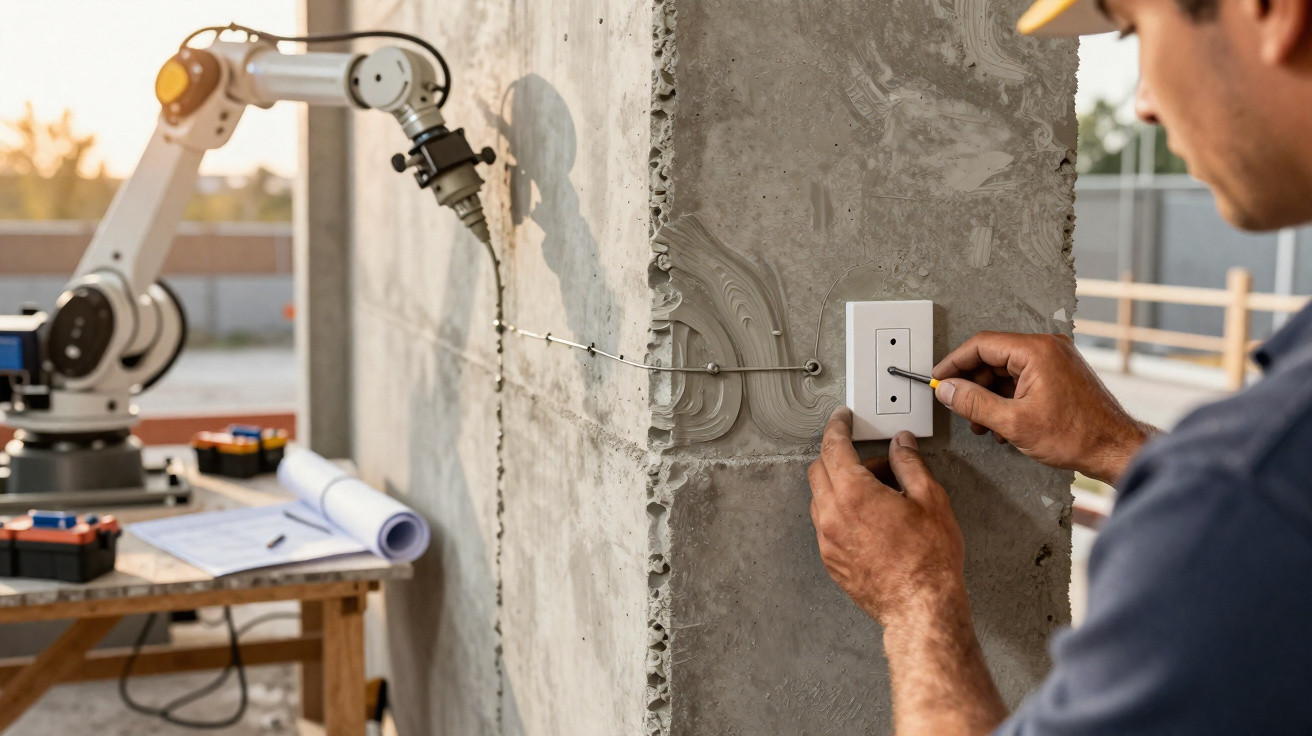
The robotic arm glides almost noiselessly, apart from a muted mechanical whirr and the steady hiss of fresh concrete. In the pale morning light it traces the footprint of a compact home, layer by layer-like a giant 3D printer set down in a muddy field. Nearby, workers sip coffee and watch the walls climb quicker than they can answer their emails.
Then it pauses. The house’s shell stands there: rough, grey, and faintly ghost-like.
That’s when people move in with tape measures, sanding blocks, paint rollers and buckets of grout. The “magic” abruptly looks like effort, repetition and patience.
On paper, the future of housing is robotic.
On site, the future still depends on calloused hands.
Robots can raise walls in hours, but homes take much longer
If you’ve ever scrolled past videos of robotic construction on social media, you could be forgiven for thinking the housing crisis has been solved with a nozzle and a cement lorry. A robot arm sweeps out broad arcs and-apparently-a 70 m² house appears almost overnight, like a speedrun version of architecture. Developers love the time-lapse: dawn on an empty slab, dusk on a fully walled structure.
What those clips tend not to show is the following morning, when the team returns with ladders, extension leads and a very human list of jobs.
Consider one of the headline 3D-printed housing projects in Texas. The robot produced the exterior and interior structural walls in under a week-quick enough to make any traditional mason do a double take. The headlines were triumphant: “House printed in 5 days!”
On the ground, however, electricians still spent weeks feeding cables through conduits that had been deliberately left in the walls. Plumbers worked in chilly rooms, lining up pipe runs and chasing down leaks. Carpenters had to trim door frames by hand to suit openings that were slightly imperfect after printing. Quietly, the real timeline for “move-in ready” stretched far beyond the viral headline.
The explanation is blunt: robots excel at repetitive, heavy, geometric work. Walls are geometry. But a skirting board that must meet a slightly uneven floor, a client’s last-minute tile change, or a bathroom niche moved ten centimetres? That’s negotiation, compromise and feel.
Finishing work is where a house stops being a structure and starts becoming someone’s home.
That shift still relies on skills stored in people’s hands and judgement, not in code. Even today’s best construction robots generally focus on framing, printing or bricklaying, while the awkward, fiddly-and often beautiful-details remain stubbornly human.
Where robots stop and human hands take over
On a robotic building site, the handover nearly always happens at the same point: once the shell is complete. The printed or robot-laid walls stand up like a draft-solid, but raw. Then the choreography changes. A finishing crew walks the rooms with blue tape and pencils, flagging the minor faults a camera would never notice: a dent here, a thermal bridge there, a socket that matches the drawing but not the actual kitchen layout.
The robot doesn’t debate anything. It just waits in the corner while people argue with the plans.
This is where expectation meets reality. Many first-time buyers arrive thinking “a printed house in 72 hours” means they’ll be unpacking the week after. Instead, they watch-often surprised-as painters spend three days on preparation alone, sanding down the layered ridges in the concrete. Tilers test every corner with a small spirit level, recutting pieces where a printed edge drops by two or three millimetres.
It’s that familiar realisation: speed in a brochure doesn’t necessarily feel fast in real life-especially when you’re paying rent on your current place and a mortgage on the next.
The dependency on people comes down to a stubborn truth about finishing: “tolerance stacking”. Be a few millimetres out in one spot, then a few more elsewhere, and suddenly the worktop won’t sit tight to the wall, or the shower door won’t close cleanly. A robot can print with impressive precision, but wind, temperature, the concrete mix and plain physics still introduce tiny variations.
A skilled finisher reads those variations with eyes and fingertips and adjusts on the fly. They don’t merely follow the drawing; they bargain with reality. And, honestly, nobody manages that perfectly every day-but it’s still a craft that robots find hard to match.
How the construction site is really changing
A practical way to frame robotic construction isn’t “robots replacing builders”, but “robots laying in the canvas”. In the field, the smartest crews are already adapting. They turn up earlier, tracking behind the printing robot with laser levels and checks, making sure later finishing steps won’t become a nightmare. They add small reference marks, tweak window heights slightly, and ask the operator to redo a section while the concrete is still workable.
The unglamorous secret is straightforward: avoid nasty surprises later, when a misaligned wall would cost days of sanding, patching and swearing.
There’s also a newer kind of problem that doesn’t get much attention. Because the main structure appears so quickly, clients are more likely to change their minds late. “Since the walls are already here, could we just move this doorway?” they ask, looking at the still-young concrete. On a traditional site, shifting a few blocks is irritating but manageable. With 3D-printed concrete, cutting a fresh opening can mean dust, reinforcement complications and waterproofing headaches.
Finishing teams then have to improvise less-than-ideal solutions: false walls, thicker plaster, extra trims to disguise cuts. The building remains sound, but the crisp logic of the robot-printed geometry gets softened by human compromise.
“People think the robot is the star of the show,” a site manager in the Netherlands told me. “For me, the real stars are the guys who show up after the cameras leave and make the place livable.”
To handle this shift, a number of builders now run through a simple checklist before they start work on a “robot-built” shell:
- Check reality against the 3D model room by room, not just overall.
- Decide early which walls will stay raw and which need full smoothing.
- Plan cable routes and plumbing exactly, to avoid brutal cutting.
- Reserve contingency time for details that will go wrong somewhere.
- Talk to clients face-to-face about what “fast build” really means.
None of these are futuristic abilities. They’re familiar habits, adjusted for a site where the first phase suddenly runs at machine speed.
The quiet partnership between code and calloused hands
Walk around a robotic construction site in late afternoon and you’ll notice something small but revealing. The robot is often parked up and powered down, its arm folded away like a sleeping animal. The people are still working-finishing a joint, smoothing a corner, debating where to end the tile run.
Nobody records this for TikTok.
Yet this is the part that becomes “quality” once the keys are handed over: how light lands on a smooth wall, the way a door closes with a soft click, whether there’s a draught under the window on a winter night. The comforts that never trend, but define everyday life.
| Key point | Detail | Value for the reader |
|---|---|---|
| Robots speed up structure | Wall printing or automated bricklaying can cut framing time from weeks to days | Understand why “house in 3 days” headlines don’t equal instant move-in |
| Finishing still needs people | Electricians, plumbers, tilers, painters adapt to real-world imperfections | Set realistic expectations about cost, delays, and what can be automated |
| New skills, not fewer jobs | Workers shift from heavy repetitive tasks to coordination and fine detail | See where human expertise will stay valuable in a more robotic future |
FAQ:
- Will robots eventually do all the finishing work too? Some tasks like spraying plaster or painting large surfaces are already semi-automated, but detailed jobs - fitting sockets, aligning tiles, adjusting doors - still rely on human judgment and touch.
- Are robot-built houses cheaper for buyers? Structural costs can drop, yet savings are often eaten up by finishing, land, permits, and energy standards, so the final price usually isn’t “half the cost” as ads suggest.
- Is a 3D-printed or robot-built house as solid as a traditional one? When designed and executed properly, yes: structural tests show comparable or better performance, though long-term durability data is still building up.
- Do construction workers lose their jobs with robots on site? Most companies report a shift rather than a disappearance of roles, with fewer backbreaking masonry tasks and more coordination, layout, and finishing work.
- How can future owners avoid disappointment with “fast build” promises? Ask for two dates: shell completion and full handover, and question what exactly the robot builds versus what humans will still do by hand.





Comments
No comments yet. Be the first to comment!
Leave a Comment