
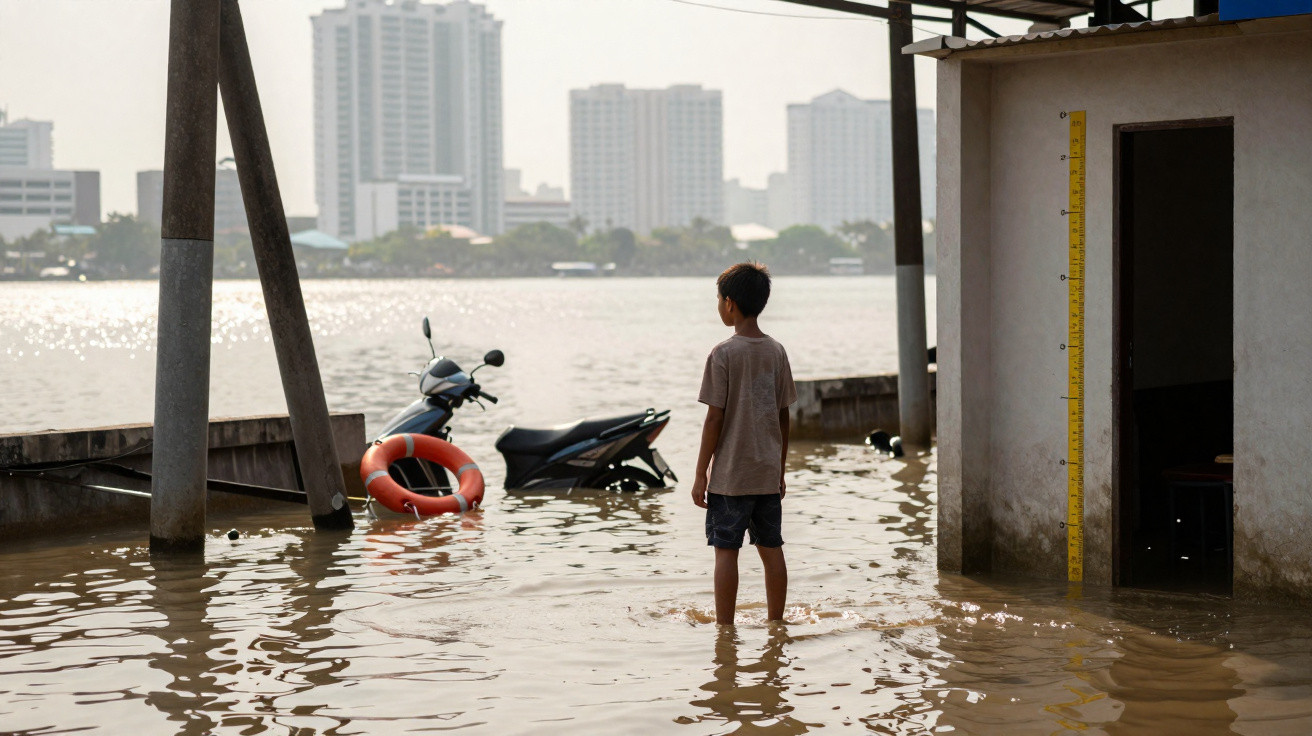
At first glance, the megacity looks like an endless carpet of high-rises, swarms of mopeds and building sites. Yet beneath that surface, a quiet drama is unfolding: year after year the metropolis is dropping lower, while the adjacent sea continues to creep inland. For tens of millions of people, the question is no longer abstract - it is whether their city will still be liveable in a few decades.
The world’s largest metropolitan region - and it is sinking
Jakarta, Indonesia’s capital, is now widely regarded as the most populous metropolitan region on the planet. About 42 million people live across the wider urban area, which stretches over more than 660 square kilometres. The skyline keeps climbing, the roads are clogged, and the construction boom shows little sign of slowing. At the same time, the ground beneath the city is moving in the opposite direction: down.
“In some northern districts, the ground sinks by more than 20 centimetres per year - a rate that ranks among the most extreme anywhere in the world.”
This downward shift - known in technical terms as land subsidence - is not some natural quirk that happens “all by itself”. It is largely driven by human activity and is therefore, in principle, reversible - or at least something that can be slowed. The trouble is that the window to act is closing.
Why the ground under Jakarta is giving way
The heart of the crisis is water - more precisely, the lack of reliable access to safe drinking water. Many lower-income households do not have a dependable piped supply. Instead, they drill wells or use pumps to tap groundwater. What solves a problem today steadily undermines the city’s foundations tomorrow.
When groundwater is drawn from deeper layers, the porous rock and sediments lose the “water core” that helps them bear loads. Those layers compact under the weight of buildings above. The result is straightforward: the surface drops.
- Too little piped water for millions of residents
- Unregulated pumping of groundwater
- Compaction of soil layers under the city’s weight
- Sealed surfaces stop rainwater soaking back into the ground
On top of that comes the sheer spread of concrete and asphalt. Roads, car parks and dense high-rise developments seal the surface. Rain that once filtered down to replenish groundwater now runs through drains straight into canals and rivers. The aquifers beneath the city have little chance to recover.
Sea level is rising - and the city is dropping faster
Subsidence is only one side of the squeeze. The second pressure comes from a global trend: rising sea levels. As oceans warm and glaciers melt, water expands and sea level continues to inch upwards. Local estimates in some places put the increase at two to four centimetres per year.
Even that would be hard enough to manage. But when the land is also sinking, the combined effect accelerates sharply: the relative gap between city and sea grows at an alarming pace. In northern Jakarta, entire neighbourhoods already sit below sea level. Only dykes and sea walls are holding back the water - and those barriers fail repeatedly.
“A city that is sinking into the ground while being lapped by a rising sea is caught in a dangerous vice.”
Salt water is pushing into residential areas more often. The consequences include flooded streets, damaged homes and a persistently damp environment in which illnesses can spread more easily.
When the rainy season and climate change meet failing infrastructure
Jakarta lies in the tropics. The rainy season runs from October to March, bringing intense downpours. With climate change, these rains are not only becoming more frequent, but in many places more severe. More water falls in a shorter time onto a city whose drainage network is already close to its limits.
Many sewers are ageing, blocked or poorly maintained. Illegal dumping makes matters worse, as plastic bags and other rubbish clog channels and culverts. When heavy rain coincides with high river levels and a rising tide, it can take only a few hours for entire districts to end up underwater.
Compounding this is dense air pollution from traffic, industry and the burning of waste. Smog regularly hangs over the city, and children and older people in particular suffer from asthma and other respiratory problems. Climate impacts, air quality and overcrowding are tightly linked - each amplifying the other.
What experts fear by 2050
A number of studies issue a stark warning: if Jakarta continues on its current path, large parts of the city could become uninhabitable by the middle of the century. Some experts say that around one third of the capital could end up at least partly underwater if effective countermeasures are not implemented.
The economic shock would be enormous. Jakarta is Indonesia’s political, commercial and cultural hub. Millions of jobs depend on the city, directly or indirectly. For people who lose their homes, the loss often also means losing access to work, education and healthcare.
What the government is doing to stop Jakarta sinking
Indonesia’s authorities are trying to prevent the worst outcomes. Their approach includes several strands:
- Building dykes and coastal protection structures in the north of the city
- Upgrading the sewerage system and adding new pumping stations
- Introducing rules intended to curb unregulated groundwater extraction
- Relocating particularly exposed residents to higher parts of the city
The most headline-grabbing move, however, is political: the government intends to relocate the capital. A new capital called Nusantara is being built on the island of Borneo, more than 1,200 kilometres from Jakarta. The projected cost is around 35 billion US dollars. The project is not expected to be completed before the mid-2040s at the earliest.
“Nusantara is meant to ease pressure on Jakarta as the seat of government - but it only partially addresses the problems of the old megacity.”
Critics argue that the plan mainly shifts the political and administrative machinery, while doing too little for the millions of people living in the vulnerable coastal districts. Many residents feel abandoned as water levels continue to rise.
What could save a city from going under
Jakarta is not alone in facing this kind of threat. Major cities such as Bangkok, Manila and Lagos are grappling with similar patterns. From the perspective of urban planners and climate researchers, there are levers that can work in places like these - provided there is political will and sufficient funding.
| Measure | Benefit |
|---|---|
| Expansion of public drinking-water supply | Reduces pressure on groundwater reserves |
| Strict management of wells and pumps | Stops unregulated lowering of the ground |
| Greening and removing sealed surfaces | More rainwater soaks in, groundwater replenishes |
| Modern drainage and sewer network | Better control of flooding during heavy rainfall |
| Long-term coastal protection projects | Protection from storm surges and rising sea levels |
Access to clean, affordable piped water is particularly crucial. If households can get reasonably priced water directly from the tap, the incentive to drill private wells falls. That protects deeper soil layers - and with them the stability of the city as a whole.
What other cities can learn from Jakarta
In the UK, many people think of sea-level rise in terms of coastal defences and storm surges. Jakarta’s situation shows how strongly human interventions and climate-driven effects can combine - even away from an exposed open coastline.
Three points stand out in particular:
- Water infrastructure is safety infrastructure - missing pipelines will, sooner or later, become expensive.
- Sealed surfaces come back to bite in crises, because every patch that could absorb water is missing.
- Spectacular projects such as building new capitals may look decisive, but they do not replace consistent repairs and upgrades on the ground.
Technical terms like “land subsidence” may sound abstract, but they translate into very real lives: families whose living rooms sit a little lower than the road each year; children wading through brackish water on the way to school; shopkeepers forced to pump out their premises again after every flood.
For anyone planning urban development today - whether in Asia, Africa or Europe - these questions can no longer be avoided: how much groundwater is being used? How much land is left unsealed? How robust is drainage when rainfall intensifies? Jakarta offers a stark example of what happens when those questions are ignored for too long - and how difficult it is to stabilise a megacity once it has started to sink.


Comments
No comments yet. Be the first to comment!
Leave a Comment