
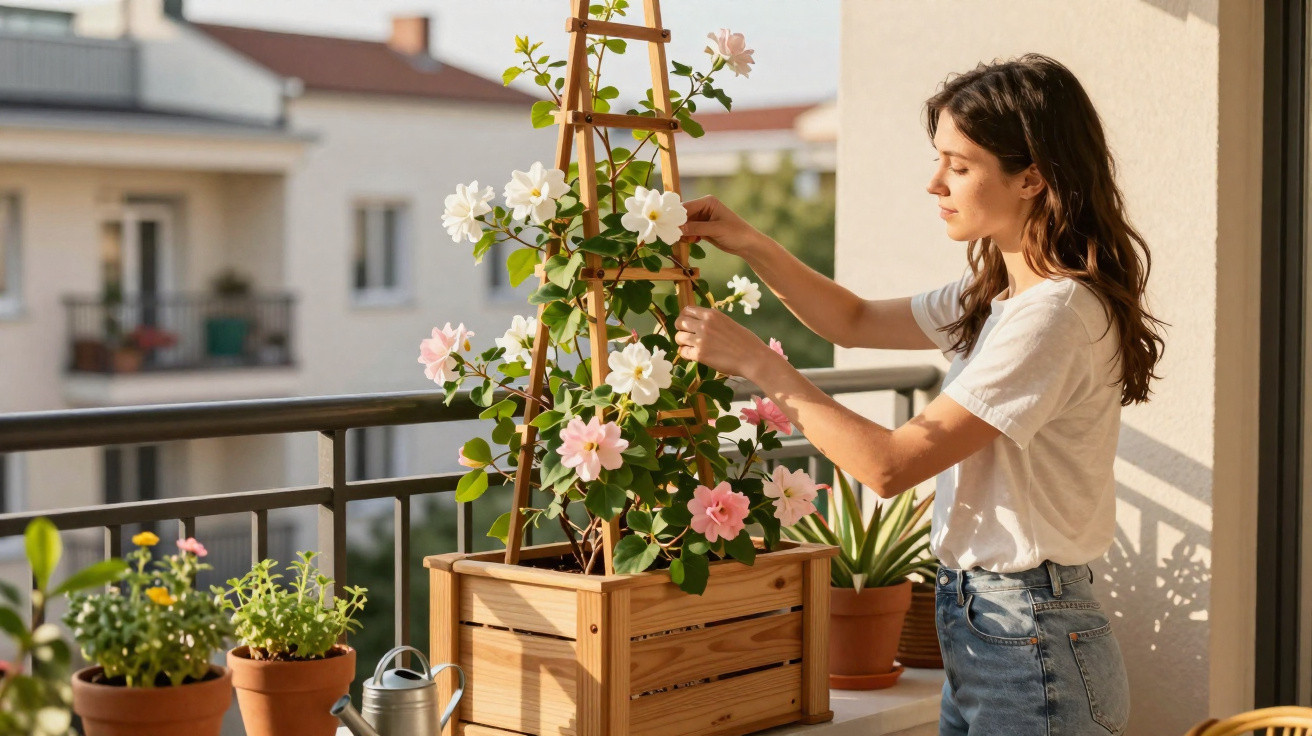
After winter, plenty of balconies and tiny gardens look bare, gloomy and far from inviting. Lidl is now putting a compact garden piece on its shelves that tackles exactly that: a sturdy wooden planter box with an integrated trellis, designed for herbs, flowers - and as a natural privacy screen to block curious onlookers.
What’s behind Lidl’s new planter box
Lidl is bringing a solid-wood planter to stores under its Parkside brand - and it’s clearly meant to do more than simply hold compost. At the base there’s a rectangular box for soil and plants; fixed to it is a trellis that rises to roughly 1 metre. Put together, it creates a small-scale “green wall”.
"For just under £30 you get a weather-resistant wooden planter box with trellis, offering space for around 20 litres of soil and a small wall of climbing plants."
The proportions are intentionally compact. At about 60 cm wide and only around 28 cm deep, it suits narrow balconies, the edge of a patio, or a spot right by the garden fence. Despite that, the overall height of roughly 1 metre can still provide noticeable privacy once the planting fills out.
Material, dimensions and specs: what buyers actually get
The planter is made from solid timber and comes pre-treated with a water-based stain. That finish helps protect it from rain and UV exposure, slowing down the usual greying of the wood. Inside, there’s a matching plastic liner, so you don’t have to put soil directly against the timber.
- Material: solid, stained wood; weather- and UV-resistant
- Liner: removable plastic insert used as the planting tray
- Capacity: around 20 litres of soil
- Maximum load: about 30 kilograms
- Dimensions: approx. 60 cm wide, 28 cm deep, 100 cm high
- Where it fits: balcony, patio, small city garden, or right along the property boundary
The box also includes screws and a straightforward set of assembly instructions. With a standard screwdriver or cordless drill/driver, it can be put together quickly. The trellis is screwed to the rear of the planter and then forms a single unit with the planting box.
Why it’s so appealing for small gardens
The key advantage is vertical growing: instead of needing wide beds, the planting climbs upwards. That’s ideal for city flats with balconies or narrow terraced-house gardens. If you only have a small patio, this combination of planter and trellis can deliver several benefits at once.
"One piece, three jobs: planter, climbing support and subtle privacy screen - all on less than half a square metre of footprint."
At the bottom you get a neatly defined mini bed for herbs, flowers or snackable veg. Above, climbers can work their way up the trellis and gradually build a green surface. That makes it possible to shield a seating area from neighbouring views without installing a solid fence or paying for an expensive screening panel.
Family-friendly: gardening without wrecking the lawn
For families with children, the raised planter adds another plus point. Kids can reach the soil easily without crawling on the ground or digging through garden beds. The “grow your own” project stays contained - and doesn’t immediately turn the whole lawn into a mess.
Many parents use planters like this for simple garden experiments with children: sowing seeds, watering regularly and watching the plants develop. The limited space keeps everything manageable. Children also tend to see results faster, which helps motivation - while learning along the way that tomatoes and herbs don’t simply originate in a supermarket.
Which plants are genuinely worth planting
If the planter is meant to look good and function as a privacy screen, the planting choice matters. In the box itself, hardy, low-maintenance varieties work best - the kind that won’t collapse after a dry day.
Herbs and flowers for the planter box
Good, proven options include:
- Rosemary: loves sun, tolerates dry spells, perfect for barbecues
- Thyme: stays low, often flowers, and attracts bees
- Mint: grows vigorously and suits tea and cocktails - the box helps keep it under control
- Nasturtium: produces long shoots and edible flowers, a great starter project for children
- Trailing petunias or verbenas: add colour and soften the planter’s edge
For the trellis itself, you’ll want climbing plants. The most suitable are varieties that grow quickly and become dense in the first year:
- Sweet peas for delicate flowers and a pleasant scent
- Annual morning glory for rich green growth and plenty of colour shades
- Smaller clematis varieties if the planter is staying put long-term
- Jasmine varieties for older brickwork or sheltered corners
If you sow early in the season or plant young specimens from a garden centre, you can expect a reasonably filled-in green screen by early summer. On a balcony, that’s often enough to create the sense of a private nook.
Practical use on a balcony, patio and in a terraced-house garden
In real life, the planter rarely ends up in the middle of the garden. It’s far more often placed along boundaries: by the balcony railing, in front of a balustrade, on the patio edge, or beside the garden door. In those spots it can partly replace classic bamboo or plastic privacy screens - but looks noticeably warmer and more homely.
"Instead of a grey concrete wall or a plastic screen, you’re looking at a living green surface - and in summer, that’s what makes the difference."
On balconies, it often doubles as a room divider: dining area on one side, “garden” zone on the other. If you work from home and use the balcony as an extra workspace, the planter can be positioned as a natural backdrop for video calls. In a terraced-house garden, it offers an add-on privacy solution towards neighbouring plots without risking arguments over fence heights.
Care and durability: keeping the wood looking good
Although the timber is stained at the factory, it’s still worth thinking about upkeep. If you want it to last as long as possible, apply a fresh coat of wood stain or oil every two to three years - ideally in a dry spring spell.
A few simple steps can significantly extend its lifespan:
- Stand the planter slightly raised, for example on rubber feet, so water can drain away underneath.
- Avoid waterlogging in the plastic liner by adding small drainage holes at the base.
- In autumn, remove spent plants and loosen or replace the soil.
- Before strong winds, check the trellis is still firmly screwed in place.
With regular maintenance, a planter like this can easily last for several gardening seasons. If you prefer, you can paint or stain the wood in your own colour - for instance to match the house exterior or balcony furniture. Done well, it can make a discount buy look like a bespoke piece.
Added value at home: privacy, microclimate and atmosphere
Beyond the obvious role as a privacy screen, a planted trellis planter brings a few extra benefits. Climbers and dense foliage can improve the microclimate, particularly on balconies that heat up strongly. Leaves provide shade, air moves more comfortably, and the filled soil retains a little moisture.
If you choose flowering varieties, it also becomes a small feeding stop for insects. Bees and butterflies can still find nectar even in densely built-up neighbourhoods. Many city residents value exactly this small slice of nature outside the door - especially when children are growing up and don’t otherwise encounter many real plants.
If you take the idea further, you can place several of these planters side by side to create a full green wall. A mix of herbs, flowering plants and climbers makes a varied-looking, very slim “garden strip” that can fit almost anywhere - from a narrow roof balcony to a paved back courtyard.





Comments
No comments yet. Be the first to comment!
Leave a Comment