
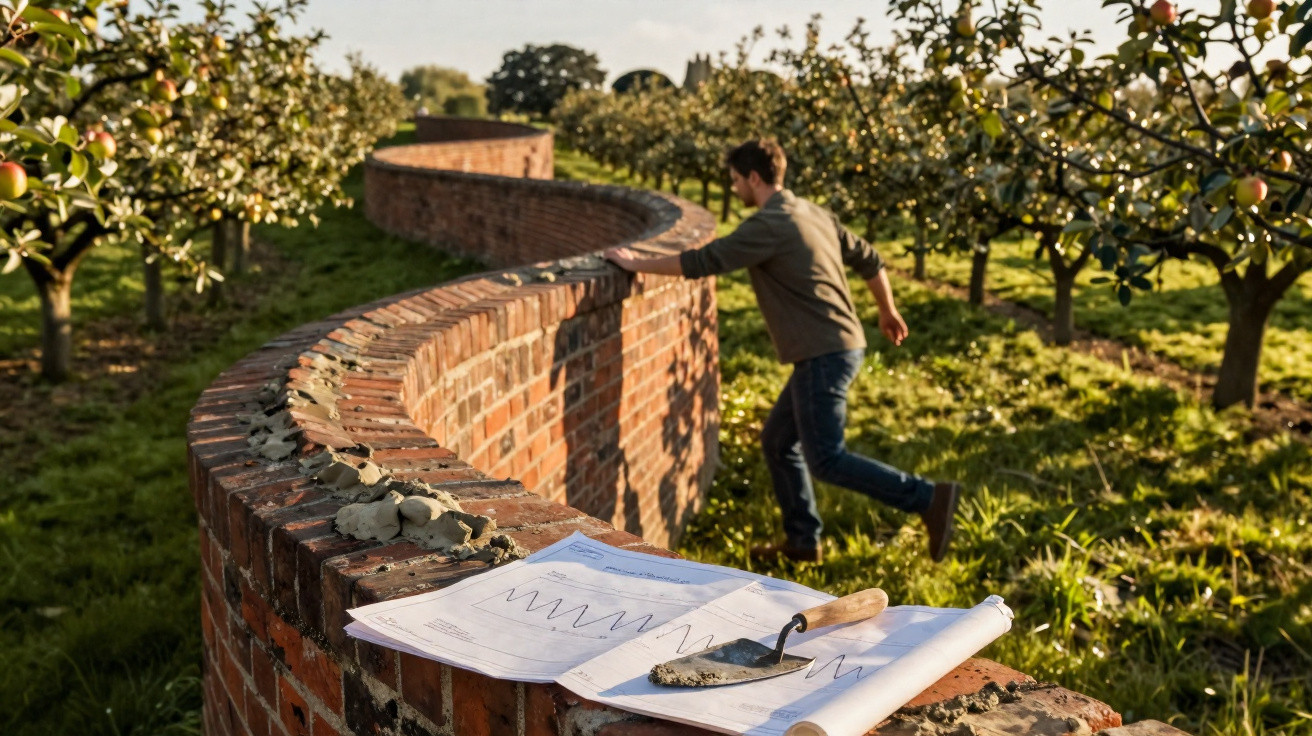
Wavy walls stand out for their unusual look, yet behind the curves lies a centuries-old piece of engineering that combines material savings, added strength and even protection for crops.
Are wavy walls stronger than they look?
At first glance, a wavy wall can seem like nothing more than an eccentric architectural flourish. In practice, its sinuous profile boosts structural stability and helps it cope with sideways forces better than a straight wall of the same thickness.
By forming a repeating series of curves, the wall effectively creates built-in bracing, which reduces the need to make the structure thicker. The upshot is that durable walls can be built using a significantly smaller number of bricks.
Why does this shape help to save so many bricks?
The key benefit comes from how loads are spread along the bends. Rather than relying purely on thickness to stay rigid, the wall gains strength from its geometry.
Among the main advantages of this approach are:
- Greater structural stability without increasing thickness.
- Brick savings during construction.
- Lower costs for materials.
- Improved durability when facing lateral pressure.
- A distinctive appearance that has become a feature of the English landscape.
English orchards took advantage of another important benefit
Beyond strength, wavy walls also found a role in orchards, particularly in the east of England. Their layout creates sheltered pockets from cold winds, helping growers cultivate more delicate species.
These structures are typically set on an east–west alignment. That way, one face points south, taking in heat from the Sun during the day and releasing it gradually, which supports crops such as grapes and figs.
How did Dutch engineers popularise this technique in England?
England’s well-known serpentine walls began to spread around the 17th century. Historians note that Dutch engineers, brought in to help drain the marshes of eastern England, played a part in promoting this construction solution.
As time went on, the method proved its economic and structural value, becoming common on rural estates and in historic gardens. Many examples have survived to the present day, drawing visitors interested in architecture and engineering.
Ancient Egyptians were already using sinuous walls more than 3,000 years ago
Despite their British reputation, archaeological finds suggest the concept is far older. In 2021, archaeologists announced the excavation of an ancient city near Luxor, Egypt, dated to approximately 1350 BC.
Among the remains were walls with a sinuous form strikingly similar to English examples built about 3,000 years later. The discovery underlines how smart engineering ideas can emerge in different civilisations and endure across millennia.
Why do wavy walls continue to spark curiosity?
Even centuries after they first appeared, these structures still impress specialists and tourists alike. They show how geometry can solve structural challenges with fewer resources-an approach that is valued even in modern engineering.
More than a historical curiosity, wavy walls are a clear example of creativity applied to construction. Their eye-catching shape continues to draw attention while pointing to an efficient solution developed long before today’s technologies.






Comments
No comments yet. Be the first to comment!
Leave a Comment