
You slide the drawer open, feel the familiar heft of the metal pulls, and your stomach drops a touch: little orange specks of rust on your favourite spanner, a flat stain on the pliers that used to gleam. The toolbox carries that faint mix of oil and dust you get in garages everywhere. Outside, the air feels close and slightly wet, the way it does after overnight rain.
You give the tools a quick rub with the corner of an old T‑shirt, as you always do. You promise yourself you’ll “sort the rust” properly one day-this weekend, perhaps, or perhaps never. Then you spot something small tucked in the corner: a crumpled silica gel sachet from an old pair of shoes, forgotten but still there.
The thought arrives so suddenly it almost seems daft.
Why your tools rust even when you barely use them
Rust rarely begins with water dripping straight on to your tools. More often, it starts with the air. The small amount of moisture hanging around in a garage, shed, or even an indoor cupboard can, given time, steadily attack metal.
That’s why tools can corrode inside a closed toolbox that never goes near rain. Air gets trapped, and as temperatures nudge up and down, tiny droplets form and vanish again. Each cycle costs you a microscopic layer of metal. You won’t notice at first-until one day the screwdriver you relied on looks older than you feel.
On a damp morning, it can feel as if your toolbox is inhaling humidity and keeping it locked away.
Ask any DIY enthusiast with a basement workshop in a wet climate and they’ll recognise the first real “rust shock”. A beloved set of spanners, stored for a couple of years “somewhere safe”, comes back out marked, rough, and faintly pitted. The metal hasn’t merely changed colour; it’s surrendered some strength and accuracy.
One reader from coastal Wales told me he ended up binning half his socket set after only two winters. Not through misuse, but because salty, humid air quietly crept into every corner of his plastic toolbox. He’d wiped his tools down, oiled them “from time to time”, then shut the lid and assumed the box would do the rest.
A sealed box without moisture control isn’t protection. It’s a slow cooker for rust.
Rust is, at heart, metal reacting with oxygen when water is present. No water, no rust-simple enough on paper. In day-to-day life, though, water is everywhere in disguise: in the air, rising off a concrete floor, or in the trace of sweat left on a handle as you put a tool away.
Silica gel acts like a sponge for that hidden moisture. Each tiny bead inside the packet captures water molecules and keeps them away from your metal surfaces. It happens quietly and out of sight, which is exactly why it’s so often underestimated.
What looks like dull packaging waste is really a small, passive device constantly working to keep your tools alive.
How one tiny packet of silica gel can change your whole toolbox
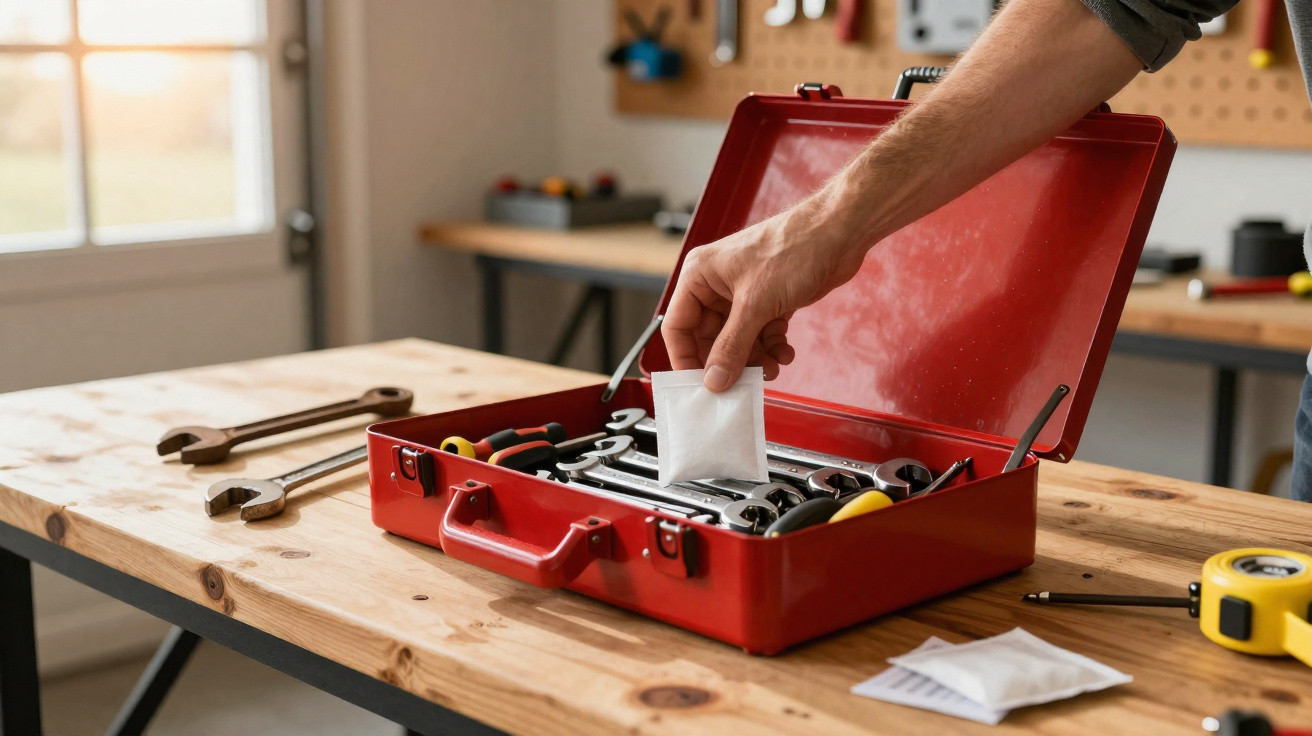
The method is almost laughably straightforward: drop a packet (or a few) of silica gel into your toolbox, close the lid, and let it get on with its silent work. No wires, no plugs, and no “maintenance routine” you’ll abandon after three days.
Put the sachets where air can actually move around them. Rest them on top of the tools rather than burying them under sockets. Tuck one into a corner of the lid and lightly tape it so it doesn’t end up soaked in oil. The aim is for the air inside the box to encounter the silica first, before moisture can settle on metal and start rusting.
It’s such a minor habit shift it feels almost too easy to be true.
Think of how many silica gel sachets you’ve binned without even glancing at the label-shoe boxes, electronics, camera kit, vitamin tubs. Some people now keep a small jar in the garage purely to collect them, like an oddly practical kind of treasure.
I met a car hobbyist in Lyon who insists he hasn’t had a fresh rust spot in his toolbox for years. His approach? A dozen reused silica sachets from every pair of trainers his family has bought. He arranges them along the inside edges like little white sentries guarding his ratchets and bits.
He said his real before-and-after moment came one autumn when he opened two boxes side by side: the “old” one without silica smelled slightly musty, with tools wearing that dull brown film; the “new” one with packets looked like something straight off a shop display. Same garage. Same air. A different microclimate inside the box.
Silica gel is a desiccant, meaning it attracts and holds water vapour. The beads have a huge internal surface area-almost like a microscopic labyrinth. Water molecules cling to that surface and stay there, rather than drifting around your tools.
So long as the silica isn’t fully saturated, it continues pulling moisture from the air inside the toolbox. That reduces relative humidity in that small enclosed space, tipping the balance away from rust. Metal will always want to react with oxygen, but without enough water present, the reaction slows markedly.
You’re not “freezing time” for your tools-you’re simply making their surroundings far less aggressive. Over the years, that can be the difference between tools you pass on and tools you quietly throw away.
Doing it right: simple moves that protect your tools for years
Begin by resetting the toolbox. Tip everything out on to a clean surface and give it a quick wipe to remove obvious dust and grime. There’s no need to buff every spanner as if it belongs in a museum-just clear away what you can see, and any lingering moisture.
Next, choose 3 to 6 silica gel packets for a typical portable toolbox, and more if you’ve got a large chest with drawers. Distribute them: a couple in the bottom corners, one near the handles, one in the top tray. If any sachets include indicator beads that change colour, put at least one where you can actually see it, so you’ll notice when it’s saturated.
Close the box and give that new little ecosystem time to settle.
A common mistake is assuming “one packet will do the lot”. It isn’t magic dust. A single sachet that came with a pair of headphones won’t dry out a big steel cabinet sitting in a damp basement. The number of packets needs to suit both the volume of air and how humid the space is.
Another pitfall is never replacing or regenerating them. Silica gel fills up. Eventually it can’t absorb any more and becomes dead weight. Let’s be honest: nobody is doing this every day. But a quick check every couple of months is manageable for most people.
If you live near the sea or in a very humid area, it may be worth using larger, reusable silica canisters with colour indicators. You can dry them out in the oven at a low temperature and put them back into use, saving both money and waste over time.
“Once I treated my toolbox like something worth protecting, not just a place to dump tools, everything changed. The rust didn’t stand a chance anymore.”
To keep it simple, treat your toolbox like a tiny climate zone you’re in control of. A handful of basic habits-done infrequently but consistently-are enough. There’s no need to become an obsessive curator of metal.
- Keep a small jar or box to collect silica gel packets from packaging.
- Refresh or regenerate packets every 3–6 months, depending on humidity.
- Combine silica gel with a light oil wipe on tools for double protection.
- Store the toolbox off the ground, away from damp floors and walls.
- Replace any torn or oil-soaked packets; they won’t work properly.
On a quiet evening, opening a toolbox that still smells dry and clean is oddly satisfying.
A tiny habit that says a lot about how you treat what you own
We all know tools are more than just things. They carry memories of half-finished projects, shelves finally hung level, and that old bike you brought back to life. Seeing them deteriorate for no good reason hits somewhere deeper than the cost.
Keeping a silica gel sachet in your toolbox is such a small act it can feel almost symbolic. You’re saying: “I want this kit to last. I respect what it helps me do.” It isn’t grand or heroic-just quiet care. And once you notice the change after a season or two, it becomes difficult to go back to ignoring it.
On a wet Sunday, opening the box to find tools still bright and ready brings a small wave of relief. No drama, no emergency scrubbing session-just calm. On a very human level, that calm matters. We’ve all had the moment when something we assumed was safe turned out to be ruined. Avoiding that now and then genuinely changes the feel of your day.
This is the sort of tip people pass on at the back of a workshop or over a neighbour’s fence, almost as an aside. It spreads quickly because it feels both smart and doable. You don’t need a special budget-just the decision to stop throwing those little packets away.
| Key point | Detail | Benefit for the reader |
|---|---|---|
| Silica gel tackles hidden moisture | The beads capture water vapour and reduce humidity inside the toolbox | Limits rust without extra day-to-day effort |
| Placement and quantity matter | Several packets spread around the box protect better than a single sachet | Maximises protection using items you already have at home |
| Simple upkeep extends tool life | Refreshing or regenerating packets every few months keeps them effective | Saves money by avoiding premature tool replacement |
FAQs:
- Can I reuse silica gel packets from shoe boxes in my toolbox? Yes-those sachets work well. If they feel damp, let them dry out, then place several in different corners of the toolbox for better coverage.
- How often should I replace or regenerate the silica gel? In a typical garage, every 3–6 months is usually enough. If you live in a very humid or coastal area, check them more often or use indicator beads.
- Is silica gel safe to keep near my tools? Silica gel is chemically inert and safe for metal, but you shouldn’t open the packets. Keep them sealed and out of reach of children and pets.
- Will silica gel alone completely stop rust? No. It significantly slows rust, but it doesn’t replace basic care. A quick wipe and an occasional light film of oil on tools still makes a real difference.
- What if my toolbox is already rusty inside? Remove visible rust, dry everything thoroughly, then add silica gel. It won’t undo existing damage, but it will help stop rust spreading further.




Comments
No comments yet. Be the first to comment!
Leave a Comment