
On a rainy Tuesday in October, Mark spotted a fine crack starting to snake out from the corner of his living-room wall.
At first, he did what most of us would: snapped a picture, zoomed in, pulled a face, and decided it was probably nothing. Homes settle, don’t they? Plaster shifts. With rain tapping softly at the panes, he turned the telly back up and thought more about what to have for tea than what that mark might mean. It joined the growing pile of “I’ll get around to it” tasks.
Three months on, he found himself outside with a structural engineer, looking at the very same corner - only now there was a gap at skirting-board level wide enough to slip a 50p coin into. The figures came back: £3,200 for foundation repairs and drainage work, plus another £700 to put right the cracks and redecorate. Mark’s expression tightened in that quiet, uncomfortable way adults get when they know they’ve played a part. The grim twist? The real culprit was right above him all along: his guttering.
The Small Thing Over Your Head That Destroys What’s Under Your Feet
It’s tempting to imagine foundation trouble as something sudden and spectacular: a once-in-a-century storm, a freak flood, or some strange problem deep in the ground. In many UK and US homes, though, it’s far more mundane - a gutter that’s blocked, cracked, or pitched incorrectly, sending water to exactly the wrong place every time it rains. Not once, but again and again. Drip after drip, downpour after downpour.
When guttering stops doing its job, the water doesn’t disappear. It sheets down the outside walls, saturates the soil around the base of the property, and follows hidden routes you never see. If your ground is heavy with clay, repeated wetting and drying makes it swell and shrink like a stubborn sponge. Over the years, that movement nudges the foundation bit by bit - until the shift is no longer subtle. That’s how people end up paying £4,000 for repairs that began with a handful of wet leaves and a single missing bracket.
And, honestly, nobody wakes up thrilled to examine their gutters. Rooflines feel awkward and a bit risky, the task sounds dull, and when everything works properly there’s nothing to “see” for your effort. We celebrate the obvious wins - a new kitchen, a smart patio. Quiet preventive maintenance gets left alone, right until it turns into a very loud problem.
The Guttering Inspection Mistake Nearly Everyone Makes
Here’s the awkward truth the engineer shared with Mark that day: Mark had checked his guttering - just not in a way that could catch the real issue. Once a year he’d lean out of the bedroom window, look along the run, poke at a little moss with a broom handle, and pronounce it “fine”. No visible blockage, no dramatic overflow during average rainfall, so what else was there to worry about?
The expensive error isn’t always refusing to inspect gutters at all. It’s believing a quick look from the ground - or a window - is enough. From those angles you can’t judge the fall of the run, spot tiny separations at joints, or see what the water actually does as it reaches the downpipe. A gutter can appear clear and still send litres of rainwater to the wrong place every time the clouds open.
We all recognise that halfway version of “doing a job” just so we can say it’s done: rinsing plates instead of properly washing them, shoving mess into a cupboard before visitors arrive. Gutter checks fit neatly into that habit. The problem is, your foundations don’t care about shortcuts, and the ground won’t negotiate with “I thought it looked okay”.
The Hidden Issue: Water Moving the Wrong Way
The most damaging gutter problem is rarely the obvious waterfall spilling over the front. It’s the steady, quiet misrouting of water. Gutters are designed to fall gently towards the downpipes so water drains away as intended. If the angle is wrong - even slightly - water can sit, seep over the back edge, or escape where the fascia meets the wall rather than travelling to the downpipe.
From street level you may notice nothing at all: no splash, no dramatic overspill. But if you were close up and ran water through on a dry day, you might spot a thin ribbon sliding behind the gutter, tracking down the brickwork and straight into the soil at the foundation. That’s where the real harm begins. It’s like a slow leak beneath a kitchen sink - easy to miss, but persistent enough to ruin everything it reaches.
How £50 of Maintenance Became a £4,000 Bill
When the contractor walked Mark around the property, the evidence was there in dirt marks and staining. The gutter above the rear corner had sagged a touch, most likely after a bracket cracked years earlier. Instead of carrying water along to the downpipe at the end of the run, it collected at the lowest point and then slipped over the back edge. Each wet winter had sent that excess straight into the flowerbed tight against the house.
That corner of soil had stayed consistently wetter than the rest of the perimeter. In time it softened, and the foundation edge in that area eased down by a few millimetres. The internal crack, the slight slope in the floor, the door frame that started to stick - all of them were symptoms of years of guttering that was “almost fine”. Putting it right meant underpinning part of the foundation, fitting a French drain to divert water, re-levelling the patio, and finally setting the gutters correctly.
A thorough clean and realignment - priced at less than a family takeaway - would have avoided the lot. But because the “inspection” was really just a glance and a hopeful shrug, the issue stayed hidden until it became costly. That’s the brutal arithmetic of water: it always finds the lowest route, and it always sends the invoice later.
The Right Way to Check Gutters (That Nobody Teaches You)
Most people treat gutter care as one job: “clear the leaves”. That’s only a fraction of it. The part that protects you from foundation repairs is confirming where the water truly goes - and whether it’s getting there properly. You don’t need specialist kit, just a ladder, a steady mate, and ten minutes of being a little more careful than the next house along.
Step 1: Inspect at Eye Level, Not from the Ground
Looking up from below will always leave you with an incomplete picture. At eye level you can spot slight bowing, silt lines, and hairline splits at joints that only leak in heavier downpours. You’ll notice tiny tufts of grass taking hold, screws that have worked loose by a fraction, and sections where the gutter has started to pull away from the fascia.
Climb safely, go slowly, and work your way along the run. Rest a hand lightly on the plastic or metal and check for any play. A small wobble at one bracket is often the first hint of something bigger. It helps you see guttering as a functioning system, not just trim at the roof edge.
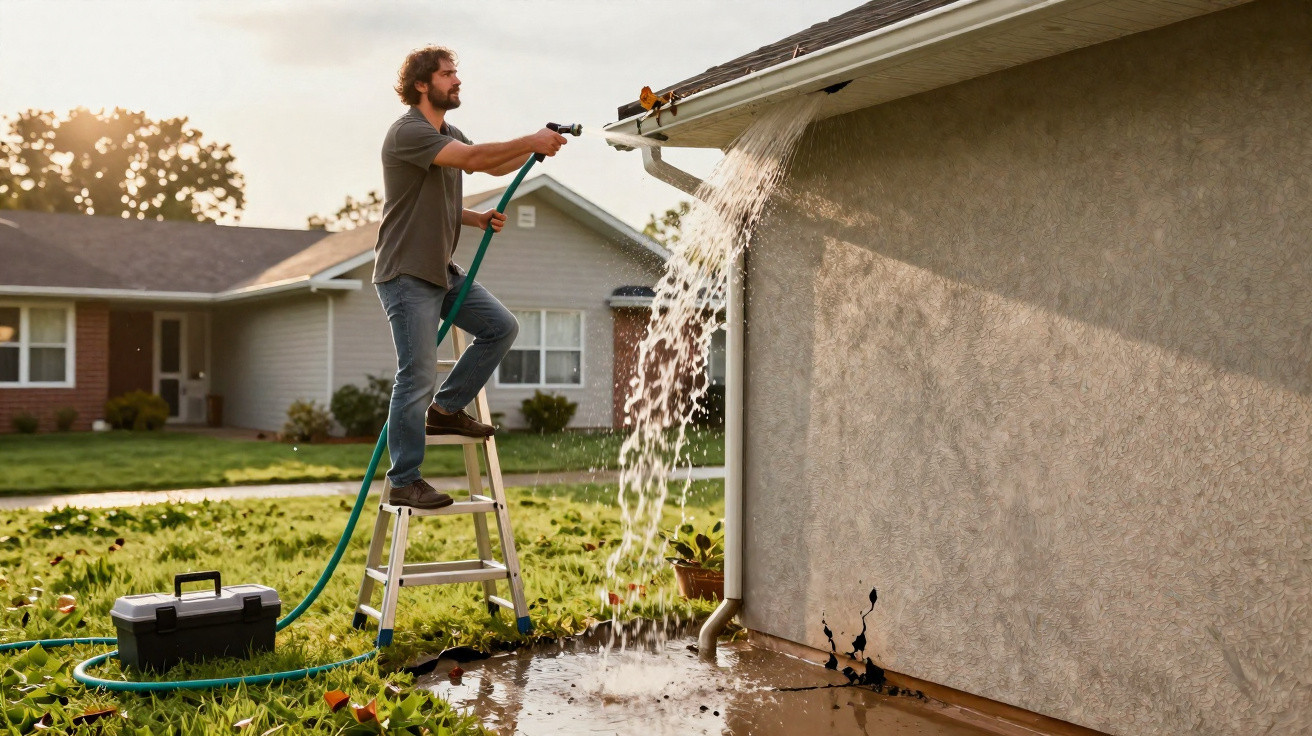
Step 2: Run a “Fake Rain” Test
This is the step many people miss - and it’s the one that matters most. Once you’ve cleared debris, trickle a hose into the gutter from one end. Watch closely. Does the water flow briskly towards the downpipe, or does it pause, pool mid-run, creep backwards, or spill in a thin sheet somewhere unexpected?
Track the path all the way down, and check the downpipe joints as well. A tiny drip there can deliver water straight to the base of the wall instead of into a drain or soakaway. That five-minute hose test has likely prevented more foundation problems than any fancy gadget ever has.
Step 3: Confirm Where the Water Ends Up
The common inspection error isn’t only about what happens up in the air - it’s also about ignoring what happens at ground level. Once water exits the downpipe, where does it actually go? Into a proper drain, across ground that falls away from the house, or into a convenient-but-disastrous puddle beside your foundations?
Stand out during rainfall and watch it in real time. You want to hear the steady glug of water moving safely into a drain - not the splatter of a small waterfall cutting into the same patch of soil. That sound - the patient, hollow drip into saturated earth - is the quiet soundtrack of future repair bills.
The Emotional Blind Spot: Why We Ignore the Boring Bits
There’s a human element here that rarely gets discussed. We don’t overlook gutters because we’re stupid or idle. We overlook them because they sit in a strange middle ground: visible enough to forget about, but not so visible that you can easily see the consequences of neglect until it’s too late. So the brain files them away as background and gets on with life.
We also like problems with obvious cause and effect: broken pane, clear issue; dead boiler, no hot water. With foundation damage the signs are vague - a door that sticks, a crack that might be harmless - and the cause can be the slow, dull failure of something you barely think about. It doesn’t shout; it mutters.
When the engineer explained that Mark’s guttering was the real villain, Mark laughed at first. The thought that a plastic channel and a few litres of rainwater could shift concrete sounded absurd. Then he remembered the years of rain streaking the glass by that corner, the damp smell on certain winter mornings, and how that patch of ground always seemed wetter than the rest. Suddenly it didn’t seem absurd. It felt uncomfortably personal.
Red Flags That Your Gutters Might Be Damaging Your Foundation
You don’t need to be a surveyor to notice early warning signs - some are almost laughably simple. Look at your external walls once the rain has dried. Can you see dirty vertical trails beneath the gutter line, as though someone has dragged wet fingers down the brickwork? That often points to repeated escape of water over or behind the gutter.
After steady rain, check the ground around the house. Is one side consistently boggy while the other stays relatively firm? That contrast usually tells you where your roof water is landing. Indoors, clock the smaller changes too: skirting that’s beginning to swell, a corner crack that slowly opens, a floor that suddenly needs a wedge under one leg of the sofa. Those little irritations can act like breadcrumbs leading back to a moisture problem.
The hardest part is paying attention to the inner nudge that says, “Something’s not right here,” rather than smothering it with wishful thinking. Homes tend to whisper before they shout. That whisper might be a faint drip, the dull scent of damp soil, or the soft groan of a door that used to swing freely.
The Quiet Power of Doing the Boring Thing Now
It’s easy to read about someone else’s £4,000 bill and think, “That won’t be me.” Maybe your place is newer. Maybe the guttering looks fine from the pavement. Maybe you tell yourself the foundation must be solid because it has “always been okay”. Mark thought the same - right up until the quote arrived in his inbox with more digits than he wanted to see.
The plain truth is that the best-value home maintenance is rarely the sort you can show off on Instagram. It’s the ladder, the hose, and the slightly awkward half hour on a Sunday when you’d rather be on the sofa. It’s choosing a small inconvenience now to avoid a much bigger pain later. One thorough gutter inspection each year does more for your foundation than any amount of wishful thinking.
After everything was finished, Mark stood in the garden during a heavy downpour simply to watch. The gutter ran cleanly, the water shot straight into the downpipe, and the ground by that once-sodden corner stayed firm. He said the sound of rain on the roof felt different now - no longer just background noise, but a system he finally understood.
If your home could speak, it probably wouldn’t ask for a new TV or fancy tiles. It would just steer you towards the ladder, gesture at the gutters and say, quietly: sort that out before I start cracking. And once you’ve seen how a cheap, simple check can stop a £4,000 repair, it’s hard to un-hear that voice.





Comments
No comments yet. Be the first to comment!
Leave a Comment