
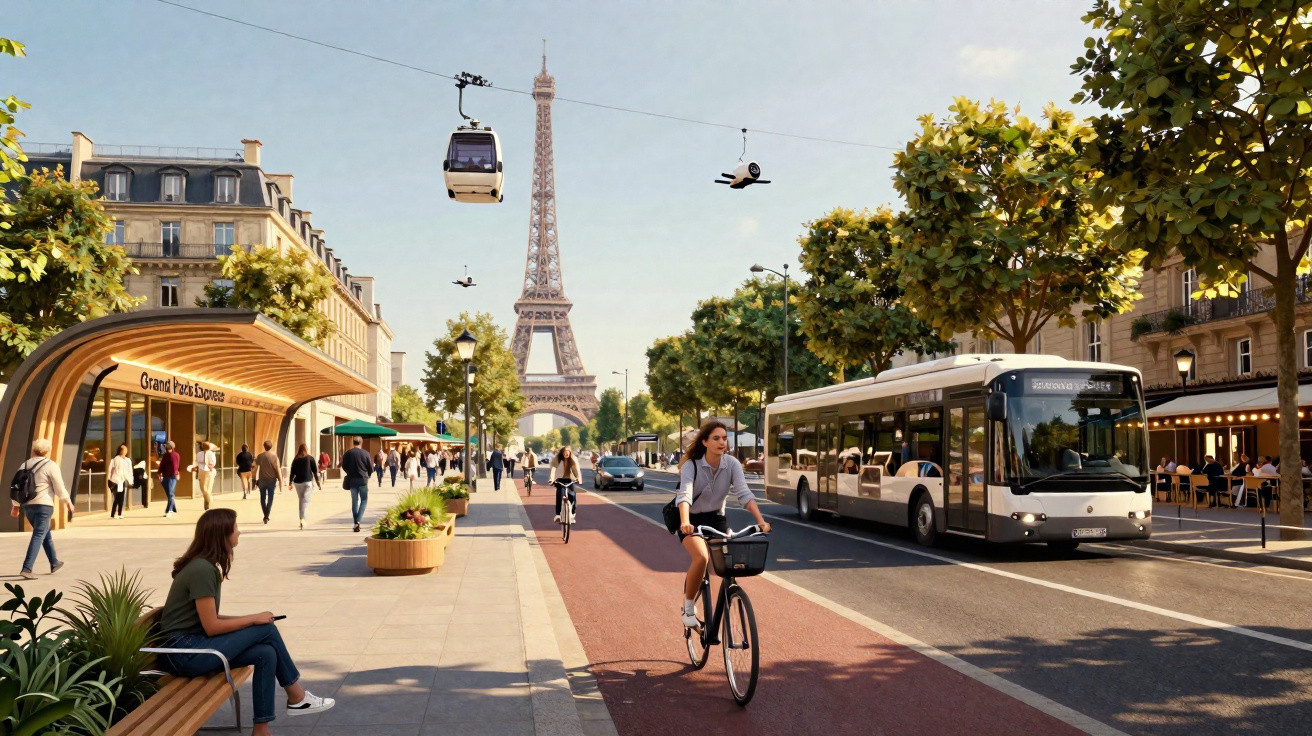
Paris is being radically redesigned: instead of long lines of cars, an XXL metro, cable cars, cycling and electric flying taxis will soon shape everyday life in the city.
Paris, the French capital, is in the midst of a quiet transport revolution. Over the coming decades, the aim is to turn an auto-centric metropolis into a place where you can get around almost entirely without a private car - faster, quieter and far more climate-friendly than today.
Why Paris is pushing cars out
From the second half of the 20th century onwards, big cities were shaped almost entirely around the car. The outcome is familiar: congestion, noise and dirty air. In Paris, private cars account for up to one third of the city’s CO₂ emissions. An analysis by mobility specialist Inrix showed in 2021 that Parisians spent an average of 140 hours per year stuck in traffic - almost a working month spent idling.
At the same time, car ownership in the capital is already falling in measurable terms. Only around 33% of households now have a car, compared with 40% in 2015. That shift shows how quickly travel behaviour changes when alternatives are genuinely available and appealing.
"Paris is using the climate crisis as leverage to reorganise the city from the ground up - away from metal boxes and towards intelligent networks."
The mega metro ring: Grand Paris Express
At the heart of the new mobility system is the Grand Paris Express, a huge infrastructure programme. By the middle of the century, the metro network is intended to be effectively doubled. New automated lines (15 to 18) will link the suburbs to one another directly, avoiding a detour through the already overstretched centre.
The logic is straightforward but powerful: if you need to travel from one outer district to the next, you should no longer have to pass through the inner city by default. That saves time, reduces transfers and makes public transport a credible alternative to the car for millions of commuters.
Mobility hubs instead of seas of parking
Around the new stations, so-called multimodal hubs are being created. These are designed to make switching between modes simple:
- Tram services right outside the metro exit
- Hire bikes and secure cycle parking
- Sharing options and organised car-pooling
- Car-club bays instead of traditional parking spaces
The goal is that hardly anyone should feel “stuck” without a car. Changing mode is made so convenient that owning a vehicle increasingly feels like a burden rather than freedom.
Bus fleets are becoming quiet and emissions-free
In parallel, the region is converting its buses. Even now, around half of the roughly 11,000 vehicles are either fully electric or run on alternative drivetrains such as hydrogen and other low-emission technologies. By the end of the decade, the region is targeting a near-fully decarbonised fleet.
For residents, that translates into far less street noise, fewer fumes in dense neighbourhoods, and a stronger image for public transport - which for a long time was seen as “dirty” and old-fashioned.
Paris wants to become a cycling city
A second major pillar is cycling. Since 2015, the city has been driving forward an ambitious “Plan Vélo” - in plain terms: Paris is meant to be fully rideable by bike without having to risk your life.
At its core is an express cycle network, protected in both directions, linking the main north–south and east–west corridors. Many sections are already visible today: wide, clearly separated lanes, often physically protected by kerbs or bollards.
Alongside this, tens of thousands of new cycle parking spaces are being added, many of them covered and monitored. Over the long term, the region is planning around 2,000 kilometres of continuous, safe cycle routes - from the centre deep into the suburbs.
The city belongs to pedestrians again
Walking is also being given a new priority alongside cycling. The local mobility plan focuses on rebalancing many streets:
- Parking spaces removed, pavements widened
- 30 km/h zones across a large share of inner-city routes
- Squares such as Châtelet and Félix Éboué rebuilt into pedestrian-friendly spaces
- Safer crossings and traffic lights timed more in favour of pedestrians
As a result, the city’s look and feel changes step by step. Children can more easily play outside again, cafés push their terraces further out, and junctions start to lose their identity as nothing more than traffic machines.
Cable cars above the rooftops: a new everyday mode
Paris is taking an unusual route with urban cable cars. In 2025, the first urban cable car line in the region is due to begin operation: the “Téléval” project links several suburbs in the Val-de-Marne department. Cabins glide over tightly built-up districts and cross busy roads without being affected by traffic jams.
"The aerial cable car becomes an everyday bus in the sky - electric, quiet and independent of road traffic."
Journey times between communities that were previously poorly connected fall to around 15 minutes. At the same time, new links to metro and RER stations are created - a major improvement, particularly for people in residential areas that have long been left behind.
Flying taxis: science fiction put to the test
Even more futuristic are electric passenger aircraft, known as eVTOLs. Paris is testing concepts for integrating these vehicles into normal transport. They take off and land vertically, look like a hybrid of a drone and a small helicopter, and are intended primarily to replace longer, unpredictable trips.
In the planners’ vision, they connect outer districts and key hubs via so-called vertiports - compact mini-airports that could be built on rooftops or at the edges of large sites. The aim is to relieve heavily overloaded approach roads.
This is far from straightforward. Open questions include noise control, flight safety, airspace management and public acceptance. What is clear, however, is that Paris wants to be among the leaders when the technology becomes market-ready - not to react only once other cities have set the standard.
How smart, connected mobility is meant to work
All of these building blocks - metro, bus, cycling, cable car, flying taxis - only make sense if they are knitted together digitally. Looking towards 2050, planners in the region envision “mobility from a single source”: one app, one ticket, many modes.
| Element | Role in the 2050 system |
|---|---|
| Automated metro | Backbone for fast city–suburb connections |
| Electric buses | Fine-grained neighbourhood coverage without exhaust emissions |
| Cycling and walking | Foundation for short everyday journeys |
| Cable cars | Bridging obstacles and congestion hotspots |
| eVTOL taxis | Fast premium option over longer distances |
Data is central to making this work: real-time information on crowding, disruptions, available hire bikes or shared cars helps people plan the best routes. Artificial intelligence can analyse traffic flows to adjust frequencies more flexibly or to steer diversions early.
Concrete effects on climate and quality of life
If the concept succeeds, transport-related CO₂ emissions will drop significantly. Fully electric metros, bus fleets powered by hydrogen or other clean drivetrains, and a major shift to cycling and walking reduce not only emissions but also particulate matter and nitrogen oxides.
At the same time, the city regains space. Where rows of parked cars sit today, there could be trees, benches or play areas in future. Public space shifts from permanent parking to places where people actually spend time.
"The fewer cars that permanently block the way, the more the street becomes a living space again."
What other cities can learn from Paris
What makes Paris compelling is not just the technology, but the mix of measures. No single solution fixes the problem; it is the combination that matters:
- Major infrastructure projects that provide real alternatives
- Political changes to street space that redistribute room
- Financial and organisational support for cycling and walking
- Willingness to trial experiments such as urban cable cars
- Digital tools that make daily travel tangibly easier
For German cities facing similar pressures - high rents, dense traffic, climate targets - Paris can serve as a laboratory. Not every measure can be copied one-to-one, but the willingness to fundamentally question car-centred planning sends a clear signal.
Terms like Grand Paris Express or eVTOL may sound abstract at first. In the end, though, it comes down to very practical situations: can a care worker get home faster in the evening? Can a pupil reach school safely without sprinting across four-lane roads? Does an outer district finally gain a fast connection to the nearest cluster of jobs?
Those everyday questions will decide whether Paris in 2050 truly becomes a model for a city without permanent gridlock - or whether the vision gets stuck in a traffic knot.




Comments
No comments yet. Be the first to comment!
Leave a Comment