
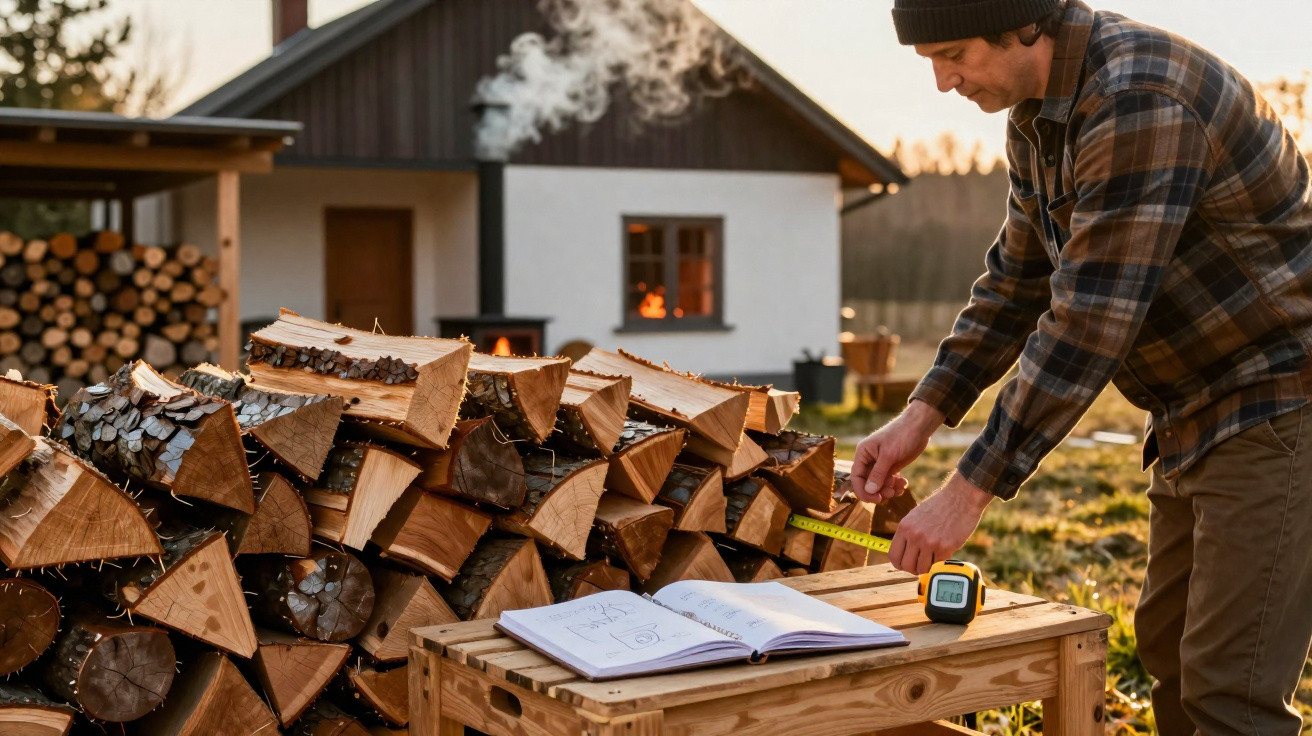
Wood heating is undeniably cosy, can reduce your reliance on fossil fuels and brings a reassuring sense of self-sufficiency - yet get your firewood order wrong and you might be cold in February or paying over the odds in October. The guide below explains how to estimate how many cubic metres of firewood you genuinely need to get through a complete winter with a wood burner or an insert.
What a “stère” really means for your log pile
In France, firewood is often sold by the “stère”, which broadly corresponds to one cubic metre of logs stacked in 1-metre lengths. On paper, that sounds straightforward; in the real world, your stack rarely looks that neat.
Most contemporary wood burners and inserts won’t accept 1-metre logs. Merchants usually cut them to 50 cm, 33 cm or even 25 cm. As log lengths reduce, the pieces pack together more efficiently when stacked. The quantity of wood is the same, but the visible (stacked) volume becomes smaller.
A “stère” is officially 1 m³ of one‑metre logs, but once cut shorter, the same wood may only occupy around 0.7–0.8 m³ on your floor.
In the UK (and in the US), you’re more likely to encounter labels such as “cubic metre bag”, “loose cubic metre” or “cord”. A cord is traditionally 3.62 m³ of carefully stacked logs in North America (4 ft high, 4 ft deep, 8 ft long). In reality, you should always confirm whether a supplier’s figure refers to “stacked” or “loose tipped” volume, and exactly what log length is being delivered. That single detail can make a big difference to how long your firewood lasts over winter.
The big factors that decide how much wood you burn
There’s no universal number that suits every household. The same winter might take one home five cubic metres and another twelve. In practice, five main variables explain most of the difference.
Home size and volume
Keeping a snug 60 m² bungalow warm is very different from heating a 180 m² farmhouse with tall ceilings. Floor area alone doesn’t tell the whole story: ceiling height and open-plan spaces increase the total air volume you’re trying to heat.
A typical modern, well-insulated 90–110 m² home using a wood burner as main heat source often needs around 5–7 m³ of properly seasoned hardwood per year.
With older homes - especially those with draughty windows, leaky doors and large rooms - it’s entirely possible for consumption to be roughly double.
How well your home holds heat
Insulation typically outweighs every other factor. The better your home retains heat, the less often you need to feed the stove.
- Properties with good loft insulation, cavity or solid wall insulation and double glazing may use 30–50% less wood than comparable homes with poor insulation.
- Straightforward improvements - such as sealing draughts around doors, chimneys and floorboards - can reduce log use noticeably.
Type and efficiency of your appliance
An open fire looks the part, but much of its heat goes straight up the chimney. A closed appliance - a wood burner or an insert - performs far more efficiently.
| Appliance type | Typical efficiency | Impact on wood use |
|---|---|---|
| Open fire | 20–30% | Burns a lot of wood for modest room heat |
| Older stove (pre-eco design) | 50–70% | Reasonable output but uses more logs |
| Modern eco‑design stove or insert | 75–85%+ | More heat from each log, less wood needed |
If your appliance is more than 15–20 years old, replacing it can cut annual wood demand and can also improve air quality both indoors and outdoors.
Type of wood you burn
Logs don’t all deliver the same energy. Denser woods contain more heat per cubic metre and tend to burn for longer.
- Hardwoods such as oak, beech, ash and hornbeam suit steady, long-duration heating. They burn more slowly, provide reliable embers and produce strong heat.
- Softwoods like pine or spruce catch quickly and burn hot, but they are used up faster - meaning more frequent trips to the wood store.
For a main heating system, combining softwood for kindling and lighting with hardwood for the long burn offers a good balance of convenience and efficiency.
Climate and how you actually use the stove
In milder coastal areas, some households only light the stove for three or four months. In colder inland or northern locations, the burning season can run for six or seven months. Your routine matters as well: working from home, heating spaces throughout the day, or keeping the stove going late into the night will all increase overall consumption.
How many cubic metres for your style of use?
Once you’ve considered your home and your day-to-day pattern, you can place yourself within a sensible range.
Occasional, “cosy evening” use
If you only light the stove on weekends and a few evenings midweek - and another system does most of the heating - you’ll typically sit at the low end.
For decorative or occasional comfort use, plan for around 1–3 m³ of seasoned hardwood for the whole winter.
This allowance generally fits small to medium, well-insulated homes where the stove is used a handful of times each week.
Regular backup heating
Many people treat a wood burner as a genuine back-up heat source, reducing dependence on gas, oil or electricity - particularly when temperatures drop.
A useful rule of thumb is:
- 3–6 m³ per winter for a 80–120 m² reasonably insulated home
- Towards the upper end if the property is older or the climate is colder
Main or near‑main heat source
If the wood burner or insert is doing most of the heating, your supply becomes much more critical. Running short can mean discomfort - or resorting to costly electric heaters at short notice.
For full-time wood heating, most households fall somewhere between 5 and 12 m³ of dry hardwood per winter, depending on size, insulation and appliance efficiency.
A small, modern, very well-insulated semi might land close to 5 m³. A bigger, older rural house with high ceilings and an average stove can easily need 10–12 m³, particularly in more severe winters.
Practical tips to cut your wood needs without feeling the cold
Using fewer logs doesn’t have to mean turning down the heat and putting up with it. A few practical changes can make a surprising difference.
- Only burn dry wood: Target a moisture content below 20%. Damp logs spend energy boiling off water as steam rather than heating the room, and they also increase soot and creosote in the flue.
- Check your burn: If the stove glass blacks up quickly and you see thick smoke from the chimney, it often points to poor combustion or wood that’s too wet.
- Service and sweep regularly: Good draw and clean combustion depend on a clean stove and flue. In many countries, an annual sweep is a legal safety requirement.
- Size logs to the appliance: Consistent, appropriately sized logs sit better in the firebox and typically burn more efficiently.
- Use the controls properly: Starving the stove of air all evening encourages tar deposits and reduces usable heat. It’s usually better to burn with healthy flames, then let the embers provide the steady warmth.
Storing your winter wood: where the real savings start
Storage often determines how much usable energy you actually get from your logs. Even well-processed hardwood can end up waterlogged if it’s tipped onto wet ground and tightly wrapped in plastic.
Good storage means air, protection from rain, and time - ideally at least 18–24 months’ seasoning for many hardwoods.
Raise the stack off the ground using pallets or rails. Cover the top with a roof, sheet or tarp, but keep the sides open to encourage airflow. A south- or west-facing position helps sun and wind speed drying. Finally, rotate your supply - burn the oldest, driest stock first - so each winter’s usage is easier to predict.
Planning scenarios: two real‑world examples
A modern, well-insulated family home
Imagine a 100 m², three‑bed new-build with strong insulation and a modern eco‑design stove rated around 7 kW. The household has gas central heating, but they enjoy running the stove most evenings and at weekends from November to March.
- Usage pattern: 4–5 evenings per week, plus weekend days in cold spells
- Estimated wood need: 3–5 m³ of dry hardwood per winter
- Potential savings: improving loft insulation and sealing draughts could nudge them closer to 3 m³ than 5 m³
An older rural home with wood as main heat
Now consider a 150 m² stone property in a colder area, with partial insulation and a 10 kW wood burner providing the main heat, supported by electric radiators.
- Usage pattern: stove lit from morning to late evening, October to March
- Estimated wood need: 8–12 m³ of hardwood, depending on winter severity
- Levers to reduce: upgrading windows and adding internal wall lining could trim wood use by several cubic metres a year
Key terms and risks worth knowing
Two phrases come up repeatedly in firewood discussions: “seasoned” and “green” wood. “Seasoned” logs have been dried - typically outdoors and under cover - for at least one to two years. “Green” wood is freshly cut and still contains a great deal of moisture.
Burning green wood wastes energy and increases the risk of chimney fires due to sticky creosote build-up.
Mixing species without understanding how each burns can cause problems too. Softwoods that burn quickly may look cheaper initially, but if your stove is your main heat source you might need up to a third more volume than you would with dense hardwoods to achieve the same comfort.
Lastly, consider pairing wood heating with other simple measures: programmable electric heaters in rooms you rarely use, thick curtains over draughty windows, and basic thermostatic controls. The less heat your home loses elsewhere, the further each cubic metre of well-stored logs will go towards a steady, stress-free winter.




Comments
No comments yet. Be the first to comment!
Leave a Comment