
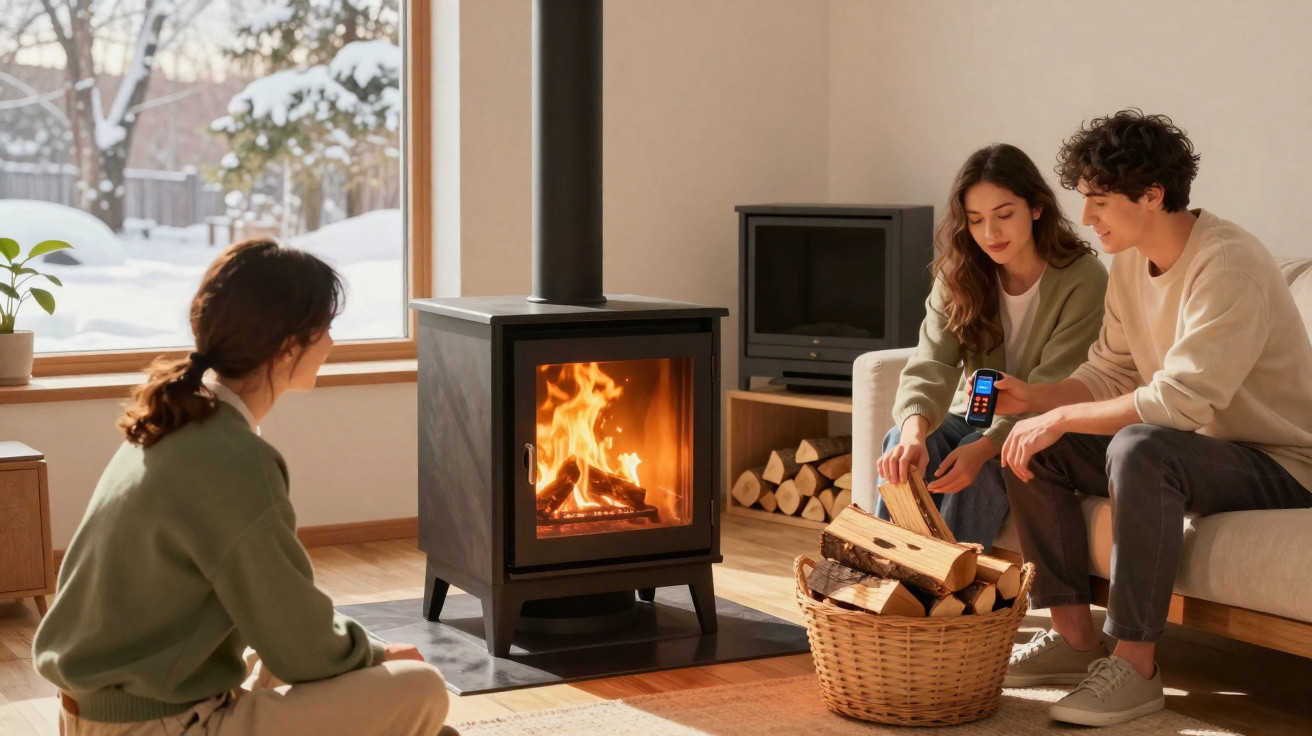
Between the romance of a crackling hearth and the reality of meeting your heating needs there is often a sizeable gap. If you want to heat 80 to 120 m² of living space primarily with firewood, it pays to work out in advance how many stacked cubic metres (rm) or loose cubic metres (srm) you will realistically need. Depending on the stove, insulation and where you live, consumption can range from a handful of rm to roughly double that.
What your firewood requirement really depends on
The straightforward question “How many stacked cubic metres do I need?” does not come with a single standard answer. Several factors interact:
- Living area: 80 m² needs noticeably less energy than 120 m² - obvious, but often underestimated.
- Insulation: Well-insulated homes retain heat; poorly insulated ones constantly lose it through walls, windows and the roof.
- Heating appliance: A modern wood-burning stove versus an open fireplace - the difference in consumption is huge.
- Region and climate: In cooler upland areas the stove runs for much longer than in milder regions.
- Wood species and quality: Hardwood provides more usable heat per stacked cubic metre than softer conifer wood.
- Heating habits: 20 °C versus 24 °C room temperature makes a noticeable difference over the months.
“If you want to plan your firewood requirement properly, you need to consider at least the living area, insulation standard, stove type and wood species.”
Typical consumption ranges by appliance type
The efficiency of the heating appliance has the biggest impact. A modern stove extracts far more heat from the same amount of wood than an open fire.
Modern wood-burning stove with high efficiency
A current wood-burning stove with a high efficiency (often over 75 per cent) is a sound option for many detached houses:
- around 80 m², well insulated: roughly 3–4 stacked cubic metres per heating season
- 100 m², average insulation: about 4–6 stacked cubic metres
- 120 m², decently insulated: usually 5–7 stacked cubic metres
If you use the stove only as supplementary heating alongside a gas boiler or heat pump system, you will naturally need significantly less.
Stove insert or closed fireplace
A closed fireplace insert typically sits between a classic stove and an open fireplace in terms of efficiency. As a result, consumption rises noticeably:
- around 80 m², moderately insulated: about 5–7 stacked cubic metres
- 100 m²: around 6–8 stacked cubic metres
- 120 m², less well insulated: 7–9 stacked cubic metres
Open fireplace as the main heat source - an expensive indulgence
An open fireplace looks great, but is a poor option energetically as a heating system. A large share of the heat disappears straight up the chimney:
- 80 m², poor insulation: often 10–12 stacked cubic metres or more
- 100 m²: roughly 12–15 stacked cubic metres
“If you seriously want to heat with wood, you should choose a closed stove with a high efficiency - open fireplaces are real wood guzzlers.”
Insulation is pivotal: same floor area, half the consumption
The condition of the building envelope determines whether the heat stays indoors or, quite literally, goes out of the window. Here are two examples for around 100 m² of living space with a modern wood-burning stove:
- Well-insulated home (new windows, insulated roof, no draughts): 4–6 stacked cubic metres
- Older property without energy-efficiency upgrades: easily 8–10 stacked cubic metres for the same feeling of warmth
So if it feels like you “have to keep topping it up”, it is not only worth trying to economise on wood - it may also be time to consider new windows, sealing external doors, or adding insulation to the top-floor ceiling.
Which wood species are worth it for 80 to 120 m²
Not all firewood heats equally well. The energy content per stacked cubic metre varies considerably.
| Wood species | Type | Characteristic | Suitability as main fuel |
|---|---|---|---|
| Oak | Hardwood | Very high density, long-lasting embers | Very good |
| Beech | Hardwood | Good flame pattern, plenty of heat | Very good |
| Ash, hornbeam | Hardwood | Similar to beech, high heat output | Very good |
| Birch | Medium-hard | Faster flame, pleasant smell | Good, better as a mix |
| Spruce, fir | Softwood (conifer) | Burns quickly, sparks heavily | Better as kindling |
For an 80–120 m² home that needs to stay reliably warm for months, beech, oak and similar hardwoods are particularly suitable. They burn more slowly, provide more energy and, thanks to cleaner combustion, are also gentler on the stove.
Why dry wood is worth twice as much
Moisture content matters at least as much as the species. Freshly cut wood often contains 40 to 60 per cent water. When you burn it, that water has to evaporate first - which consumes energy.
- Recommended residual moisture: under 20 per cent
- Required storage time: depending on the species, two to three years of airy drying
- What happens with wood that is too wet: poor draw, little heat, sooted stove glass, more fine particulate emissions
“If you have enough storage space, drying your own wood properly saves real money and noticeably improves heating performance.”
How to store firewood correctly
To stop your winter stock from rotting or going mouldy, you need a sensible storage setup:
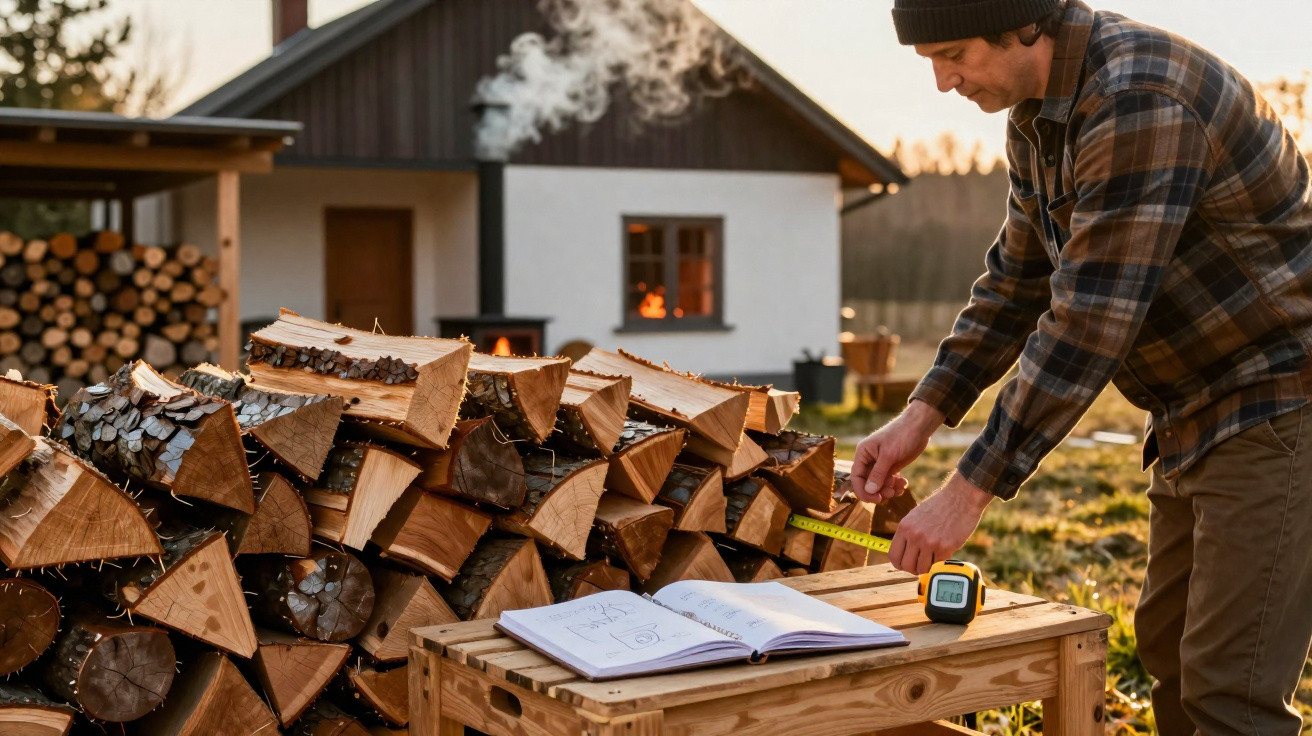
- Do not place wood directly on the ground; use pallets or a raised base.
- Keep the end faces open so wind can pass through.
- Protect only the top with a tarp or roof, leaving the sides as open as possible.
- Avoid wrapping it completely in airtight plastic, which traps moisture.
- Order as early as possible in spring so it can finish drying before winter.
A supply of 6 to 8 stacked cubic metres quickly requires a fairly large storage area. If you only have a small garden or a balcony, factor that into your planning early.
So how much wood, specifically, for 80 to 120 m²?
Using typical conditions, you can derive rough guide figures. The following assume wood is your primary heat source during the heating season:
- 80 m², well insulated, modern stove, hardwood: around 3–5 stacked cubic metres
- 100 m², average insulation, modern stove: about 4–6 stacked cubic metres
- 120 m², decently insulated, closed stove: usually 5–7, and up to 8 stacked cubic metres in colder locations
- Poorly insulated older properties of this size: depending on stove output, up to 8–10 stacked cubic metres
If it is your first year heating with wood, it is sensible to plan in a little extra. Having one stacked cubic metre too many is far less stressful than having to reorder in a rush in mid-January - at peak times prices often rise, and not every supplier can deliver at short notice.
Practical tips to reduce your wood consumption
A few everyday routines can cut usage noticeably without leaving the home cold:
- Do not overheat rooms - each degree less saves energy.
- Keep doors closed to rooms you rarely use.
- Run the stove with full, clean air supply rather than throttling it down to a “small flame”.
- Match heating times to when you are at home instead of heating continuously.
- Plan regular stove servicing and chimney sweeping.
If you also tackle a few simple insulation jobs - replacing door seals, sealing roller shutter boxes, insulating radiator recesses - you often see the difference in the woodpile by the next season.
What units such as stacked cubic metre and loose cubic metre mean
When buying firewood, the units can be confusing. In brief:
- Stacked cubic metre (rm): one cubic metre of neatly stacked wood including the gaps between logs
- Loose cubic metre (srm): one cubic metre of loosely tipped wood; it contains more air and therefore less wood
- Solid cubic metre (fm): one cubic metre of pure wood with no gaps
Many suppliers now sell in loose cubic metres, while older consumption figures are often given in stacked cubic metres. So if you want to compare prices, check the unit carefully or ask the supplier directly.
If you are aiming to keep 80 to 120 m² warm with wood, an honest stocktake is worthwhile: how well insulated is the property, how efficient is the stove, and what kind of wood is available? With realistic assumptions, a bit of reserve in storage and a properly dry supply of logs, winter does not become a nerve-racking exercise - either for heating or for your bank balance.


Comments
No comments yet. Be the first to comment!
Leave a Comment