
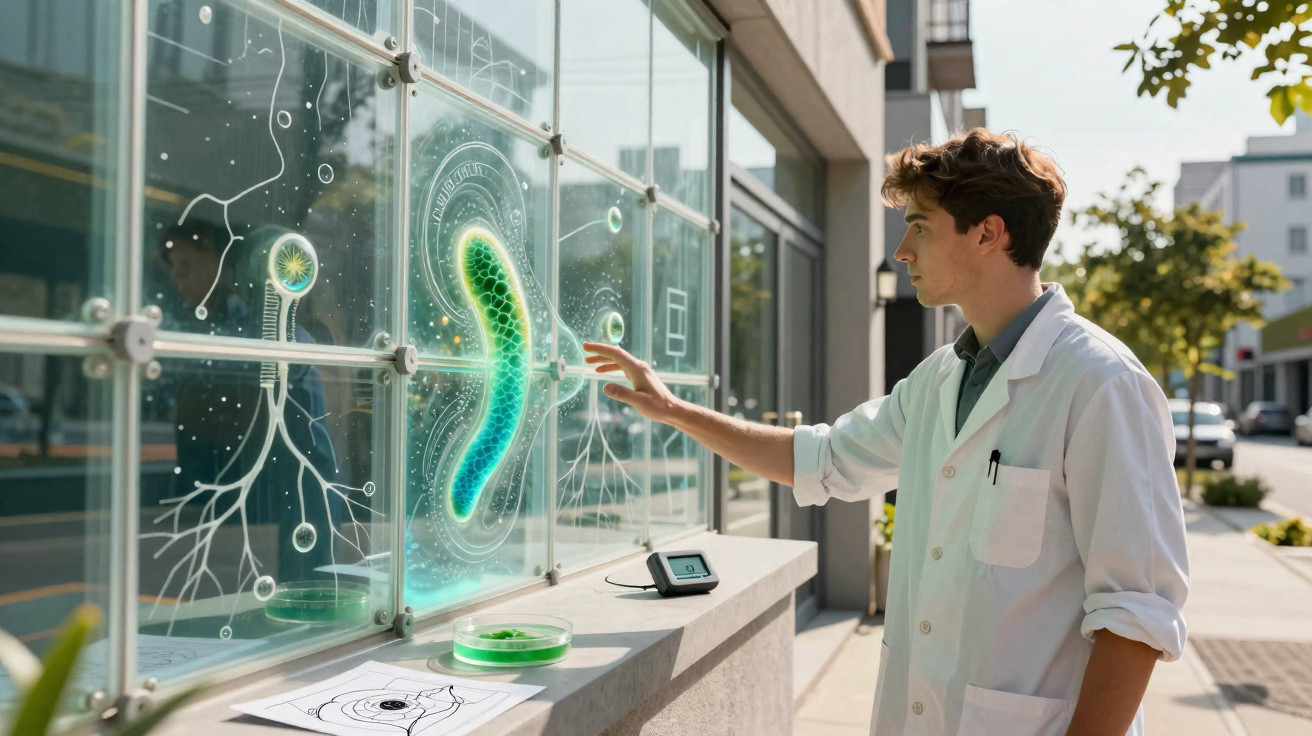
A research team at ETH Zurich is developing a novel construction material that quite literally stays alive. Tiny microorganisms embedded within it draw carbon dioxide from the air, chemically lock it away, and gradually make the material harder over time. The long-term ambition is clear: façades that absorb CO₂ like trees do, become more stable as the years pass, and-at best-can even compensate for minor damage on their own.
How cyanobacteria at ETH Zurich bring ancient tricks to modern construction
At the heart of the work are cyanobacteria, often referred to in everyday language as blue-green algae. These organisms are among the oldest forms of life on Earth, with billions of years of experience turning sunlight into usable energy.
The underlying process is familiar. Through photosynthesis, the bacteria take up CO₂, use water and light, and generate oxygen along with energy-rich compounds. What makes the approach especially compelling, though, is what they can do beyond simply building biomass.
The new construction material stores some of the absorbed carbon dioxide not only in biomass, but converts it directly into solid, lime-like minerals.
That second capability is what gives the material its distinctive appeal: inside the structure, the microorganisms create a kind of mineral “skeleton”. This mechanism-known as mineralisation-reinforces the material over the long term and binds the carbon in a very stable form.
Unlike pure biomass, which can only grow to a limited extent and eventually breaks down, these mineral structures remain in place. In that sense, the algae provide a natural analogue to what cement achieves chemically-only in a far more climate-friendly way.
Hydrogel as a habitat: the “flowerpot” for microbial building materials
To stop the organisms from drying out or dying off, the researchers embed them in a tailored hydrogel. This is a water-rich, sponge-like substance with many pores, acting both as a habitat and as the surface on which the microbes can work.
- high water content to support the microorganisms
- fine pores to move CO₂ and nutrients
- permeable to light so photosynthesis can take place
- mechanically shapeable and suitable for 3D printing
The gel can be processed using a 3D printer, enabling freely shaped forms such as columns, panels, or ornamental façade elements. It allows light to penetrate deep into the structure, while water and gases circulate through tiny channels. For the algae, that combination creates near-ideal living conditions.
The system was tested over 400 days. Throughout this period, the material stayed active and its appearance and stability shifted: it became stiffer and denser and took on a more noticeable green colour, before appearing slightly lighter again as mineralisation progressed. Over the same time, it fixed around 26 milligrams of CO₂ per gram of material-substantially more than other bio-based CO₂ storage concepts manage.
Buildings as active CO₂ absorbers
The researchers are already thinking well beyond laboratory samples. The aim is to apply the material to façades and other building components that are directly exposed to outside air, turning buildings into active participants in a city’s climate system.
At an architecture exhibition in Venice, the team showcased prototypes shaped like artificial tree trunks. According to their calculations, each of these “trunks” could absorb about 18 kilograms of CO₂ per year-roughly comparable to a pine tree around 20 years old.
The vision: house walls that strengthen over the years while continuously pulling carbon dioxide from the surrounding air.
The key point is that the more minerals form, the more stable the structure becomes. Gradually, the microorganisms deposit a kind of lime layer internally. Over time, this produces a more load-bearing, more robust system that, in an ideal scenario, could close small cracks or reinforce weak points.
How much climate protection is realistically in materials like this?
Naturally, this idea is not a substitute for large industrial CO₂ capture facilities. Even so, the cumulative impact could become meaningful if millions of square metres of façades were actively contributing. The concept is particularly interesting in dense cities dominated by concrete and short on green space.
It also opens up synergies with architecture and urban design. Façades could shade, cool, and bind carbon dioxide at the same time. Combined with green roofs and other bio-based elements, buildings start to look less like part of the problem and more like part of the solution.
Biotechnology as a turbocharger for “living” building materials
To scale the approach significantly, the cyanobacteria’s natural performance may not be sufficient. For that reason, the team is working on genetically optimised variants, aiming to boost photosynthetic output and accelerate mineral formation.
This raises ethical and regulatory questions, but it also creates opportunities. Bacterial strains could be adapted to harsh conditions-for instance, intense heat on sun-exposed façades or high salinity in coastal locations.
Nutrient supply is another practical issue. In the experiments so far, the researchers used artificially produced seawater solutions. For real-world deployment, workable concepts are needed in which nutrients are integrated into the system or delivered via rainwater and airborne deposition-without overburdening the material.
How sustainable is a living building material, really?
Compared with energy-intensive CO₂ capture plants, the algae-based material is remarkably frugal. Its primary energy source is sunlight. There is no need for pumps, compressors, or high pressure, as long as the structures remain openly exposed to air.
That can substantially reduce the overall environmental footprint. Even though the production and end-of-life handling of the hydrogel matrix must be assessed critically, the evidence already suggests that the CO₂ yield per unit of energy invested is far more favourable than in conventional technical approaches.
| Approach | Energy demand | CO₂ binding |
|---|---|---|
| Industrial CO₂ capture | high (electricity, pressure, heat) | very high, but expensive |
| Tree planting and reforestation | low to medium | high, but slow and land-intensive |
| Algae-based construction material | low (sunlight, minimal technology) | medium, can be integrated into buildings |
Opportunities, risks, and what this could mean for cities
A “living” building material comes with its own set of questions. It must be safe, must not release unwanted substances, and should be capable of being deactivated if necessary. It also needs a defined lifecycle: how long should the microorganisms remain active, and what happens when a building is demolished?
From an urban-planning perspective, the concept creates new possibilities, such as:
- active façades in heavily polluted city centres
- building elements along busy roads
- temporary structures at large construction projects or trade fairs that absorb CO₂ for as long as they stand
- combinations with solar panels that generate electricity while also providing shade for the algae
From an engineering standpoint, there is still plenty to resolve: how do these materials behave through freezing winters? What happens under persistent rain or extended dry spells? How much maintenance is required, and what would large-scale production cost?
A simple analogy can help non-specialists: the material behaves somewhat like a thin coral shell on a house wall. Microorganisms deposit minerals, strengthen their surroundings, and build up a solid structure step by step-except these “corals” are designed in the lab and deliberately controlled.
There are also promising ways to pair it with conventional concrete or brick. The algae material does not have to replace everything; it could serve as an additional layer-an active, breathable external system in front of a standard load-bearing structure. That would allow established construction methods to be extended with biotechnological elements without reinventing the entire building system.

Comments
No comments yet. Be the first to comment!
Leave a Comment