
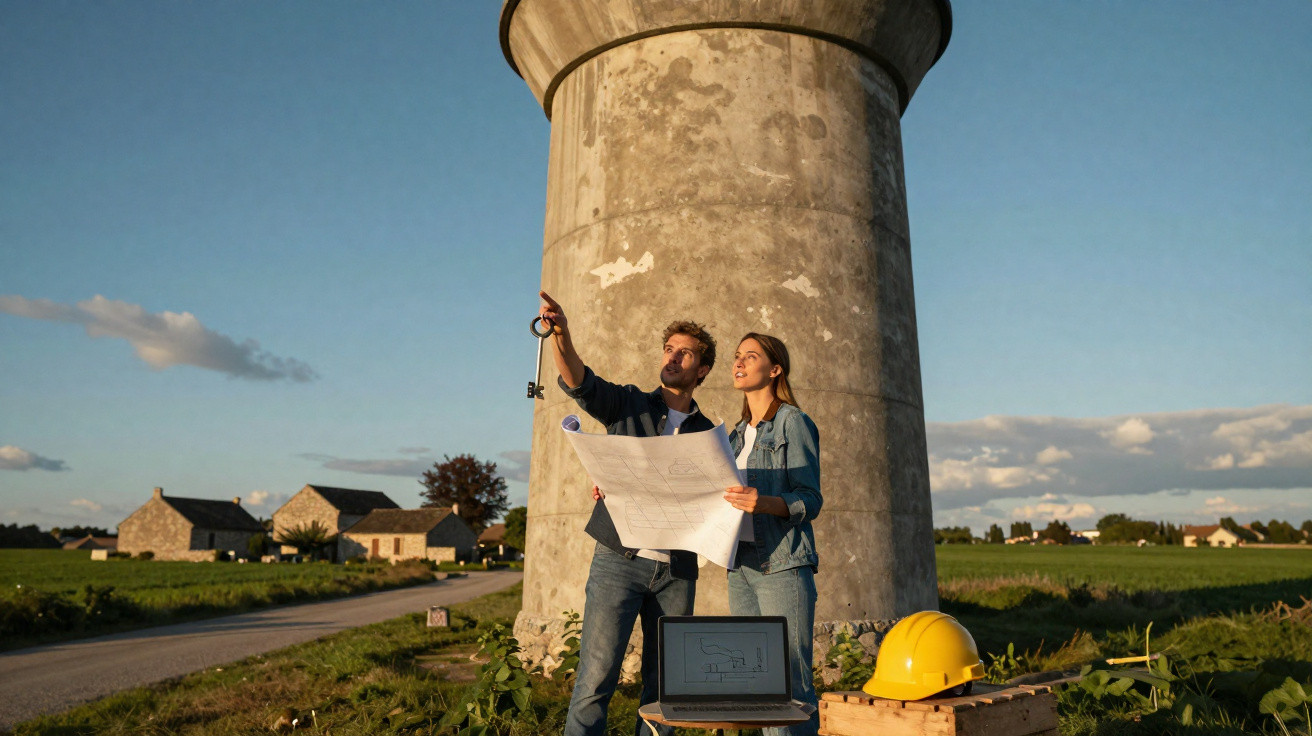
A building for the price of a bread roll – and entirely above board: in the small commune of La Chapelle-Baloue in the Creuse département, an old water tower is being offered for the symbolic sum of 1 euro. The local authority wants to dispose of this post-war relic without paying for an expensive demolition, and is counting on imaginative buyers with the nerve for a highly unusual project.
A water tower bargain – but with conditions
The tower stands around 15 metres tall on a plot of just under 80 square metres and has been out of use since the drinking-water network was upgraded. The commune is selling the structure “as seen”: no refurbishment, no conversion, and no warranty. Anyone who takes it on is acquiring a piece of infrastructure history – along with every challenge that comes with it.
“For 1 euro you get a 15-metre-high water tower, but not a ready-made dream home – rather a blank canvas for visionaries.”
Priority is given to the immediate neighbours. For them, it could be a straightforward way to extend their land – for instance as a studio, an unconventional guest annexe, or simply a striking viewing point. If nobody locally comes forward, the council will also consider applications from further afield.
Time is tight: anyone interested must register their interest by 31 March. After that, demolition could return to the agenda – along with the substantial costs the small commune has been keen to avoid.
Why the tower is being sold at all
The reasoning is pragmatic: the water network has been modernised, so the old tower is no longer required from a technical standpoint. Rather than spend a large sum to remove it, the commune is opting for a symbolic sale.
“Demolishing it is expected to cost around 100,000 euros – a figure that would put serious strain on the village budget.”
Those in charge are hoping for a win-win outcome: the commune avoids a costly, redundant structure, while a buyer gets the chance to launch an out-of-the-ordinary scheme. The project lead for drinking-water supply has described it, in essence, like this: if high demolition costs can be avoided and someone can repurpose a piece of local history, it works for both sides.
Symbolic 1-euro sales are not unusual in France
The idea of selling buildings for 1 euro is not entirely new in France. Municipalities repeatedly offload station buildings, former schools or empty houses at token prices to prevent decay and to attract fresh projects. The thinking behind it is:
- easing public budgets by avoiding renovation or demolition costs
- keeping historic or character-defining buildings in the streetscape
- attracting creative private investors or community organisations
- turning derelict plots into usable spaces
With La Chapelle-Baloue’s water tower, the aim is less about revenue and more about giving a technically outdated structure a future. The tower dates from the period after the Second World War, when many communes expanded their drinking-water infrastructure. Today, estimates suggest France still has around 16,000 water towers – but only a very small share of them are suitable for living in.
How realistic is converting it into a home or leisure space?
On paper it sounds simple: pay 1 euro, convert it, move on. In reality, the details matter, because water towers are specialist structures. Repurposing one can be demanding both technically and financially.
Planning rules and safety requirements
Anyone hoping to turn a water tower into a house, office or holiday loft should expect strict requirements, including:
- structural surveys and evidence of load-bearing capacity
- a fire-safety strategy and safe escape routes
- new access solutions such as staircases or lifts
- connections for electricity, water, drainage and possibly fibre broadband
- thermal upgrades, particularly for concrete structures
Visual changes – such as adding large windows or balconies – also need to be agreed with the authorities. Because the tower shapes the local skyline, its impact on the townscape can be relevant to permissions.
Financial hurdles
The purchase price may be just 1 euro, but conversion costs can quickly multiply far beyond that. Strip-out work alone, plus new floors, services and insulation, can easily run into six figures. Anyone tackling a project like this needs a robust financial plan and, ideally, experience of working with older structures.
“The low entry price doesn’t disguise the fact that this is a genuine building project – not an impulse weekend purchase.”
Why a water tower can still be worth it
Despite the obstacles, there are clear reasons to consider buying – especially for people drawn to unusual places to live and work:
- Distinctive architecture: circular floor plans, significant height and often far-reaching views.
- Emotional value: many water towers are seen as local landmarks and trigger memories for residents.
- Flexibility: potential use as a home, studio, holiday accommodation, viewing platform, cultural venue, or a mix of these.
- Media appeal: striking conversions often attract coverage in TV features and magazines.
For the commune, there is an upside as well: instead of a silent industrial leftover, the site could become a focal point that draws visitors and strengthens the area’s image. In regions facing economic challenges, a creative flagship project can have an outsized impact.
What prospective buyers should expect in practice
The commune will hand over the tower cleared out. In other words, the technical equipment used for water supply will be removed before transfer. The buyer will receive a bare concrete structure with the plot, and must decide from scratch what it is to become.
Typical steps prospective buyers can expect include:
- contacting the council and submitting an informal expression of interest
- a site visit to assess condition and location realistically
- checking local planning rules and what uses may be permitted
- bringing in an architect or engineer for a feasibility study
- producing an initial cost estimate and funding plan
- presenting a concept to the commune, as it will decide who the buyer will be
Because immediate neighbours are considered first, external applicants may be wise to speak to the council early, so they do not spend unnecessarily on plans.
How water towers are already being used creatively
Across France and Germany there are examples of former water towers being given a second life. These offer clues as to what might be feasible in La Chapelle-Baloue.
- Holiday lofts: multi-storey apartments with panoramic views, often in the upper part of the tower.
- Artists’ studios: workspaces or exhibition areas that make the most of the unusual atmosphere.
- Micro-hotels: single-room hotels or “tiny hotels” for guests seeking something different.
- Observation towers: platforms for nature or stargazing, sometimes combined with guided visits.
- Offices or co-working spaces: small but distinctive work hubs for freelancers.
All of these uses depend on the structure and access being workable. They also show that a technically obsolete building can, in the right hands, be reshaped into an appealing space with genuine added value.
Opportunities and risks for buyers and the commune
Anyone taking on a water tower is accepting a risk that can, in principle, be calculated. The biggest danger is costs spiralling while permissions take time, leaving a long-term stopgap that frustrates both the owner and nearby residents.
On the other hand, there is the prospect of a project unlike anything else in the area. If the conversion succeeds, the new owner could end up with a property that is difficult to compare with ordinary houses – including on price. Such niche properties appeal to a smaller pool of buyers, but in the right location and with a high-quality finish they can still attract strong demand.
For La Chapelle-Baloue, the move is a statement in any case: the commune is signalling that it is willing to try unconventional solutions rather than simply letting outdated structures vanish. Whether someone will step forward to take this tower for 1 euro and give it a new role will become clear in the coming weeks.
Anyone dreaming of life in a tower, a show-stopping holiday stay or a highly personal retreat is being offered a rare proving ground here – heavy on concrete, demanding plenty of imagination, and priced at a level more commonly seen in online flash deals.


Comments
No comments yet. Be the first to comment!
Leave a Comment