
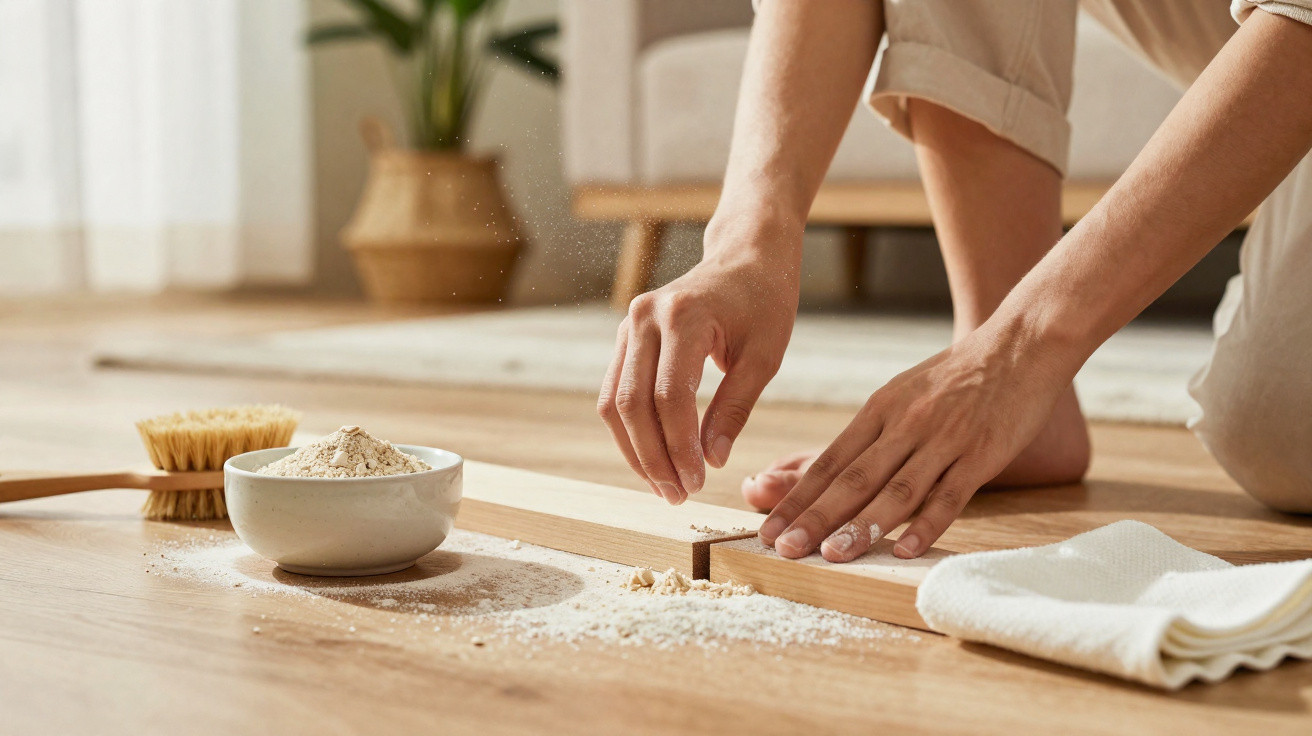
The house was quiet - but the floor certainly wasn’t.
Each small step along the hallway made the boards protest with a sharp, high little squeal, as if the place objected to being walked on. The dog would stop dead at the sound, the children learned to creep about at bedtime, and the one slightly loose board outside the bedroom became a shared family nemesis. It was the sort of daily irritation you stop mentioning, yet never stop noticing. A contractor had offered a quote that sounded closer to surgery than a minor fix: lift the boards, get to the joists, “open it up and see what we find.” All of that… just to deal with a noise.
Then someone tipped a white powder into the gaps, brushed it in, walked across it once or twice… and the floor went silent. No screws, no nails, no crowbar - just quiet. It felt almost like cheating.
Why a noisy floor can drive you quietly insane
At first, a squeak seems trivial. One chirp near the kitchen. A quick squeal by the stairs. You promise yourself you’ll sort it out when you “have time”. Days turn into weeks, and the noise becomes part of the home’s background track, tucked between the fridge’s hum and the washing machine’s spin.
What begins as a mild annoyance can morph into a kind of low-grade torture. The floor always chooses the worst moments to speak up: when you’re settling the baby, when you’re trying to grab a midnight snack, when you’re making a point of not waking a partner who’s finally nodded off. You start taking odd little zigzags to avoid “that board”. Before long, the place that’s meant to feel restful starts to feel like it’s setting traps.
In practical terms, squeaks are simply friction. Wood rubbing against wood, or timber moving against metal fixings. Boards that have dried out, shrunk, or shifted slightly on their joists. Old nails that don’t bite as firmly as they did twenty years ago. Each step flexes the board, the board scrapes, and the sound travels straight up into the room. That’s it - no mystery, no drama. And yet that thin, sharp noise can get under your skin. It’s not dangerous, just relentlessly present.
The numbers tell you how widespread it is. In older homes - especially those with timber subfloors - squeaky patches are almost part of the standard kit. One US housing survey even suggested floor noise lands in the same irritation bracket as draughty windows and dripping taps. People don’t always call a professional for it, but they moan about it endlessly. Online, videos titled “How to stop floor squeaks” quietly clock up millions of views.
One homeowner shared a story that’s painfully recognisable. Their hundred-year-old house had a staircase that squealed like a parrot at every step. Their dad tried driving in extra nails, then wood screws, then placing rugs in just the right spots. Nothing held for long. Eventually, more out of fatigue than confidence, they tested a powdered graphite product. Two passes with a soft brush, three trips up and down the stairs, and the shriek dropped to a dull murmur. By the next day, it was nearly gone. The dad’s reaction wasn’t delight - it was disbelief.
For decades, the so-called “proper” fix meant real disruption. Pull back the carpet. Find the guilty board. Drive screws into the joists at the correct angle. Sometimes, open up the ceiling below so you can reach the subfloor from underneath. That kind of work isn’t merely costly; it’s messy and invasive. Dust, noise, time off, and weeks of warning the children not to tread there. So most people put up with squeaks and tell themselves that’s simply what older houses do - until a low-mess powdered product comes along and quietly rewrites the rule.
The appeal of a powdered lubricant or de-squeak powder is brutally straightforward: wherever friction is creating noise, you get something thin and slippery between the moving parts. The right powder doesn’t glue anything in place. Instead, it settles into microscopic gaps and allows the timber to move without that dry, complaining sound. The structure remains unchanged. The feel underfoot remains unchanged. Only the noise disappears. It’s a tiny, almost invisible fix - and that’s exactly why it can feel like modern magic.
How the powder trick actually works on your floors
The whole trick relies on access. Rather than pulling anything up, you use the hairline gaps that already exist between boards or at the room’s edges. A squeak powder - often a very fine graphite-based product or a PTFE-style powder - is sprinkled directly over the noisy area. The goal is for gravity and movement to draw the particles down into the cracks where the rubbing is happening.
Once it’s on the boards, the powder doesn’t just remain on the surface. Typically, you’ll see it swept gently with a soft brush, an old paintbrush, or even a folded piece of card. That motion helps guide the powder into the seams. Next, you walk over the spot, a touch more firmly than normal. Each step flexes the board, and that flex effectively pumps the powder deeper into the contact points. Within minutes, the floor starts behaving like a better version of itself.
At this stage, most people worry about mess: white powder, darker flooring, pets, children - it sounds like chaos. In practice, a little goes a long way. Pour it deliberately, not as if you’re icing a cake. Any excess left on top can be gently vacuumed up or wiped away with a dry cloth. Once the powder is inside the gaps, it’s largely out of sight. And unlike oils or waxes, you’re not coating the top surface or turning it slippery. The work happens where you can’t see it - between the parts that used to complain each time you walked past.
There’s also a small, unspoken emotional shift when that first squeak vanishes. The room seems calmer; the house feels quieter. That nagging sound - the daily reminder of an “unfinished job” - disappears without the renovation drama you were bracing for. To be clear, a powdered solution doesn’t “repair” a structural fault; it addresses the symptom, the noise. If joists are moving significantly or boards are damaged, you may still need a professional. But for the classic dry squeak caused by normal ageing timber, a thin veil of powder can reset the relationship between your feet and your floorboards in minutes.
Using powdered solutions at home without overthinking it
The approach is refreshingly simple. Start by tracking down the squeak. Walk slowly across the room, testing one footfall at a time until you pinpoint the exact plank or patch that sings the loudest. Mark it - with tape, a sticky note, even a coin - anything you won’t overlook. Then give the area a quick clean so crumbs and dust don’t get in the way of the actual fix.
When the spot is ready, sprinkle a small amount of squeak powder or fine graphite along the board edges and across the noisy zone. Think teaspoon, not shovel. Use a soft brush to work the powder into seams and cracks, brushing both along and across the boards. Then walk over it - heel to toe - several times. Test it. If the noise has dropped but hasn’t fully gone, repeat with a little more. Often, two or three rounds are enough to turn a squeak into silence or a muted whisper.
The most common mistake is impatience. Some people tip out half the container in one go, create a mess, then conclude the product “doesn’t work”. Others try once, hear a slight improvement, and stop too soon. There’s also the temptation to combine fixes - powder in one place, oil in another, a random screw somewhere in the middle. That mix rarely ends well. Use one method at a time. And if you’ve got children or pets, keep them out of the room until any extra powder is cleaned up. Nothing dramatic - just sensible.
On a more human note: Let’s be honest: nobody really does this every day. Squeaks build up precisely because floor noise isn’t an emergency. It’s not a broken boiler or a leak. It’s a slow drip of irritation that keeps sliding down the to-do list… until one day, you simply can’t un-hear it.
“The quiet after fixing a noisy floor is strange at first,” says one homeowner. “You walk over the same spot out of habit, bracing for the noise, and when there’s nothing… you realize how loud it used to feel.”
- Use the right product: Choose powders sold specifically for squeaky floors, or a fine, dry graphite lubricant intended for wood and mechanical components.
- Start small: Try a small patch first before treating an entire room.
- Keep it dry: Don’t combine powder fixes with liquid products or water-based cleaning in the same area.
- Watch the finish: If your floor has a delicate finish, test in an unobtrusive corner and wipe residue gently.
- Remember: a squeak that returns quickly may indicate a deeper structural issue worth checking.
Living with quiet floors and what that really changes
Once the noise has gone, the way you move through the house changes in subtle ways. You stop navigating around the problem. Those odd detours - the habit of stepping over or around certain boards - tend to vanish within days. The hallway becomes a hallway again, rather than a miniature obstacle course. Bedtime feels smoother. Late-night trips to the fridge no longer seem like a stealth operation.
That’s the odd truth about small domestic irritations: they rarely justify major renovation, yet they shape daily life in a thousand tiny moments. A squeak lasts less than a second, but it can trigger a chain reaction - an irritated glance, a baby stirring, a partner waking, your own pulse rising. Silencing it with a pinch of powder isn’t only a “DIY win”. It’s reclaiming a slice of quiet you didn’t realise you’d mislaid.
Some readers will instantly picture a specific spot in their own home. The stair that always shouts. The strip of wood outside the bathroom. The living-room corner where guests inevitably step - and the floor answers back. These are exactly the places where a low-cost, almost invisible powdered fix makes the most sense. No tools, no bookings, no drama. Just a small action, repeated patiently, until the boards remember how to behave.
There’s another layer too: passing the trick on. This sort of simple, near-secret solution tends to spread by word of mouth. A neighbour tries it, a cousin swears by it, a short clip shows the before-and-after. You don’t need to be a renovation expert to feel a quiet kind of pride when the squeak disappears under your own feet. It feels like you’ve won an argument with the house - and, for once, you didn’t have to rip anything apart to do it.
| Key point | Detail | What it means for the reader |
|---|---|---|
| Powder reduces friction | Fine particles slip between rubbing boards and fixings, cutting the squeak at its source. | A practical, low-mess fix without opening up the floor. |
| The method is minimally invasive | Sprinkle, brush into gaps, walk over it, repeat if needed. | Makes the approach doable even if you’re not into DIY. |
| Not all squeaks are the same | Surface friction often responds well; deeper structural movement may require a professional. | Helps you judge when powder is enough and when expert help matters. |
FAQ:
- What kind of powder actually works on squeaky floors? Look for products sold specifically as squeak-reducing powders, or use a fine, dry graphite lubricant designed for wood and mechanical parts.
- Can I just use talcum powder, bicarbonate of soda, or cornflour? They can help briefly in some situations, but they’re not made for long-term lubrication and may clump or attract moisture over time.
- Will the powder damage my floor finish or stain it? Most purpose-made products are neutral on standard finishes, but always test in a discreet corner and wipe any residue from the surface.
- How long does a powdered fix usually last? For straightforward friction squeaks, results can last months or even years, though very high-traffic areas might need a quick refresh.
- When should I skip powder and call a professional? If the floor feels spongy, visibly shifts, or you notice cracks, gaps, or sagging, you’re past squeaks - it’s time for a structural check.



Comments
No comments yet. Be the first to comment!
Leave a Comment