
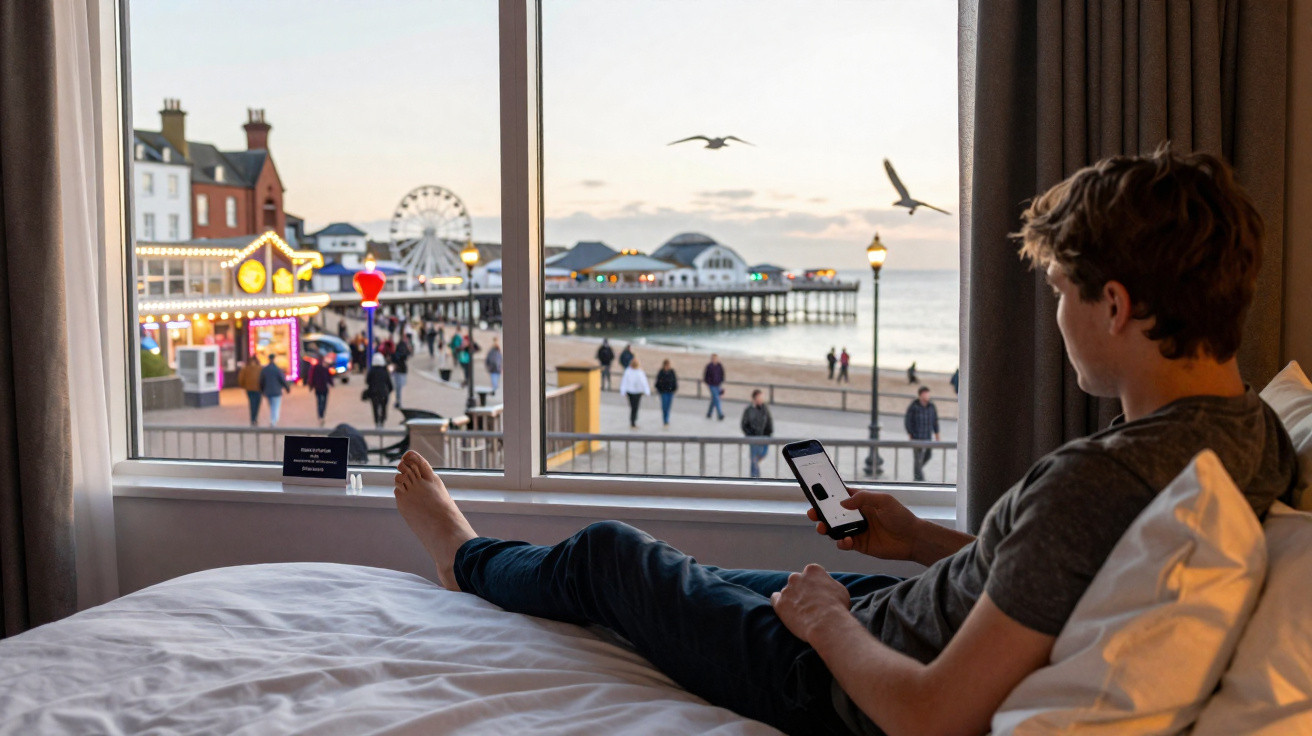
Piers keep glowing long after dark, arcades flash and chirp, the breeze drags snatches of karaoke across the promenade, and groups drift past Victorian frontages sounding like they’ve brought their own PA. Where hotel managers once pushed a “sea view”, they now market something rarer: quiet. Along the coast, window upgrades have become a kind of low-key arms race against gulls, fairground rides and bass that slips through glass like gossip. The question guests now murmur at check-in is straightforward: how quiet is the room? The real answer sits in decibels, not stars.
The moment it clicked for me that the seaside has shifted, I wasn’t standing on sand at all. I was leaning into a sash window in a Broadstairs guesthouse, listening hard to the thrum outside. A busker on the pier had Ed Sheeran on loop, the tide kept smacking the harbour wall, and at 5 a.m. a delivery lorry sighed to a stop. The receptionist pushed my key across the desk with a gentle caveat: “We’ve had the new glazing put in - you’ll hear the difference.” I did. Later, I found out the number that makes it real.
The new soundtrack of the British seaside
Today’s pier isn’t an Edwardian stroll. It’s a miniature city: speakers, compressors, extractor fans and those impossible-to-ignore arcade jingles. Each part adds its own layer, and together they reach bedrooms faster than most people expect. Hoteliers talk about summer weekends the way marathon runners talk about hydration: pacing, endurance and the need to recover. Quiet fills rooms.
Look around: in Brighton, taxis idle at the Palace Pier into the small hours; in Blackpool, rollercoaster wheels “sing” with an oddly maritime rhythm; in Southend, the wind can turn the pier into a huge reed instrument. One night manager told me about a family who arrived after dusk, enchanted by the fairy lights, then returned to reception at midnight carrying pillows. The hotel shifted them to a rear room with secondary glazing. By breakfast, the smiles were back. Not a peer-reviewed study, but a familiar pattern.
For owners, the maths is blunt. You can’t ask the tide to quieten down, and you can’t reliably persuade the bar next door to hush the singalong by ten. What you can do is treat the building. Modern glazing can improve both thermal performance and acoustic control, so the spend often sits under energy budgets as well as comfort. In hospitality, a three-in-one benefit is unusual; this comes close. Hoteliers now drop Rw figures into conversation the way car fans talk about torque.
So what decibels should you aim for near a pier?
Here’s the practical target: aim for about 30 dB(A) inside the bedroom at night, measured as LAeq over eight hours, with peaks (LAmax) kept below 45 dB(A). In the daytime, 35 dB(A) tends to feel settled for reading or working. That aligns with BS 8233 guidance for restful rooms, and it matches what your ears expect in the early hours. If a hotel can keep 30 dB(A) indoors while the pier carries on, you’ll sleep.
Standard double glazing helps with heat, but sound can still travel through frames and tiny gaps. The detail that counts is laminated acoustic glass plus properly fitted seals, not simply adding another pane. Secondary glazing - a separate, discreet inner window with a generous air gap - is the coast’s quiet hero, often reaching Rw 40 dB or more. Ask what’s fitted on the street-facing side and what’s on the room side. And if you’re curious, use a phone meter app before you settle in: with the lights out, you want to see numbers in the high 20s to low 30s around 1 a.m.
Everyone knows the feeling: the music dips, the room relaxes, and then one laugh outside lands as if it’s at the foot of the bed. That’s the “peak” your brain clings to. Avoid rooms above the bar or directly over the entrance canopy where voices gather. Request higher floors and rooms set at an angle to the pier rather than facing it head-on. If a hotel mentions “acoustic laminate” or “secondary glazing with 100–150 mm gap”, you’re probably in good hands.
Keep it simple, and keep it specific. A window is a system: glass, frame, seals, vents and installation. Even a decent pane won’t save a mediocre system that leaks through pinprick gaps. The tiniest draught can cancel out the priciest glass.
“We design for 30 dB(A) at the pillow,” says Hannah Lewis, an acoustics engineer who’s worked on three South Coast hotels. “Guests don’t review Rw values - they review sleep.”
- Target inside the room at night: 30 dB(A) LAeq, peaks under 45 dB(A).
- Ask for laminated acoustic glass or secondary glazing with a wide air gap.
- Prefer rooms that don’t face the pier head-on; corners and rears are calmer.
- Check for acoustic trickle vents and proper perimeter seals.
- Use a phone meter briefly; if it shows 40 dB at 1 a.m., request a swap.
What hotels are fitting - and how you can ride the wave
From the pavement, the retrofit trend can look straightforward. Behind the scenes, it’s all about millimetres. Many hotels choose 10.8 mm acoustic laminate for the outer layer, then add a slimline secondary unit with a 100–150 mm cavity. That wide gap is the trick: air works like a spring, splitting and weakening sound energy. When it’s done properly, you feel the door latch and the outside world drops away, like stepping into a recording booth built for ordinary sleepers.
Frames have their own tell-tale signs. Timber can look brilliant, but it needs compression seals that truly compress; uPVC can perform perfectly well if the installer sweats the last two per cent. Trickle vents can be the villain or the saviour - acoustic versions reduce road and promenade noise without suffocating the room. Let’s be honest: nobody lives by lab rules every day. You’re not sleeping in a test chamber; you’re sleeping in a hotel. The goal is for the science to disappear.
Costs come up, of course. A typical seaside bedroom might need £1,000–£2,500 of acoustic work, including glass, vents and fitting. Owners say the return shows up as fewer refunds, longer stays and reviews that glow with an unglamorous adjective: quiet. Your ears decide your stay.
One figure sits behind all of this: a 10 dB reduction is roughly heard as halving loudness. If the street party sits at 60 dB outside your window, a glazing system that delivers 30 dB inside doesn’t merely take the edge off; it reshapes the whole night. You wake thinking about the sea, not the speakers.
Windows aren’t the only lever. The better hotels treat the entire stack: soft-close corridor doors, padded architraves, quieter ice machines, rugs on timber landings. It isn’t luxury for its own sake; it’s basic sound discipline. A few are even offering in-room white-noise options - a gentle hush that masks the strays: the one-off shout, the bottle bin at dawn, the gull with opinions.
Guests can help too. If you’re booking near a pier in peak season, email two questions: what’s the window specification on sea-facing rooms, and what’s the usual night-time dB level at the pillow? Two decent replies tell you more than twenty sunset photos. If the response is careful and specific, you’ve probably found a reliable place.
The seaside isn’t about to fall silent. It’s just getting smarter. Hotels aren’t trying to kill the fun; they’re containing it. A good window lets the sparkle in and keeps the racket out, like a lens for sound. You can still catch the soft shush of a late tide when you want it. You won’t hear the 1 a.m. chorus unless you lift the sash and invite it inside.
Pick your decibels and you pick your night. That’s the new reality on Britain’s coast. Piers can glitter and sing while your room stays a pocket of calm. The best hotels have decided both can belong in the same holiday - and they’re fitting that solution right into the frame.
| Key point | Detail | Why it matters for you |
|---|---|---|
| Night-time decibel target | 30 dB(A) LAeq, peaks under 45 dB(A) | A clear benchmark for sleeping near a pier |
| Best glazing choice | Laminated acoustic glass + secondary glazing, wide air gap | A practical option that stands up to promenade noise |
| Room location | Higher floor, not facing the pier, well-finished doors and seals | A simple step that lowers perceived noise without building work |
FAQ:
- What’s the difference between double glazing and secondary glazing? Double glazing is one factory unit with two panes. Secondary glazing adds a separate inner window and a wider air gap, which blocks more sound from arcades and late-night chatter.
- How can I measure decibels in my hotel room? Use a phone app that shows LAeq and LAmax. Take a 5–10 minute reading around 1 a.m. with the window shut; a calm room will sit near 30–33 dB(A).
- Is laminated “acoustic” glass worth it? Yes, because the plastic interlayer damps vibration. It won’t fix a leaky frame, though, so seals and vents must be part of the package.
- Will a higher floor always be quieter? Often, since street voices and engines lose energy with height. Watch for rooftop plant or gull hot-spots near parapets, which can swap one noise for another.
- Should I bring earplugs or a white-noise app just in case? Practical backup, especially in peak season or during events. That said, a well-glazed room near a pier should still land you near 30 dB(A). Let’s be honest: nobody really does this every day.




Comments
No comments yet. Be the first to comment!
Leave a Comment