
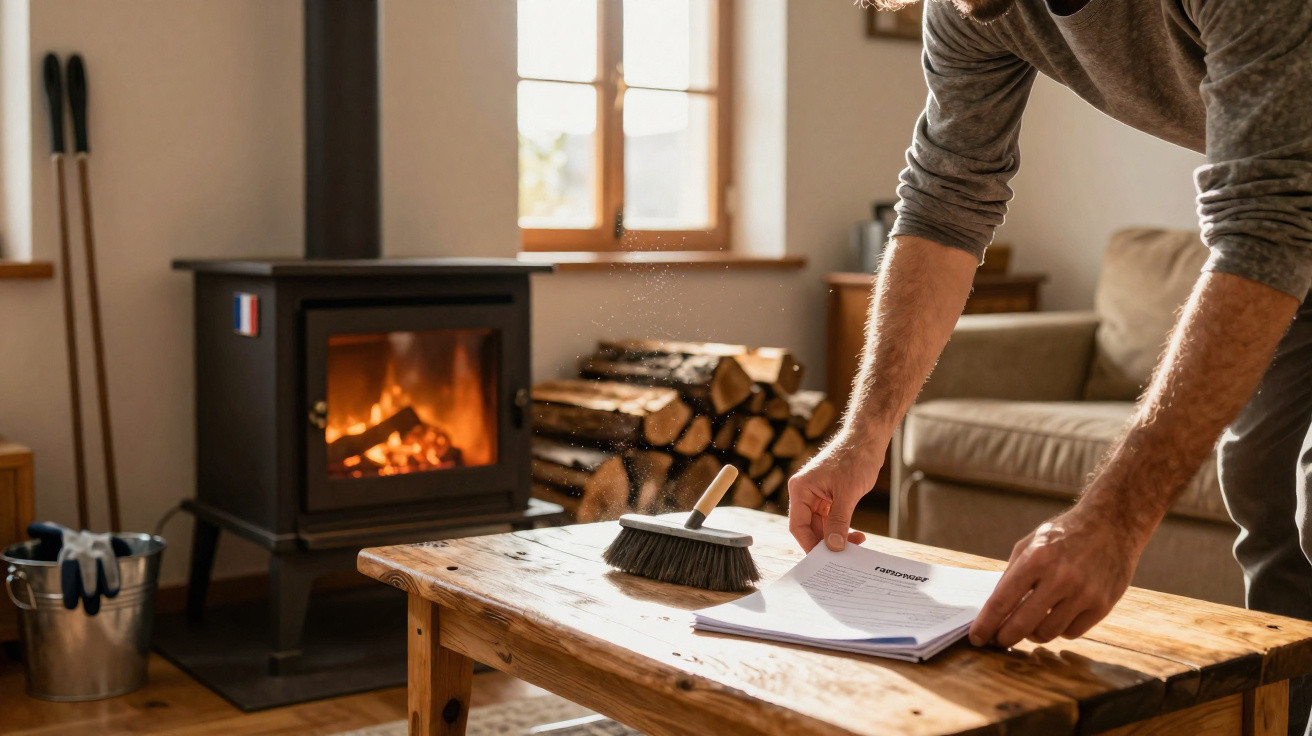
You know the moment: the air indoors feels a bit sharp, a lingering whiff of smoke hangs in the sitting room, and you start wondering whether the stove is doing its own thing.
In France, winter brings those doubts back as reliably as scarves and slow-cooked casseroles. And one question keeps resurfacing: do you genuinely have to get your stove or chimney flue swept, or is it just guilt-driven sales talk?
Between the neighbour who swears they have not done it once in ten years and the insurer who demands proof of sweeping, the stories clash. Meanwhile, the legal texts are not always read to the end-and they sometimes hide details that change everything.
One point is beyond debate: if something goes wrong, nobody else takes the hit on your behalf.
What French law really says about sweeping stove and chimney flues
One wet morning in November in a town near Lyon, a firefighter once showed me the inside of a chimney pipe after a call that was meant to be about a “simple” smell of smoke. The metal lining was coated in thick, glossy soot-almost like black glass. The household insisted they burned “good wood” and opened the window now and again. When was the last sweep? No one could say.
That is precisely the gap French law is designed to close. It is not interested in how good you believe your logs are, or how careful you think you have been. It focuses on the condition of the flue and whether maintenance can be evidenced. Ask an insurer what they look for first after a fire, and you will often hear the same answer: the chimney sweeping certificate.
That plain A4 sheet can carry far more weight than it seems.
Paris is a clear example. Local health regulations require chimneys and flues serving fuel-burning appliances to be swept at least twice a year, including one sweep during the heating season. In many other French departments, the strict baseline for wood and pellet appliances is one sweep a year, sometimes two depending on the local prefectural order. This is not merely “best practice”: those local sanitary rules have legal force.
In 2023, French fire and rescue services logged thousands of chimney fires, frequently linked to flues that had not been properly maintained and were heavy with creosote. The official reports can read like paperwork, but firefighters describe the same pattern in everyday language: an “it will be fine” mindset becomes an orange glow on the roof at 2 a.m. At that point, everyone suddenly wants to know the date of the last sweep.
That is also the moment insurers start paying close attention to the small print in your home insurance policy.
In legal terms, the sweeping obligation does not stem from one famous, easy-to-quote national article. Instead, it sits across a patchwork of local authority law, public health requirements and local rules set by prefectures or councils. Together, they land on one straightforward principle: the person using the appliance must keep the flues clean and safe by arranging mechanical sweeping at regular intervals.
In most communes, the sweep needs to be carried out by a professional if you want a certificate that will stand up to scrutiny. That document-your chimney sweeping certificate-is exactly what an insurer will ask for if smoke stains your walls or a flue fire breaks out. Without it, they may reduce the payout, or even decline cover for damage connected to the chimney. Let us be honest: most people do not read those clauses properly until everything quite literally goes up in smoke.
The law is not going to turn up at your door every winter. The real test comes on the day something happens.
How to stay on the right side of the law – and not get burned by your insurer
The most reliable first step is simple and unsentimental: check the local rules where your home is. The obligation is typically set out in the Departmental Health Regulations, usually available on the prefecture’s website, and sometimes also on the town hall website under housing or public hygiene. Look for the section on sweeping smoke flues, then write down two essentials: the minimum number of sweeps per year and whether mechanical sweeping is explicitly required.
Once you know that, ring a qualified chimney sweep and ask one direct question: “Will your certificate meet the insurance requirements and the local regulations here?” A reputable professional will be familiar with the local rules, use mechanical brushes, and leave you with dated paperwork showing their business details and the appliance information. File that certificate alongside your home insurance documents and energy bills-because in an emergency you want it in ten seconds, not ten days.
Some households also take a quick photo and save it to cloud storage. Paper burns. Digital copies do not.
A common mistake is to focus on what you can see: the attractive stove body, the flames, the spotless door glass. The legal duty, however, is aimed at what you cannot see: the flues running through walls and up through the roof, where soot accumulates quietly. Another frequent misconception is that sealed stoves or high-efficiency pellet boilers somehow do not need routine sweeping. French law is not swayed by a glossy brochure; it is concerned with what exits the flue.
Many owners also skip sweeping in mild winters, assuming lower use makes it unnecessary. Yet even short burn periods can create deposits-particularly where draught is poor or the wood is damp. A gentle winter followed by a cold snap is often an ideal recipe for a flue that is already close to overloaded. In most departments, the rule is written in yearly terms, not in “how many times you lit the fire”.
It is an easy psychological trap. Maintenance feels theoretical… until the day the sitting room fills with smoke halfway through Sunday lunch.
A veteran firefighter in Haute-Savoie once put it to me during a call-out:
“Every time I pull up to a chimney fire, I know I’m looking at a problem that could have been solved with one phone call and 120 euros.”
Those words may sound blunt, but they echo what insurers, mayors and emergency services repeat again and again in private.
The legal requirement also pairs naturally with everyday habits. Burn properly seasoned wood, keep packaging and treated timber out of the stove, and pay attention to the colour of smoke coming from your chimney on cold mornings. Thick, dark smoke can indicate the flue is working hard and building deposits. A professional sweep will often offer small, practical suggestions tailored to your installation and your region’s climate. Those few minutes of advice at the end of the visit are worth hearing.
- Keep all chimney sweeping certificates for at least five years.
- Put the sweep dates in your calendar as soon as you book them.
- Ask your insurer in writing what frequency they require.
- After any major roof work, check the chimney terminal still meets the rules.
Real-world implications: money, safety and quiet evenings in front of the fire
French rules on chimney sweeping are not just an abstract hurdle designed to frighten homeowners. They show up in very practical moments: when you let out a property, sell an old stone house, or fit a smart black stove in a new-build. If you cannot produce recent sweeping certificates, a sale can slow down, a notary can raise queries, and negotiations may start around the final price. Buyers want clarity on what they are taking on-both structurally and legally.
Rentals make the issue even more down-to-earth. Landlords are generally responsible for providing a safe, compliant installation; tenants are often responsible for routine maintenance such as sweeping. Disputes over who arranges it and who pays for it still trigger tense emails in many shared properties and family lets. A single sentence in the tenancy agreement stating who does what can prevent months of silent frustration.
This is not law in a vacuum; it lands directly in everyday relationships.
| Key point | Details | Why it matters to readers |
|---|---|---|
| Legal sweeping frequency | Most French departments require at least one mechanical sweep per year for wood and pellet appliances; some (such as Paris) require two, including one during the heating season. | Knowing the local rule helps you book the right number of visits and avoids nasty surprises if an insurer or a notary asks for up-to-date certificates. |
| Who must arrange the sweeping | Owner-occupiers arrange it themselves; in rented homes, tenants usually organise and pay for sweeping unless the tenancy agreement clearly states otherwise or local rules set different duties. | Getting this clear prevents landlord–tenant arguments and avoids maintenance gaps that could leave someone legally exposed after a fire. |
| Insurance and certificates | Insurers commonly ask for a professional chimney sweeping certificate dated within the legally required period; without it, they may reduce or refuse compensation for chimney-related damage. | Keeping the certificates and checking your policy conditions can be the difference between a paid claim and an extremely expensive rebuild. |
The more closely you look, the less this topic is about soot and old-fashioned rules-and the more it becomes about something quieter: feeling safe at home. A properly functioning flue is, by design, out of sight; you barely remember it is there. Until it fails dramatically. In that sense, sweeping sits in the same mental box as smoke alarms or seat belts: nobody wakes up eager to deal with them, but everyone knows what they prevent.
Here, French law plays the part of the slightly irritating relative who repeats the same advice at every family gathering. It may sound repetitive, yet it is often right. Calling a chimney sweep once or twice a year is not just bureaucracy; it places you in a chain connecting firefighters, insurers, neighbours and the people who lived in your home before you. Perhaps the real question is not “Is sweeping really mandatory?”, but “How much peace of mind do you want on the night you light the first fire of winter?”
FAQ
- Is chimney sweeping legally mandatory everywhere in France? The national framework allows for local variation, but almost all French departments impose regular mechanical sweeping for fuel-burning appliances through their Departmental Health Regulations. Because the required frequency differs by area, checking your local rules is essential.
- Can I sweep my chimney myself and be covered by insurance? You can use sweeping logs or brushes yourself as an extra safety step, but many insurers accept only a professional certificate as proof of proper maintenance. If you rely only on do-it-yourself cleaning, you may have no valid document to produce after a claim.
- How much does professional chimney sweeping usually cost in France? In most regions, a standard sweep of a single flue costs between €60 and €150, depending on access, the type of appliance and travel distance. Some firms charge less if you book outside the busy autumn period.
- What happens if I never sweep my stove or chimney flue? You increase the risk of chimney fires, carbon monoxide problems and smoke damage in your home, and you may face reduced or refused compensation from your insurer after an incident. In some cases, you could also be held responsible if poor maintenance affects neighbours or other owners in a shared building.
- How can I know the exact sweeping rule that applies to my home? Check the Departmental Health Regulations on your prefecture’s website, or ask your town hall’s housing or public health service for the clause on flue maintenance. A local chimney sweep or your building’s managing agent will often know the applicable frequency as well.





Comments
No comments yet. Be the first to comment!
Leave a Comment