
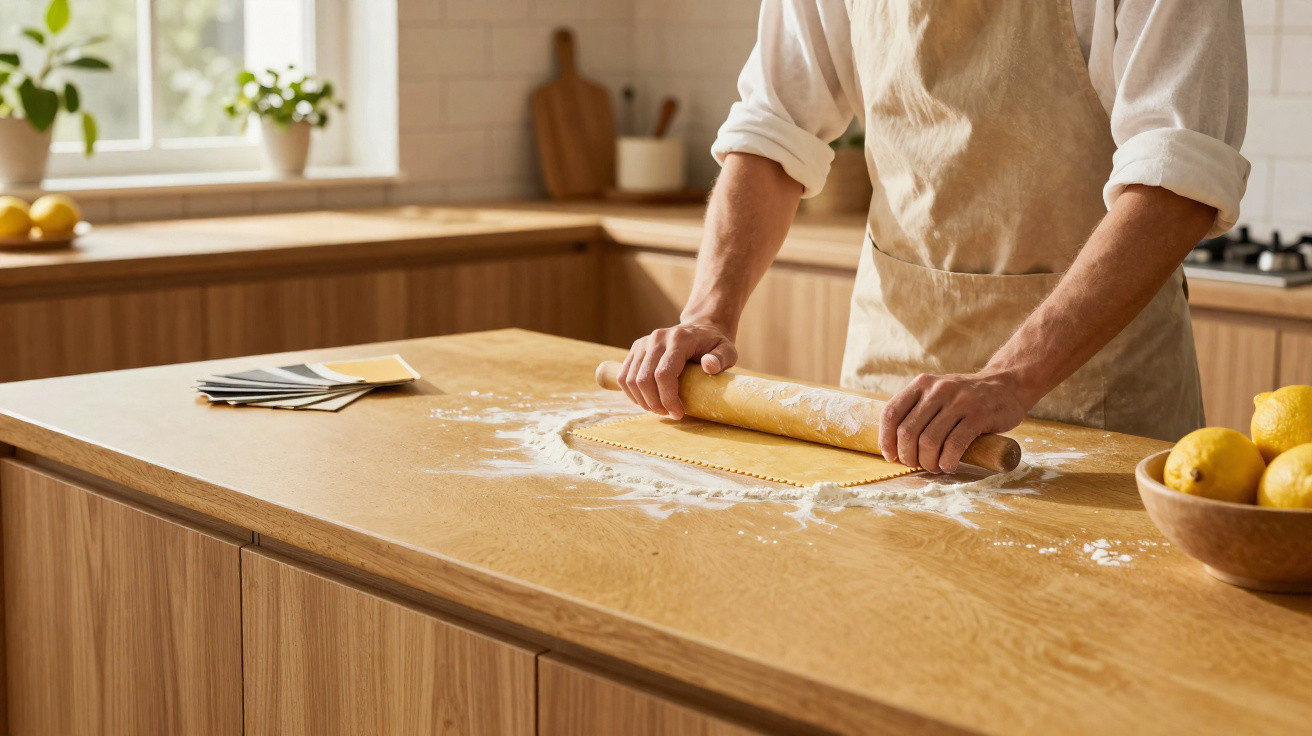
His kitchen screamed 2026: matte-black appliances, a flush induction hob, and handleless cabinetry that disappeared into the joinery. Yet the worktop beneath his hand could have belonged in a 1920s café - softly marbled, pleasantly warm, never glossy, never icy. It had that relaxed, lived-in refinement. The owner grinned and said, “My grandmother had this in her house. I never thought I’d choose the same material.”
Against the endless feed of Instagram marble veining and engineered quartz perfection, it felt unexpectedly human - a touch imperfect, a touch nostalgic. You could almost imagine cups clinking and jazz drifting from a crackling wireless. The twist isn’t that designers are championing it; it’s that showroom figures suggest homeowners are, too - and many are bypassing supposedly timeless granite to get it. The worktop everyone forgot has returned, and it’s making itself known.
The surprise return of linoleum countertops
Step into the most in-demand kitchen showrooms for 2026 and there’s a small, quietly radical shift. Among the stone slabs and high-gloss composites sits a soft, matte surface in shades that feel oddly reassuring: deep forest green, near-black navy, and a caramel beige reminiscent of latte foam. You reach out expecting something plastic-like. It isn’t. It’s linoleum - specifically furniture-grade linoleum, often marketed as a linoleum countertop or desktop linoleum.
This isn’t the brittle, worn school-corridor flooring many of us remember. Today’s version is a dense, natural material made from linseed oil, wood flour and pigments, with a tactile finish that reads almost velvety. Designers are bending it over rounded edges, pairing it with oak, and placing it in ultra-contemporary schemes. The effect is both forward-looking and oddly familiar - like a century-old diner reinterpreted by a Scandinavian architect.
What you see is being echoed by what’s being bought. Several European kitchen brands say linoleum worktops are among their quickest-growing categories for 2025–2026, fuelled by clients who want “soft modern” rather than “showroom shiny”. At one German retailer, internal sales figures presented at a trade fair showed linoleum moving from a niche choice to nearly 12% of bespoke countertop orders in two years - a striking jump in a sector ruled by quartz and laminates. In customer surveys, the same three motivations keep surfacing: comfort, colour and conscience.
“Comfort” is the day-to-day feel of it. “Colour” is the appeal of depth and richness that doesn’t demand attention. “Conscience” is the small question in the background: do I really want yet another petrochemical-heavy surface if there’s an alternative? Not everyone follows that instinct - let’s be honest, plenty of us still pick whatever photographs well - but there’s something in this century-old recipe that matches the 2026 preference for homes that feel softer, slower and more human.
How to bring this vintage material into a 2026 kitchen
A sensible starting point is to design in “zones” rather than wrapping every last centimetre in linoleum. Many designers specify it for the places you touch most: a breakfast bar where forearms rest, a coffee nook, a baking area, or a long island with generous curves. Used alongside hardier options - stone near the sink and hob, for instance - it becomes a highlight without turning into a liability.
After that, the decisions come down to colour and edge detailing. Dark, atmospheric blues and charcoals deliver that cool, gallery-kitchen mood. Pale putty and mushroom tones take the sting out of minimal rooms that can otherwise feel clinical. Some of the strongest installations carry the linoleum over a thick plywood edge, then soften the corners with a radius so it reads like furniture rather than a simple slab. All at once, the island stops looking like a “surface” and starts feeling like a table you’d happily linger around.
Most of us know the point when a kitchen begins to resemble an appliance showroom instead of the heart of a home. Linoleum succeeds because it pushes back against that vibe. There’s a slight give under your fingertips, a muted sheen in the morning light, and a forgiving quality that makes tiny crumbs less obvious between wipes. It nudges the room towards “lived in” rather than “staged”. That’s also why some restaurateurs are bringing it back for bars and pastry counters: people settle more quickly when a space looks touchable instead of precious.
Living happily with linoleum worktops
For linoleum countertops to be a pleasure day to day, the mindset is straightforward: treat them more like a cherished wooden table than an indestructible stone block. They respond best to warm, soapy water rather than harsh cleaners. A soft cloth beats an abrasive pad. A couple of times a year, applying the manufacturer’s recommended wax or care product helps keep the surface nourished and a little more stain-resistant.
Hot pans belong on trivets; sharp knives need chopping boards. If you’re used to slamming cast iron onto granite, this material will quietly encourage you to slow down. Many people who choose linoleum genuinely enjoy that - it gently nudges everyone in the house towards being a bit more mindful. And, of course, accidents happen: a splash of red wine, a smear of curry, a lemon slice left too long. New marks typically clean off. Sometimes a faint patina lingers. In 2026, that isn’t a catastrophe - it’s part of the story.
The biggest mistake is assuming linoleum behaves like plastic laminate. It doesn’t. Strong bleach, steam cleaners held over one spot, and repeated soaking around a sink that isn’t properly sealed are the usual routes to disappointment. Another common misstep is picking a colour from a tiny online swatch. This material has visual depth, and it can look very different in daylight compared with warm LED lighting. Take large samples home, live with them for a few days, drip a little coffee on them, and wipe it away.
“People are tired of kitchens that feel like airport lounges,” says London-based kitchen designer Maya Hart. “Linoleum brings back that café-table warmth, but with a contemporary edge. It’s less ‘museum’, more ‘come in, sit, stay’.”
- Do: Combine linoleum with stone or stainless-steel zones if you cook a lot, rather than committing to it everywhere.
- Don’t: Assume it will stay factory-fresh forever; a gentle patina is part of the appeal.
- Do: Ask your installer about edge details, moisture protection, and the care kit for the specific brand you’re choosing.
- Don’t: Feel pushed into grey - the standout 2026 linoleum kitchens embrace rich, soulful colour.
Why this old-new countertop hits a nerve in 2026
Linoleum’s return feels like more than a passing design moment. It speaks to a quiet weariness with flawless, ultra-hard surfaces where every crumb is visible and every photo looks like it’s meant to be judged. Kitchens are once again doing heavy lifting: remote work days, children’s homework, sourdough experiments, and chaotic group dinners. A worktop that’s a little more forgiving - visually and emotionally - can feel oddly radical.
There’s also a sustainability angle that doesn’t shout, it murmurs. Linoleum is made from ingredients your great-grandparents would recognise: linseed oil, wood flour, natural resins and pigments. For some renovators, that’s the deciding factor. For others, it’s simply a welcome bonus attached to a material they chose because it looks lovely on a rainy Tuesday at 7 pm.
That may be why the comeback doesn’t register as retro cosplay. There’s no forced checkerboard floor or obligatory chrome stool. Instead, 2026 linoleum countertops slip into calm, pared-back kitchens and subtly loosen the atmosphere. They’re a softer handshake in a room full of hard edges. Whether this is a long-term shift or a strong cycle, the message from kitchens adopting it now is clear: this is a space for living, not just photographing.
| Key point | Detail | Why it matters to you |
|---|---|---|
| A century-old material made current again | Natural, tactile, matte linoleum, based on a recipe more than 100 years old | Discover a warmer alternative to conventional worktops |
| Used in strategic zones | Ideal on islands, bars and coffee corners, paired with stone near water and heat | Adapt the trend to real life without sacrificing practicality |
| Care and patina | Gentle cleaning, occasional protection, a light patina that reflects everyday kitchen life | Know what day-to-day ownership looks like before committing |
FAQ:
- Is linoleum really durable enough for a busy kitchen? Yes - with proper installation and basic care. It holds up to everyday use better than many expect, but you’ll still need chopping boards and trivets.
- Will it stain easily with coffee, wine or turmeric? Spills that are dealt with quickly usually clean off with mild soap and water. Strong pigments can leave a faint shadow over time, more like wood than stone.
- Can I retrofit linoleum onto my existing worktops? In many cases, yes. Installers can often apply it over stable substrates such as plywood or existing laminate, provided the base is sound and flat.
- Is linoleum more eco-friendly than quartz or laminate? It’s largely made from renewable, natural ingredients and avoids the same level of petrochemical content, which is why it appeals to many eco-conscious renovators.
- What style of kitchen does it work with best? It looks particularly good in warm minimal, Scandi, Japandi and mid-century inspired spaces, and it can also soften industrial or loft-style kitchens with a more human feel.



Comments
No comments yet. Be the first to comment!
Leave a Comment