
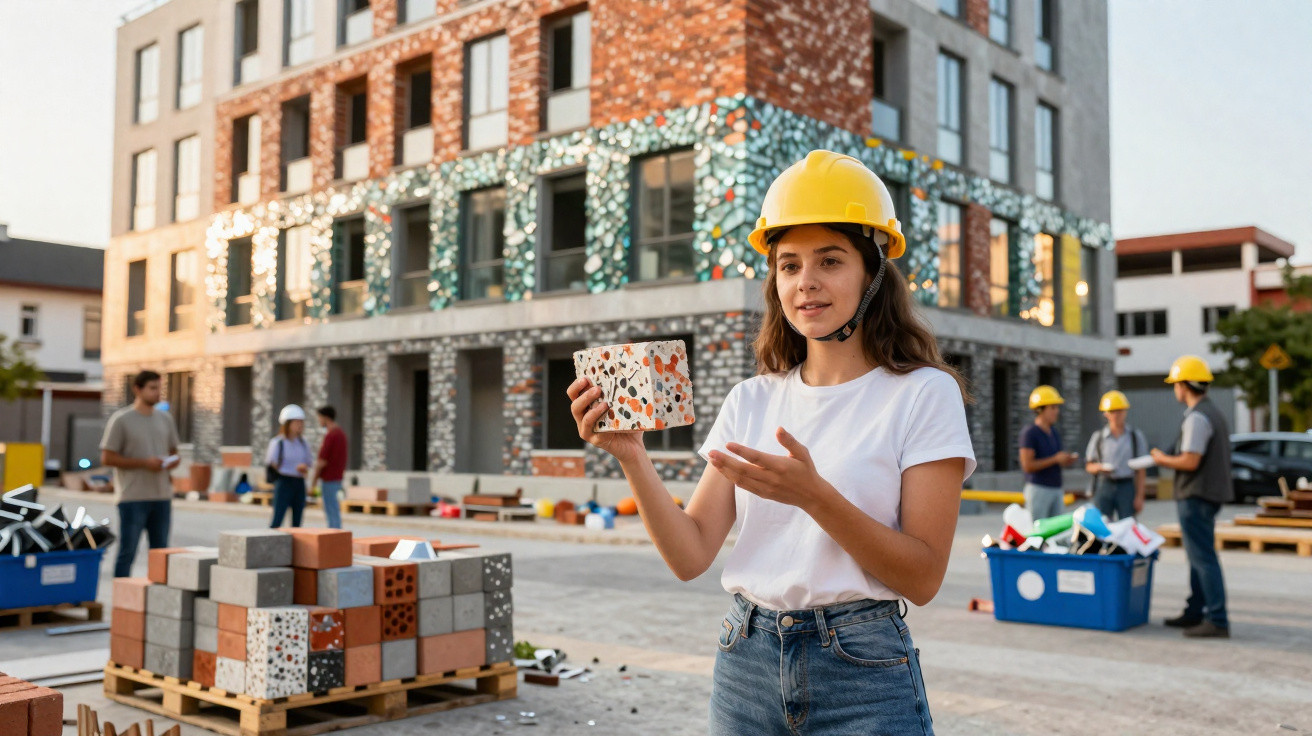
Plastic film, cracked tiles, discarded cables, food wrappers - compacted, shredded, liquefied, then formed again. A few metres away, workers pile up pale grey blocks that, last summer, were yoghurt pots. A school is being built on the frame of last year’s rubbish.
The air carries a light tang of heated plastic, cut through with concrete dust and coffee. A council official records the scene on a phone, eyes wide, as though watching a conjuring act. But it isn’t magic. It’s an ordinary production line, thrumming away.
By turning waste into construction products at industrial scale, we’re quietly reshaping what our towns and cities are made from. Streets, houses, parks - all resting on layers of yesterday’s leftovers.
Once you notice it, you can’t unsee it.
When the city starts growing out of the bin
Stroll through parts of Amsterdam or Nairobi today and the walls carry a secret history. Beneath paint and plaster sit crushed glass, milled concrete, shredded textiles - even plastic bags. At first glance, nothing looks unusual. It simply looks… like a city.
What’s different is the narrative inside every brick and board. Instead of fresh sand dragged from riverbeds or limestone blasted out of quarries, the inputs are offcuts, demolition debris and household waste given another turn at life. The figures are stark: construction consumes about half of all raw materials used worldwide. It’s no surprise some architects have stopped asking, “What can we build?” and started asking, “What are we throwing away?”
With that change, the bin behind your building becomes a raw-material store. Loud, messy, overlooked - and oddly valuable.
In Mexico, one start-up compresses used plastic and agricultural waste into interlocking bricks that click together like oversized LEGO. They’ve helped put up schools and community centres in places where conventional materials are either unaffordable or simply hard to get. The result can look unexpectedly refined: smooth surfaces, vivid colours, clean edges. Children lean on the walls while waiting for lessons, unaware they’re touching what used to be crisp packets.
India offers another approach: a company called Carbon Craft Design combines particles from air pollution with construction waste to make tiles. Smog, turned into flooring. Each tile traps pollution that might otherwise end up in someone’s lungs. In Finland, a cement plant mixes finely ground demolition concrete into new cement, reducing how much fresh limestone it needs.
These are not small-scale craft experiments in sheds. They are conveyor belts, silos and industrial mixers running from morning to night. Lorries bring waste in. Pallets of building products leave.
To understand why this matters, hold two crises in your mind at once: rubbish piling up faster than cities can bury it, and construction guzzling sand, stone and energy as though resources are endless. Traditional cement alone accounts for roughly 7–8% of global CO₂ emissions. At the same time, landfill sites fill with concrete rubble, glass, metals, plastics and old insulation.
Converting waste into building material does more than “recycle” an item. It flips the entire supply logic. Waste becomes feedstock, not a headache. Pulling down an old building stops being the end of a story and becomes the start of a new one. A city begins to behave more like a living organism, reusing its own cells instead of continually importing new flesh.
At industrial scale, that isn’t a minor adjustment. It’s a new metabolism.
How trash becomes tomorrow’s walls and roads
The overall choreography is surprisingly straightforward, even if the engineering is precise. Waste is first collected and separated: concrete in one stream, plastics in another, metals and glass set aside. Next comes crushing and shredding, breaking bulky items into fragments or powders that can be processed. After that, cleaning and filtering remove the worst contaminants.
Then the waste moves into the world of formulations. Crushed concrete can substitute for part of the virgin aggregate in new concrete. Shredded plastic can be melted and pressed into bricks or panels. Old glass can be ground down and blended into cement or tiles. Each facility guards its own “recipe”, aiming to match the performance of conventional materials while reducing the carbon and raw-resource footprint.
For roads and pavements, some operations go a step further. Plastic waste can be mixed with bitumen to create more durable road surfaces. They don’t look futuristic; they look like ordinary asphalt. The quiet revolution is that the “mine” is now the city’s own waste stream.
People love the phrase “waste into walls”, but the real challenge appears once projects move beyond the pilot phase. The first major test is quality. No one wants a school built from bricks that split after two winters. Engineers carry out repeated stress tests to show recycled materials can meet - and sometimes exceed - conventional standards. Often they can, yet building regulations can lag behind the evidence.
The second obstacle is scale. Making a few tonnes of plastic into attractive benches is one thing. Supplying tens of thousands of tonnes to a cement works each year is quite another. You need reliable inputs, robust sorting, and councils prepared to reshape how their waste streams work. Let’s be honest: hardly anyone manages that every day, even in the most committed public bodies.
The third point of friction is psychological. For some buyers, “waste” still reads as “cheap” or “dirty”. That’s why many brands don’t lead with recycled content; they simply compete on performance and price. The wall may be born from rubbish, but the sales pitch talks about design, strength and comfort.
Turning neighborhoods into material banks
One increasingly popular approach is to treat every building as a future “material bank”. Rather than seeing a block as a single lump, designers plan it like a kit: beams, panels, bricks, insulation - all logged and traceable, all intended to be recovered later. When the structure reaches the end of its life, it shouldn’t become rubble; it should become stock.
It begins with something almost low-tech: knowing what you’ve actually built into the walls. Some schemes now include a “material passport” - a digital record listing each component, from steel beams to façade panels, and where it sits. That passport acts as a route map for future recovery. Demolition becomes disassembly, directed by data.
It’s a different way to draw a city: less “bulldoze and rebuild”, more “unscrew, swap, and remount”.
A frequent error is to treat waste as an afterthought, dealt with only at the end of a job. By then, money is tight, deadlines are loud, and carefully separating debris feels like a luxury. On a busy site, everything can end up in the same skip, even if the plan looked virtuous on paper. In real terms, workers are balancing safety checks, weather and last-minute changes; sorting three types of offcut doesn’t rank highly amid the chaos.
Projects that hold up over time plan for reuse from the first sketch. They choose materials that come apart easily. They set up colour-coded bins on site with clear signage. They give contractors a financial reason to recover materials rather than throw them away. And, crucially, they involve the future recycler early, so no one discovers too late that the “recyclable” façade has been glued in a way that makes separation impossible.
If you’ve ever renovated an old flat and watched perfectly usable doors or tiles smashed because “it’s quicker”, you’ll know how easily good intentions collapse without a system.
“Cities are the mines of the future,” says a circular-economy architect in Copenhagen. “Every building we put up today is either a future problem or a future resource. We decide which one long before anyone cuts a ribbon.”
That shift in mindset turns into practical checklists. Before demolition, teams carry out “urban mining surveys” to identify what can be salvaged. During construction, they log leftover materials so they can be routed to local reuse platforms. Local authorities trial rules requiring a set percentage of recycled content in public works.
- Ask where materials come from and where they can go next.
- Choose modular elements that can be unscrewed, not smashed.
- Seek out local initiatives that turn construction waste into new products.
- Press your council to publish data on demolition and reuse rates.
- When in doubt, remember: waste is just a resource in the wrong place.
What it means to live in a city built from yesterday
There’s a quiet emotional jolt in sitting in a café knowing the counter under your elbows contains ground glass from old windows - or that the pavement outside includes plastic that once wrapped your shopping. Rationally, it’s about emissions, material flows and smart engineering. Instinctively, it changes how you feel about what you throw away tonight.
Most of us have had that moment: staring at an overflowing bin at a party or in the office kitchen, feeling a brief stab of guilt. Multiply that feeling by millions of people across thousands of cities and you start to see why this change isn’t only technical. It’s cultural. A city built from its own discards carries a quiet lesson: there is no true “away” when we throw something away.
That doesn’t mean every wall must be made from rubbish, or that technology will somehow solve overconsumption on its own. But it does open a more candid conversation about limits, ingenuity and responsibility. When a new library or bridge appears, residents can ask not only, “How much did it cost?” but also, “How much waste did it prevent?” and “What does this structure say about us?”
Perhaps the most fascinating angle is what future archaeologists will uncover. Instead of pure stone and brick, they may find strata of reprocessed plastics, re-fired tiles, and hybrid materials born from our waste streams. Our era may not be remembered solely for the rubbish we left behind, but for how we learned to fold it back into everyday life.
In that sense, cities built from what was once thrown away are less science fiction and more mirror. They reflect our habits, our blind spots and our flashes of creativity - and they quietly pose a disarming question: if our rubbish can become a home, what else are we underestimating?
| Key point | Detail | Why it matters to you |
|---|---|---|
| Waste as building stock | Waste streams and demolition debris are turned into bricks, tiles, concrete and roads at industrial scale. | Helps you see your city as a vast material reservoir, not just a consumer of resources. |
| Designing for reuse | Buildings become “material banks” with components documented, traceable and recoverable. | Shows how better design today can cut costs and waste in your neighbourhood tomorrow. |
| Cultural shift | Living in cities built from waste changes how people think about throwing things “away”. | Encourages you to rethink your own habits and expectations about what waste can become. |
FAQ:
- Are buildings made from waste really safe? Yes, when done properly. Recycled materials used at scale go through strict testing for strength, fire resistance and durability, just like conventional products. In many cases, they must meet even tougher standards to be accepted.
- Will my house look different if it uses recycled materials? Usually not. Most recycled bricks, tiles or panels are designed to blend in and perform like traditional ones. The difference is mainly in the hidden composition and environmental impact, not in how they look or feel.
- Is this more expensive than normal construction? Costs vary. Some recycled materials are cheaper because they use local waste; others are still niche and can be pricier. Over time, as production scales and rules evolve, many cities expect these options to become the new cost baseline.
- What can ordinary citizens do to support this shift? You can ask for recycled content in public projects, support policies that promote construction reuse, choose renovation companies that salvage materials, and sort your household waste so it’s easier to transform at scale.
- Could we really build whole cities from waste one day? Not 100%, as we’ll always need some fresh resources, but a large share of buildings, roads and public spaces can already integrate significant amounts of recycled material. The more organised our “urban mines” become, the closer that vision gets.



Comments
No comments yet. Be the first to comment!
Leave a Comment