
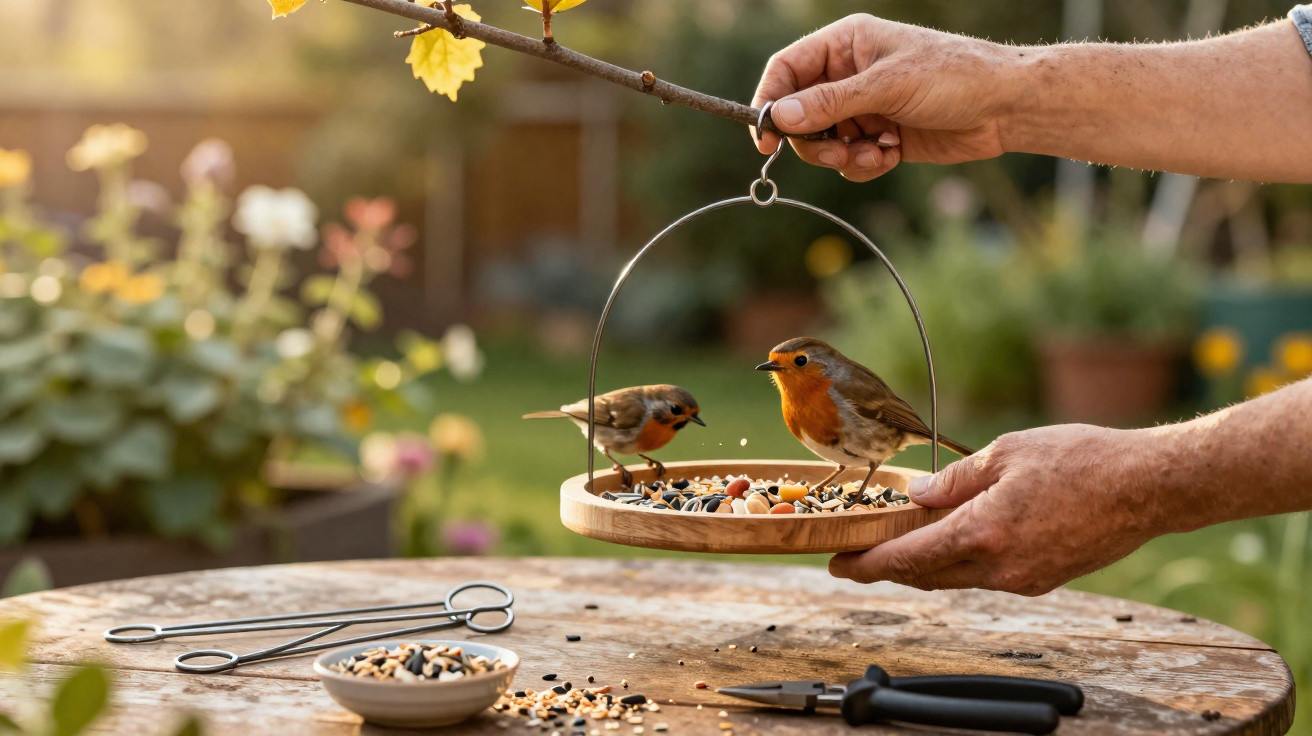
Step out onto the balcony during the first cool hours of the morning and you will already hear them: blackbirds, tits, sparrows and their companions are under constant pressure in spring. They are looking for mates, building nests and need plenty of energy. Ready-made feeding stations from garden centres can easily cost £20, £30 or more. Yet the material for an attractive, practical feeding point is probably already sitting in a cupboard: an unassuming wire clothes hanger.
Why a homemade bird feeder is so worthwhile
Wild birds have access to fewer and fewer natural spaces in towns and densely populated areas. Shrubs are disappearing, insect numbers are falling and more land is being sealed over. A feeding station cannot replace a natural habitat, but it can make the demanding breeding season considerably easier for birds.
By bending just one wire hanger, you can create a safe landing spot, a source of food – and give a piece of metal a second life.
Building it yourself also means you decide exactly what goes into the feeder. This helps you avoid questionable mixes and heavily packaged products that often contain plenty of filler but little nutritional value.
Materials: what you actually need
The principle is straightforward: a basic metal coat hanger from the dry cleaners becomes the supporting frame for fruit or seed food. You need very little else.
The humble metal hanger takes centre stage
Most people know these thin, slightly misshapen metal hangers left over from the dry cleaners, cluttering up the wardrobe. They are exactly what you need for this project. They are:
- sturdy enough to hold around 200–300 grams of food,
- flexible enough to reshape with ease,
- free, as they are already in the home.
Rather than throwing it away, the hanger becomes a robust frame that birds can grip while feeding.
Tools and small items: a short list with a big impact
A few everyday tools, found in most homes, are enough to shape the hanger:
- wire cutters for trimming unnecessary wire ends,
- flat-nose or round-nose pliers for neat bends and shaping,
- work gloves to prevent sharp edges from cutting your fingers,
- half an apple or a cut-out plastic bottle base to hold the food.
The bottle base can easily replace costly shop-bought feeding dishes. It is lightweight, easy to clean and would otherwise become waste.
Step by step: turning a hanger into a bird buffet
There is no need to worry: this is not a complicated DIY task. Anyone who can use pliers can complete it in roughly 15 minutes.
Straighten and prepare the hanger
First, turn the hanger into a straight length of wire:
- Use the pliers to undo the small twist beneath the hook.
- Carefully straighten the wire until no corners remain.
- Roll the resulting wire length over the edge of a table or another smooth edge to make it as straight as possible.
You should end up with a reasonably straight wire rod measuring about 70 to 80 centimetres. A few slight waves do not matter; the important thing is that the finished feeder will not hang crookedly.
Shape the feeding platform
Now the wire takes on its purpose. There are two simple options: a fruit-skewer version and a seed dish.
| Option | Shape | Food |
|---|---|---|
| Fruit skewer | Small spiral at the bottom, hook at the top | Apple pieces, pear, grapes |
| Seed dish | Ring at the bottom, hook at the top | Sunflower seeds, unsalted nut mixes |
For the fruit skewer, bend the lower third of the wire into a small spiral around five centimetres in diameter. The spiral acts as a support, while the upright point holds half an apple securely in place.
For the seed dish, shape the lower third into a closed ring, into which the bottle base can later be fitted. Make the ring slightly smaller than the diameter of the plastic dish so that it sits tightly.
At the top, use the pliers to form a wide hook for attaching the bird feeder to a branch, balcony railing or pergola.
The right spring food mix for your bird feeder
Many people instinctively reach for fat-based food. While this makes sense in severe frost, it is unsuitable once temperatures rise because the mixture quickly turns rancid. In spring, the priority is good-quality energy without placing unnecessary strain on the birds.
Foods that work especially well
- Sunflower seeds (shelled or unshelled) for tits, finches and sparrows,
- unsalted peanuts in small quantities,
- pieces of apple or pear for blackbirds and other softbill species,
- millet for smaller birds such as sparrows.
Use roughly 50 to 100 grams of food per station each day, depending on how many birds visit. It is better to top up smaller portions more frequently than put out too much at once and let it spoil.
Food that harms birds
Not every kitchen leftover is suitable. Avoid offering:
- seasoned or salted nuts,
- bread and baked goods,
- cooked food scraps,
- leftover spices and garlic.
These leftovers can swell in birds’ stomachs, spoil quickly and attract rats. Bird food should be as natural and unprocessed as possible.
The ideal location: safety comes first
A feeding station acts like a magnet, not only for birds but also for cats and martens. Where you place it determines whether birds can feed without stress.
Hang it high with clear access
Key requirements for the location include:
- a minimum height of around 1.5 metres,
- no dense shrubbery directly beneath it, as this provides cover for cats,
- a clear approach route of two to three metres,
- a view from a window or seating area – for your benefit.
A clear branch, roof edge, hook beneath a covered terrace or sturdy post can all work well. Birds prefer being able to check their surroundings comfortably from a higher branch first.
Cleaning, hygiene and risks
When many animals feed in one place, the risk of disease increases. Keeping feeding stations clean is therefore especially important.
Clean regularly and prevent mould
Inspect your setup every few days:
- remove old food remnants,
- rinse the plastic dish with hot water,
- replace spoiled fruit immediately,
- wipe away droppings with a cloth.
If an unusually high number of sick or lethargic birds are seen, stop feeding temporarily and clean the station thoroughly.
Benefits for the environment and your budget
The appeal of this project is not limited to helping wildlife. It saves money and cuts waste. A metal hanger stays in use, a plastic bottle avoids the general waste bin, and there is no need to buy an expensive bird table.
Two household leftovers become a fully functional feeding station – it is hard to make it cheaper, or more sustainable.
It can also create a new daily ritual. Many people say that watching the birds each day makes them more aware of the changing seasons. Children get to see at close range how different species look and behave – from the hesitant arrival of the first tit to the crowded feeding station on cold days.
More easy garden recycling projects
Anyone who enjoys making this bird feeder can continue with similar materials. Typical ideas include:
- filling tin cans with tubes and straw to make insect hotels,
- screwing old wooden boards together to create benches or planter boxes,
- using jars from spreads as mini water dishes for insects, with stones to help them climb out.
Over time, this creates a small wildlife-friendly space where birds, insects and people can all feel at home – without costly designer items from a catalogue.

Comments
No comments yet. Be the first to comment!
Leave a Comment