
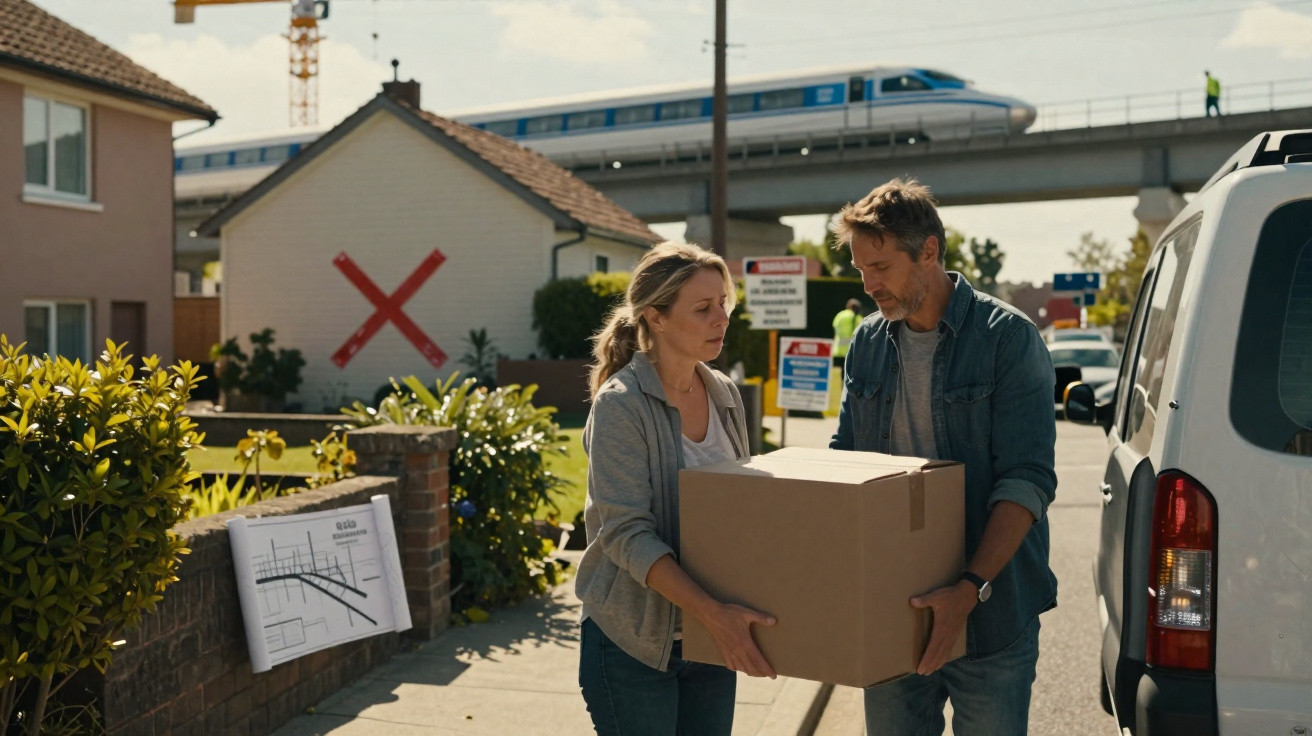
The high-speed rail project will lead to the demolition of 17 homes and force the relocation of two businesses in Estarreja. Expropriations are about to begin, and construction is scheduled to start in August.
Although the works on the high-speed line are expected to get under way in August, Bruna Pereira and her mother, Marisa Ribeiro, have lived with uncertainty for the past three years. It was then that residents in Avanca, in the municipality of Estarreja, began to suspect that the country’s push for faster rail would cost them the home they have lived in for two decades.
They had recently replaced the roof, were about to start improvement work on the house and hoped one day to build a barbecue area and a swimming pool. Everything stopped because of the TGV.
"We panicked," Bruna admits. Living with lupus, she says her health worsened. The "anxiety" was so intense that Marisa was signed off work for two months. "Even now I still suffer with it," she lets slip.
The timing of the project moving forward is also "difficult", Bruna adds, because "houses are incredibly expensive". "I’m afraid they won’t give us enough time or money to leave here comfortably and find another home," she says, stressing that she wants to stay in the area where she has put down roots.
"They’ve put a knife to our throats and now it’s: make do. Will they give us a fair value for the house and for the damage [we’ve suffered]?" Marisa asks.
Expensive alternatives
They are not the only ones being "sacrificed" by high-speed rail in the municipality of Estarreja, where-alongside the main TGV route-there will also be a branch connection to the Northern Line. According to information sent to JN by the AVAN consortium, which holds the concession for the design, planning, construction, financing and maintenance of the high-speed line on the Porto–Oiã (Oliveira do Bairro) section, "in the municipality of Estarreja, the construction project for the high-speed section will directly impact 12 homes and indirectly impact five homes". At this stage, it is not possible to specify how many are primary residences.
Two local businesses have also been "identified" as being affected by the works.
Businessman Pedro Silva has already started running the numbers. Warehouses in Beduído used by three family companies will be demolished. The news did not come as a shock: more than a decade ago, the family tried to expand the facilities and were unable to do so, "because there was already talk of the TGV".
"We’ll have to relocate the businesses and we’re struggling, because there are hardly any warehouses to rent or buy. What little there is is extremely expensive. We have large machines that are difficult to move, and employees who may not accept going too far," he says.
Pedro Silva says he is "extremely worried" for other reasons too. His parents’ home, next to the warehouses, will not be demolished like the neighbour’s, but the railway line will end up "24 metres" from their front door. The street in front will also be cut off. His parents, he says, are "very psychologically affected" by the change.
Minimising the impact
Pedro Silva says he is relying on the "good faith of the company" that will carry out the expropriations in Estarreja.
"What’s about to happen is already bad enough. I hope the valuers present realistic proposals and don’t make people’s lives even harder," he says, while noting that he understands the benefits some specialists attribute to the new TGV connection.
"I believe the Government wouldn’t undertake a project like this lightly, just to spend European money and taxpayers’ money. If it’s for the good of the country, then I think so. But they must create conditions and minimise the impact for the Portuguese who will be affected."
"At this point, the discussion is over. The line will happen." The words are from Isabel Simões Pinto, Mayor of Estarreja, opening a public information session held by the local authority a few days ago.
"Concerns are now focused on expropriations. There are people who will be left without a home, businesses that will have to relocate" and land that will be expropriated because of the high-speed line, the mayor acknowledges. The parishes facing the greatest impact will be the União de Canelas e Fermelã, Beduído and Avanca.
Specialist valuers will assess
Álvaro Fonseca, Operations Lead at the AVAN consortium, assured residents there would be "transparency" and that the expropriation process would be "costly". It will be led by the AVEXP team-part of the same consortium-and valuations will be carried out by "independent specialist valuers", who will submit compensation proposals to be negotiated with affected residents and business owners.
"There are already agreements being reached further south" and, "in the coming months", the same will happen in Estarreja, Álvaro Fonseca added. The first construction activity on the ground is expected to begin in "late August, September".
In Estarreja, the railway corridor will extend for 30 kilometres: 13.4 kilometres for the main section, plus 16.6 kilometres for the connection from Canelas to the Northern Line. The route will lie predominantly to the east of the A1 (the Northern Motorway) and will include several major structures, including a bridge over the Antuã River, a bridge over the Jardim River, and ascending and descending viaducts due to the junction in Canelas.
Centre will create jobs
The plan also includes a maintenance centre, a new electrical traction substation, and a passing loop and train stabling facility. With the centre-responsible for maintenance across various parts of the high-speed line-the consortium said around "a hundred jobs" will be created.
As for local roads, the scheme includes reinstating several routes that will be severed, so that communities are not left isolated.
Because it cuts through the municipality, the high-speed line will pass through protected areas, requiring a range of impact-mitigation actions set out in the Single Environmental Title issued during the project’s licensing. The design therefore includes measures to protect the Aveiro lagoon and the BioRia trails, such as ecological corridors, drainage and water-filtration systems, and reducing disturbance in wetland areas, among other actions.
Water-both quantity and quality-was, in fact, one of the concerns raised at the Estarreja information session. One attendee warned about the project’s impact on groundwater and the risk that it could "dry up wells" used to cultivate gardens and fields. In response, the company said it will monitor water throughout the works.





Comments
No comments yet. Be the first to comment!
Leave a Comment